
Gold and Chrome Security Cameras: Applications and Selection Guide
Where are gold, chrome, gold-tone and metallic security cameras used? We examine decorative CCTV camera selection for luxury stores, hotels, restaurants, villas and architectural projects, considering custom body finishes, image quality, IR reflections, IP/IK ratings and warranty terms.
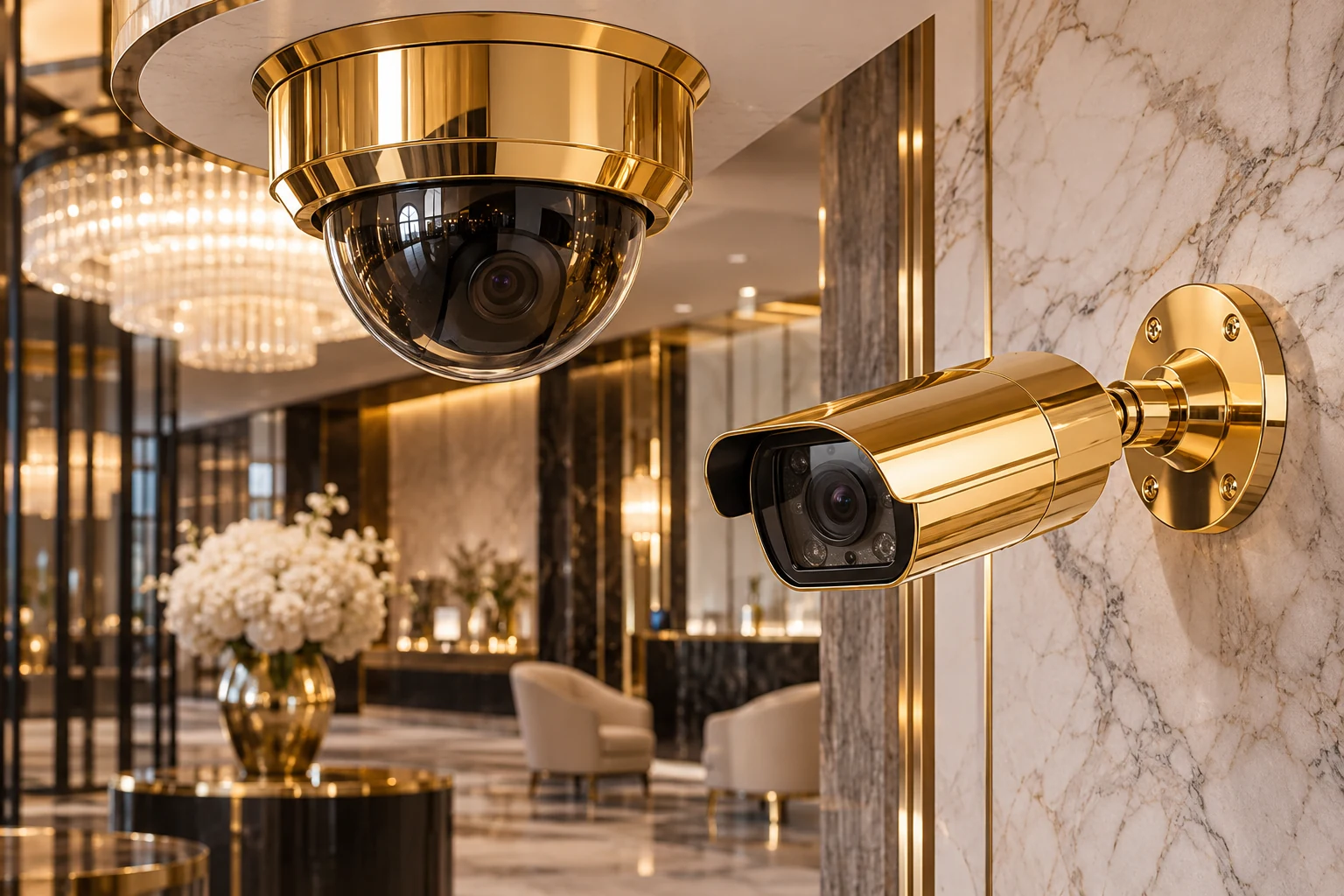
Gold and chrome security cameras are specially finished CCTV solutions intended to bring electronic security systems into harmony with architectural design. In luxury hotels, jewelry stores, prestigious offices, restaurants, historic buildings and high-end residential projects in particular, not only the technical specifications of security cameras but also their compatibility with the overall aesthetics of the space matter.
Traditional security cameras are generally manufactured with white, black or gray housings. However, some architectural projects may call for camera housings in gold, champagne gold, chrome, brushed metal or custom RAL colors.
These solutions may be offered as a factory color option, a replaceable decorative cover or a custom surface treatment performed in accordance with the manufacturer's requirements.
However, coloring the camera housing for decorative purposes must not adversely affect the device's optical performance, cooling, environmental durability or warranty terms. Therefore, choosing a decorative CCTV camera involves assessing aesthetic and technical requirements together.
What Is a Gold or Chrome Security Camera?
A gold or chrome security camera is a camera solution whose outer housing has a metallic color, glossy finish or decorative surface treatment.
The term does not refer to a separate imaging technology.
A gold-colored camera may use the same image sensor, lens, video compression or network features as a standard IP security camera.
The main difference lies in the camera's physical appearance and how it is adapted to the architectural design.
These cameras can be designed with the following surface finishes:
Polished gold.
Matte gold.
Champagne gold.
Brushed gold.
Polished chrome.
Brushed chrome or silver-toned metal.
Satin metal.
Bronze, copper and brass tones.
RAL colors customized for the architectural project.
Here, a gold or chrome appearance does not mean that the camera is actually made of precious metal.
For example, a gold appearance can be achieved with suitable metallic paint or a special decorative coating. A polished chrome appearance can also be produced using different surface technologies, depending on the product's material and treatment.
Why Choose Gold and Chrome Security Cameras?
The primary function of security cameras is to monitor designated areas at an image quality suited to the purpose and record footage when necessary.
However, in luxury architectural projects, it may also be important that the camera does not detract from the design of the space.
Harmony with Architectural Design
In a hotel lobby with gold accents, a glossy white camera housing can create a strong contrast with the ceiling and decorative surfaces.
By contrast, a suitably chosen champagne-gold or metallic camera housing may blend more harmoniously with the design.
Premium Brand Identity
In luxury retail stores, interior design is an important part of brand identity.
A camera housing that coordinates with lighting fixtures, decorative profiles or metal surfaces can support the overall coherence of the space.
Reducing Visual Attention
In some projects, the aim may be to make the physical appearance of a security camera less noticeable in the space.
However, making a camera less noticeable does not mean that unlawful covert surveillance is permissible.
Personal data protection requirements and any necessary notice obligations must also be met.
Applications of Gold Security Cameras
1. Luxury Jewelry and Goldsmith Stores
Gold tones are a common decorative choice in interior design applications in the jewelry sector.
Gold-colored security camera housings:
Jewelry display areas.
Store entrances.
Around sales counters.
Suitable points in private customer consultation areas.
Decorative ceiling systems.
These are areas where they may be considered to achieve architectural harmony.
However, in jewelry-store security, camera color must not take precedence over image quality.
To capture faces and transaction details appropriately, resolution, lens, field of view and pixel density must be calculated according to the target distance.
2. Luxury Hotels and Hotel Lobbies
Luxury hotels may feature decorative metal elements in brass, bronze, gold and champagne tones.
In such projects, gold- or chrome-colored dome cameras may be considered for:
The main lobby.
The area around reception.
Elevator lobbies.
Common corridors.
Restaurant and lounge entrances.
Meeting areas.
These locations may be considered for such cameras.
However, a camera housing that matches the space does not mean that camera placement can disregard privacy rules.
3. Luxury Retail and Boutique Stores
In premium fashion, watch, jewelry and accessory stores, store design is an important element of the brand.
Gold- or chrome-finish camera housings can blend with metallic ceiling details.
In particular:
Store entrances.
Product display areas.
Areas around cash registers.
Private product rooms.
Common circulation areas.
These locations may be considered as an architectural option.
In these applications, camera imaging performance should also be tested because of display windows, mirrors and powerful spotlights.
4. Restaurants and Private Event Venues
Luxury restaurants may feature decorative gold profiles, brass chandeliers and metallic surfaces.
Standard security cameras with white plastic housings may stand out in some designs.
Suitable custom-colored dome cameras may be chosen to complement the interior aesthetics.
However, camera placement should take customer privacy and suitability for the purpose of processing into account.
5. Villas and Luxury Homes
In high-end homes, security cameras may be planned as part of the architectural project and smart-home infrastructure.
Gold, chrome or bronze tones may be considered for:
Private entrance halls.
Garage entrances.
Enclosed parking areas.
Shared-use areas.
Exterior facades featuring metallic architectural elements.
These locations may be considered for such finishes.
For cameras used on exterior facades, however, the decorative finish must be verified as suitable for UV exposure, rain, temperature and corrosion conditions.
6. Historic Buildings and Restoration Projects
In historic hotels, museums and protected buildings, the visual impact of modern technological equipment may be important.
Custom-colored security cameras may look more compatible with existing architectural surfaces.
Nevertheless, installation and intervention requirements for protected buildings must be assessed separately.
A camera color that harmonizes with the architecture does not justify unauthorized intervention in the building.
Where Are Chrome Security Cameras Used?
A chrome appearance may refer to silver, polished metal or mirror-like surfaces.
Chrome tones may be preferred particularly in modern and industrial architectural designs.
Possible applications include:
Modern offices and high-rise commercial buildings.
Hotel elevator lobbies.
Spaces with stainless-steel decorative surfaces.
Luxury stores.
Modern restaurants.
Prestigious residential entrances.
Areas where architectural metal panels are used extensively.
However, the light-reflecting properties of polished chrome surfaces differ from those of matte surfaces.
Therefore, the interaction of the custom coating with the camera lens and night-vision systems should be tested.
Comparison of Gold, Chrome and Standard Camera Housings
Feature | Standard white/black | Gold appearance | Chrome appearance |
|---|---|---|---|
Architectural character | Neutral and technical | Warm, decorative and premium | Modern, metallic and glossy |
Application | General CCTV | Luxury and decorative spaces | Modern architecture and metallic decor |
Product availability | Widely available | Depends on model and project | Depends on model and project |
Need for custom coating | Generally none | May be required | May be required |
Glare and reflection | Depends on the surface | Depends on the gloss level | Important, especially on glossy surfaces |
Warranty | Manufacturer's terms | Approval may be required for modifications | Approval may be required for modifications |
IP/IK rating | Product-specific | Must be verified after treatment | Must be verified after treatment |
The color or type of coating does not by itself improve the camera's resolution, DORI performance or AI features.
Methods for Producing Gold and Chrome Cameras
Custom-colored cameras can be produced using different methods.
1. Factory-Available Housing
The simplest approach is for the manufacturer to offer the relevant camera model as a standard product in the desired color.
In this case, the product's technical specifications and warranty terms should be verified for the specific color variant being purchased.
2. Replaceable Decorative Cover
Some camera manufacturers offer replaceable outer covers or paintable protective parts for certain models.
For example, Axis Communications provides outer housing covers compatible with certain models and paintable skin cover options.
Compared with directly treating the camera housing, this method may offer a customization route better suited to the product design.
However, cover compatibility with the model should be confirmed against the manufacturer's accessory list.
3. Custom Painting in Accordance with Manufacturer Requirements
Some manufacturers may permit certain camera models to be painted, subject to specific conditions.
Axis Communications may treat the repainting of some products as covered by the warranty, provided that specific instructions are followed.
Hanwha Vision also publishes a painting guide for adapting camera housings to their surroundings.
For these applications, only a professional team should carry out the work, following the manufacturer instructions specific to the relevant model.
4. Metallic Surface Coating
A polished chrome or metallic gold appearance can be created in some projects using special surface treatments.
However, real metal plating, metallic paint, coating film and a replaceable metal housing do not have the same technical properties.
Processes such as electroplating or chemical coating should not be applied directly to an electronic camera housing without confirming the camera manufacturer's explicit approval.
These processes may affect the product's material structure, electrical properties, sealing and mounting tolerances.
Does Painting the Camera Housing Affect the Warranty?
Yes, it may.
Housing modifications not approved by the manufacturer may cause problems for the product warranty and service entitlement.
Axis Communications' Approach
Axis specifies warranty exceptions for certain products when suitable painting and reassembly conditions are met.
However, for products without approval, painting may void the warranty.
The manufacturer also notes that painting may affect mechanical tolerances, temperature behavior, and moving parts.
Hanwha Vision’s Approach
Hanwha Vision’s camera-painting guide notes that customers may wish to change a camera’s color to match the architecture.
The manufacturer explains that it does not offer in-house painting services; qualified third-party applicators may be used for custom color requirements.
Parts such as the serial number, optical components, IR LEDs, and ventilation membranes must be protected during painting.
Important: A manufacturer allowing certain cameras to be painted does not mean that all its products can be gold- or chrome-plated.
Do Custom Finishes Affect Camera Image Quality?
Improperly applied finishes can adversely affect image quality and device reliability.
IR Reflection
In dome cameras with night vision, infrared illumination may reflect undesirably off custom-finished surfaces.
Particular attention should be paid to glossy metallic bezels and reflective areas near the dome.
An unsuitable design can:
Glare in night-time images.
Loss of contrast.
Image washout.
Internal reflections caused by IR.
Image distortion at certain angles.
can cause.
For this reason, custom finishes should not be applied to optical surfaces around the lens or to IR components.
Lens and Protective Dome
Lens glass, transparent protective domes, and optical windows should not be altered with decorative finishes.
A change in color or finish on these surfaces may affect light transmission and optical performance.
Temperature and Thermal Management
The camera housing’s color and surface finish can affect its thermal behavior, particularly in applications exposed to direct sunlight.
Dark colors may absorb more solar energy, while the properties of glossy metallic surfaces also vary depending on the finish.
It should not be assumed that a gold or chrome color alone results in a lower operating temperature.
PTZ Mechanisms
On moving PTZ cameras, a finish may affect mechanical clearances and friction.
Paint thickness or surface treatments may cause tolerance problems at moving joints.
For this reason, custom coloring for moving cameras should be assessed separately.
IP and IK Standards for Gold and Chrome Cameras
For custom-colored security cameras, environmental and mechanical durability requirements must be maintained regardless of decorative appearance.
IP Ingress Protection Rating
IEC 60529 defines the degrees of protection provided by enclosures against ingress of solid objects and water.
For example, removing and refinishing the housing of a camera rated IP66 for outdoor use does not mean that the same protection is automatically retained after reassembly.
Seals, cable glands, and mating surfaces may be important.
IK Impact Resistance
IEC 62262 defines the mechanical impact-resistance classifications for electrical equipment enclosures.
For example, IK10 is a test level associated with an impact energy of 20 joules.
Applying a custom-color finish to a camera housing does not increase the device’s IK rating.
Housing modifications not verified by the manufacturer may also affect the validity of tested mechanical performance.
When selecting a custom-colored camera, the technical suitability of the final product configuration being purchased is therefore important.
Which Camera Type Should You Choose for Gold and Chrome Security Cameras?
Dome Cameras
Their compact design makes them worth considering for hotels, restaurants, luxury stores, and decorative ceilings.
In some projects, a colored outer body ring or a manufacturer-approved interchangeable cover may be a better fit.
Turret Cameras
Because the lens section is separate from the surrounding housing, turret cameras may be considered for custom-colored outer-housing solutions in some applications.
However, the optical and IR components must be protected.
Bullet Cameras
For some exterior projects, bullet cameras may be chosen in a color matching the architectural surface or in a suitable metallic tone.
Outdoor durability and solar loading are particularly important.
Mini Dome and Compact Cameras
Small cameras may be suitable for certain indoor settings where decorative appearance is a priority.
However, it should not be assumed that a smaller housing will provide better images or be less visible.
How Should You Choose a Camera Color for Luxury Spaces?
When choosing a camera color, consider not only the dominant color of the décor but also camera placement and surface materials.
Architectural setting | Color to consider | Point to note |
|---|---|---|
Hotel lobby with gold details | Champagne gold, matte gold | Glare and ceiling coordination |
Modern office with chrome décor | Brushed metal, silver | Reflection |
Luxury jewelry store | Gold, bronze | Spotlighting and image |
Modern villa | Chrome, matte black, metallic tone | Outdoor conditions and UV |
Historic building | Bronze, brass appearance | Architectural permissions |
Premium restaurant | Champagne gold, bronze | Lighting and privacy |
Luxury boutique | Architecture-specific RAL or metallic color | Brand identity and warranty |
These colors are examples to consider from an architectural-design perspective, not mandatory choices.
Technical Checklist for Choosing a Custom-Colored Security Camera
Checklist item | Criterion to verify |
|---|---|
Camera model | Intended use and technical suitability |
Color option | Standard product, cover, or custom application |
Manufacturer approval | Written approval and warranty |
Coating material | Chemical and mechanical compatibility with the housing |
Optical surface | Protection of lens and dome |
IR illumination | Night-time glare and reflection |
Thermal management | Operating temperature and solar impact |
IP protection | Environmental durability after installation |
IK protection | Tested mechanical resistance |
Mounting accessories | Color and mechanical compatibility |
Image quality | Lens, resolution, DORI |
Network compatibility | PoE, NVR/VMS, ONVIF |
Maintenance | Cleaning, paint, and cover replacement |
Cybersecurity | Updates, authorization |
Acceptance testing | Day/night imaging and environmental checks |
Frequently Asked Questions About Gold and Chrome Security Cameras
Are gold-colored security cameras available?
Camera solutions with a gold appearance can be created. However, do not assume that every manufacturer offers a gold-colored model in its standard catalog. Look into ready-made color options, compatible decorative covers, or custom-painting options that meet the manufacturer’s requirements.
Can a chrome-colored IP camera be used?
A chrome-look camera housing may be considered with a suitable product and manufacturer approval. The finish must not affect the lens, IR illumination, electrical safety, or environmental durability.
Can a security camera be painted gold?
Some manufacturers may allow certain models to be painted. However, the painting method and warranty conditions must be verified for each model.
Can a camera be chrome-plated?
True chrome plating or similar chemical/electrical surface treatments should not be applied without the manufacturer’s explicit approval. A safer option may be a manufacturer-approved decorative cover or a suitable painting solution.
Are gold-colored cameras more expensive?
A custom color, low-volume production, or additional surface treatment may increase the total cost. However, no definite price difference can be given without details of the specific model and quote.
Do gold or chrome finishes affect night vision?
Unsuitable glossy surfaces may cause unwanted reflections, particularly around the lens and IR illumination. Night-time images should be tested under actual installation conditions.
Is a gold-colored dome camera suitable for a luxury store?
It may be architecturally suitable. However, the right lens, image detail, WDR, night-time performance, network security, and data-protection requirements must also be assessed.
Does changing a camera’s color void the warranty?
It depends on the manufacturer and model. Some manufacturers accept painting carried out according to specific instructions, while unauthorized modifications may affect warranty coverage.
Conclusion
Gold- and chrome-colored security cameras are distinctive-finish solutions that can be considered to better align electronic security infrastructure with architectural design.
In luxury hotels, jewelry stores, premium retail spaces, restaurants, prestigious offices, and high-end residences in particular, the camera housing’s color can be important to a space’s visual coherence.
However, decorative appearance should not take precedence over the security camera’s core function: accurate and reliable imaging performance.
The right solution involves choosing a suitable camera model, considering manufacturer-approved color or cover alternatives, protecting the lens and IR components, verifying IP/IK durability, and testing image quality under real-world operating conditions.
In professional projects, the goal is not merely to use a gold- or chrome-colored camera, but to bring architectural aesthetics, security performance, and technical reliability together in one solution.