
What is DORI Analysis in Camera Systems? How is it Performed?
DORI analysis is a technical method used to evaluate the level of detail at which security cameras can capture people or objects at specific distances. We examine the Detection, Observation, Recognition, and Identification levels, PPM calculation, lens selection, and the new criteria introduced with the IEC 62676-4:2025 standard.
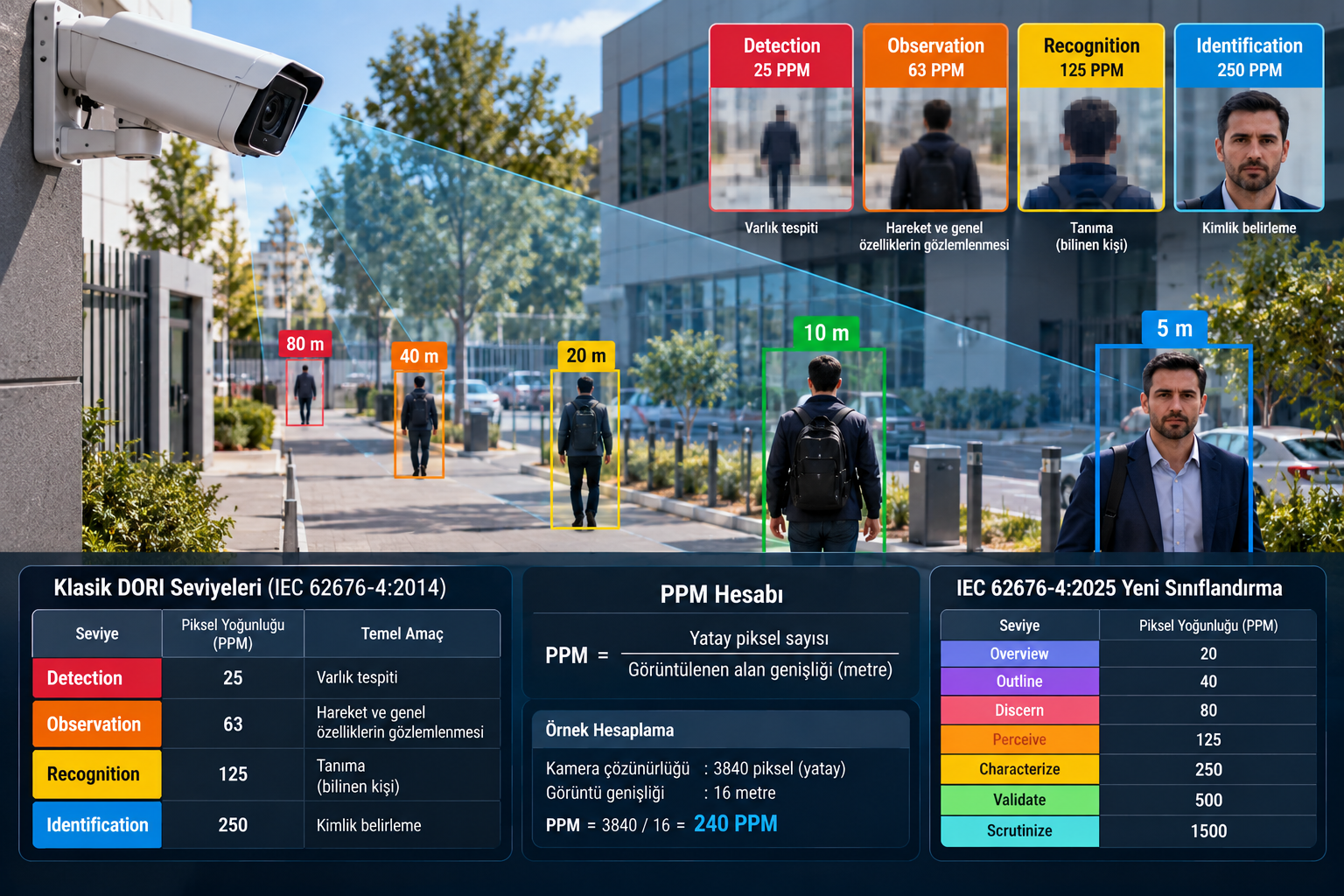
When selecting a security camera, making a decision based solely on megapixel value, night vision distance, or camera model is not sufficient to meet the actual needs of a security project. What is important is the level of detail at which the camera can capture a person or object at a specific distance.
For example, a wide-angle camera with 8-megapixel resolution can cover a large area. However, it may not provide sufficient detail to identify a person in the distant part of the image. In contrast, a lower-resolution camera, positioned with an appropriate lens, can offer higher image detail at a specific point.
At this point, DORI analysis and pixel density (PPM) calculation are among the fundamental evaluation tools for CCTV project design.
The DORI approach helps understand how much image detail a camera can provide at what distance. However, with the renewed IEC 62676-4 standard in 2025, significant changes have been made to pixel density classification.
What is DORI Analysis?
DORI is an acronym formed from four English concepts:
D – Detection: Detecting
O – Observation: Observing
R – Recognition: Recognizing
I – Identification: Identifying
This approach is used to evaluate whether images obtained from a security camera have sufficient detail for specific operational purposes.
DORI became widespread, especially with the pixel density approach in the IEC 62676-4:2014 standard, and has been used in security camera manufacturers' technical data sheets for many years.
The main goal is to evaluate not just the camera's ability to view an area, but its capacity to provide the necessary information for a security task.
Four Fundamental Levels in DORI Analysis
1. Detection
Detection refers to the ability to determine whether a person or relevant object is present within the image.
At this level, it is not expected to see the person's face, identity, or detailed physical characteristics.
For example, detecting the presence of a person around a factory can be given as an example of this level.
Classic reference pixel density: 25 PPM.
2. Observation
Observation refers to the ability to observe the number of people, their movements, and some distinguishing features in the image.
For example, in a parking lot, it can be evaluated in which direction people are moving or in which area they are located.
At this level, the definitive identification of a person is not the goal.
Classic reference pixel density: approximately 63 PPM.
3. Recognition
Recognition is the level of detail aimed at evaluating whether a person in the image is the same as a previously seen or known person.
For example, examining an image to match a person at a building entrance with someone previously encountered can be considered.
However, this level does not guarantee the definitive identification of an unknown person.
Classic reference pixel density: 125 PPM.
4. Identification
Identification refers to the targeted level of detail required to determine a person's identity from an image.
It can be particularly important at building entrances, critical security points, and for post-incident investigations.
However, achieving the specified pixel density alone does not mean that definitive identification will be possible.
Classic reference pixel density: 250 PPM.
Classic DORI Levels and PPM Values
| DORI level | Pixel density | Primary imaging purpose |
|---|---|---|
| Detection | 25 PPM | Detect the presence of a person or object |
| Observation | Approx. 63 PPM | Observe movement and some characteristics |
| Recognition | 125 PPM | Recognize a known person |
| Identification | 250 PPM | Provide detail for identification |
These values are associated with the IEC 62676-4:2014 approach and are widely used in technical documents based on the older standard.
Important: The values in this table should not be confused with the new seven-level classification of the IEC 62676-4:2025 standard.
What is PPM? How is DORI Calculated?
PPM is an abbreviation for Pixels Per Meter and indicates the number of pixels per meter.
It can be calculated using the horizontal width of the area viewed by the security camera at a specific distance and the horizontal resolution of the image.
PPM = Horizontal pixel count / Horizontal width of the viewed area (meters)
This formula is one of the fundamental calculation methods used to evaluate image detail in the field.
Example 1: PPM Calculation with an 8 Megapixel Camera
Let's consider a camera with a resolution of 3840 × 2160 pixels.
Assume the camera views a horizontal area 16 meters wide at the distance to be evaluated.
PPM = 3840 / 16 = 240 PPM
In this case, the calculated horizontal pixel density in the specified section of the image is 240 PPM.
When evaluated against classic DORI criteria:
It is above the 25 PPM level specified for Detection.
It is above the approximately 63 PPM level specified for Observation.
It is above the 125 PPM level specified for Recognition.
It is below the 250 PPM level specified for Identification.
Therefore, the pixel density in this example does not reach the Identification threshold in the old DORI model.
However, in the new IEC 62676-4:2025 classification, a 240 PPM value exceeds the 125 PPM threshold specified for Perceive but falls below the 250 PPM level specified for Characterize.
Example 2: If the Same Camera Views a Narrower Area
Let the same camera now view a horizontal area 10 meters wide.
PPM = 3840 / 10 = 384 PPM
In this case, the pixel density becomes 384 PPM.
In terms of numerical thresholds alone, the Identification level in the old DORI model is exceeded. In the new 2025 classification, the Characterize threshold is exceeded, but the 500 PPM level required for Validate is not reached.
These two examples demonstrate that even if the camera resolution does not change, pixel density can increase as the viewed area narrows.
High resolution alone is not sufficient. The camera lens, field of view, and target distance must be evaluated together.
Impact of Camera Lens on DORI Analysis
The camera lens is one of the fundamental components that determine the width of the area the sensor will view.
While wide-angle lenses can cover larger areas, narrow-angle lenses can help achieve higher pixel density at specific distances.
For example, let's consider two cameras with the same image resolution:
The first camera views a large parking lot with a wide-angle lens.
The second camera focuses on the entrance gate of the parking lot with a narrower-angle lens.
The second camera can provide higher pixel density in the entrance gate area.
Therefore, the following parameters should be examined together during lens selection:
Physical dimensions of the image sensor.
Focal length of the lens.
Horizontal and vertical angles of view.
Mounting height of the camera.
Distance of the target from the camera.
Width of the area to be viewed.
Lens distortions and optical performance.
Relationship Between Angle of View and Distance
In a simplified linear perspective model, the horizontal field of view width at a specific distance can be calculated as follows:
Field of view width = 2 × Distance × tan(Horizontal angle of view / 2)
Then, the approximate PPM value can be found by dividing the horizontal pixel count of the image by this width.
This geometric calculation relies on ideal conditions. Distortions in wide-angle or fisheye lenses, image correction processes, and the camera's line of sight can affect the actual pixel distribution.
What is DORI Distance?
DORI distance is a term used by camera manufacturers in their technical documentation to define distances corresponding to specific image detail levels.
For example, a camera's technical data sheet might include four different DORI distances.
These distances are approximate values calculated for specific lens and resolution conditions.
An important point to note is:
DORI distance does not guarantee that the camera will provide successful images or reliable identification information under all conditions at that range.
Especially low light, motion, camera vibration, image compression, and optical performance can affect the actual image quality at the calculated distances.
For PTZ cameras, it should also be examined for which optical zoom position the stated DORI distances were calculated.
What Has Changed in the DORI Approach with IEC 62676-4:2025?
A significant development in CCTV project design is the update of the IEC 62676-4 standard with its second edition in 2025.
IEC 62676-4:2025 was published on October 9, 2025, and includes important technical changes that supersede the previous 2014 edition.
In the new version, pixel density levels have been redefined, and seven different operational image detail levels have been established.
New IEC 62676-4:2025 Pixel Density Levels
| New level | Reference pixel density |
|---|---|
| Overview | 20 PPM |
| Outline | 40 PPM |
| Discern | 80 PPM |
| Perceive | 125 PPM |
| Characterize | 250 PPM |
| Validate | 500 PPM |
| Scrutinize | 1500 PPM |
In the new classification, tasks requiring low pixel density and tasks requiring higher detail are addressed under two different groups.
The LPDO (Low Pixel Density Object) group includes Overview, Outline, and Discern levels.
The HPDO (High Pixel Density Object) group includes Perceive, Characterize, Validate, and Scrutinize levels.
Especially the Validate and Scrutinize levels are aimed at more detailed visual evaluation requirements.
Even if some of the new levels share the same numerical PPM values as the old DORI levels, their operational definitions are not directly equivalent.
Therefore, the 250 PPM Identification level in the old DORI system should not be interpreted as the same technical objective as the 250 PPM Characterize level in the new system.
In new projects, the applicable version of the standard, the targeted operational task, and the necessary image verification conditions should be evaluated together.
Where is DORI Analysis Used?
Factories and Industrial Facilities
In factories, different image detail requirements may exist for perimeter security, production areas, vehicle gates, and critical equipment zones.
For example, detecting movement along the perimeter might be sufficient, while more detailed imaging may be required at a specific point at a personnel entrance.
Banks and Financial Institutions
Building entrances, transaction areas, ATM surroundings, and specific security points have different imaging needs.
Camera selection should be based not only on the size of the environment but also on the required image detail.
Shopping Malls
Shopping mall entrances, common areas, parking lots, and service areas have different operational needs.
Monitoring general visitor movements and detailed investigation of a specific incident may not be met with the same camera placement.
Site and Residential Security
At site entrances, general monitoring of vehicle movements versus detailed examination of person or vehicle specifics at a particular point creates different lens and image density requirements.
Warehouses and Logistics Centers
Warehouse entrances, loading areas, and wide aisle corridors may require different camera placements.
Physical obstacles, camera height, and target distance should be included in the calculation.
Common Mistakes in DORI and PPM Calculation
Selecting a Camera Based Solely on Megapixel Value
An 8 MP camera does not mean it will provide a more successful image than a 4 MP camera under all conditions.
The number of pixels in the target area of the image and optical quality should be evaluated together.
Ignoring the Angle of View
Viewing a wide area does not mean that high pixel density is achieved across the entire area.
Accepting the Manufacturer's DORI Distance as a Definitive Performance Value
The distance stated in the technical document is often a calculation based on certain assumptions.
Actual performance should be evaluated under field conditions.
Not Accounting for Night Performance
The image detail obtained during the day may not be of the same quality at night.
Insufficient light, motion blur, infrared illumination limits, and image noise can reduce perceptible detail.
Overlooking Recording Resolution
A camera can produce high-resolution images. However, if the recording device records at a lower resolution, the subsequently reviewed image will contain less detail.
Therefore, the camera, recording device, video stream used, and monitoring screen should be evaluated as a whole.
For more information on image resolution and the basic features of recording devices, GüvenlikOnline's article Best Digital Recording Device can be reviewed.
Equating Video Analytics with DORI Criteria
DORI and the new image detail levels in IEC 62676-4 are primarily criteria for human operator interpretation of images.
In applications such as AI-powered object detection, facial recognition, or license plate recognition, performance depends on the algorithm used and the specific technical requirements of the system.
Therefore, the accuracy of any AI application cannot be guaranteed by merely looking at the PPM value.
How to Perform DORI Analysis in Professional CCTV Projects?
For a sound camera project, the following engineering process should be applied.
1. Define Security and Imaging Purpose
The security task the camera will perform must be defined.
General area surveillance, movement observation, person recognition, or examination of specific details are different needs.
2. Conduct Site Survey
Camera locations, mounting heights, target distances, lighting conditions, and physical obstacles must be determined.
3. Evaluate Camera and Lens Alternatives
The image width and pixel density of different resolution, sensor, and lens combinations should be calculated.
4. Select Relevant Standard and Pixel Density Criteria
When evaluating older systems, classic DORI values may be encountered.
For new systems, IEC 62676-4:2025 and applicable national standard requirements for the project should be considered.
5. Perform Image Verification in the Real Environment
The targeted areas in the project should be examined through actual camera footage.
Whether the image detail is sufficient under day, night, and other necessary operating conditions should be checked.
6. Document Results
Camera position, lens settings, resolution, target distance, calculated PPM, and field test results should be documented in the project documentation.
This approach not only improves installation quality but also creates a technical reference for future maintenance and system changes.
Technical Checklist for DORI Analysis
Is the camera's task and imaging purpose defined?
Are the target distance and viewed area width measured?
Is the camera and lens combination verified?
Is the horizontal pixel resolution and PPM calculated?
Is the applicable IEC 62676-4 version determined?
Is the image detail in the target area sufficient?
Is night and low-light performance checked?
Is the resolution and image quality of the recording device verified?
Are the angle of view, lens distortions, and physical obstacles evaluated?
Are field tests and commissioning results documented?
This checklist is an engineering evaluation tool. It does not replace a product or project conformity certificate on its own.
Frequently Asked Questions
What is the purpose of DORI analysis?
DORI analysis helps evaluate what image detail security cameras can provide at specific distances. It is particularly used in the design of camera resolution, lens, and field of view.
How many PPM are required for DORI analysis?
In the classic DORI approach, Detection uses 25 PPM, Observation approximately 63 PPM, Recognition 125 PPM, and Identification 250 PPM. However, IEC 62676-4:2025 introduced a new seven-level classification.
From how many meters can an 8 MP camera recognize a face?
A single distance cannot be given. The lens, angle of view, number of pixels on the image of the target, lighting, and other imaging conditions must be evaluated.
Is 250 PPM sufficient for identification?
In the old DORI approach, 250 PPM is the reference value for the Identification level. However, it does not guarantee actual identification success. In the new IEC 62676-4:2025 classification, 250 PPM also corresponds to a different operational category.
Are DORI analysis and AI object detection the same thing?
No. The DORI approach is aimed at evaluating image detail. The detection accuracy of AI algorithms must be tested separately.
Conclusion: Image Quality Must Be Planned Before Camera Quantity
DORI analysis and pixel density calculations are important components for selecting the right equipment in security camera projects.
Looking solely at camera resolution or the manufacturer's stated maximum detection distance is not sufficient to evaluate project needs.
Correct CCTV design requires defining the security need, selecting appropriate lenses and cameras, calculating pixel density, and performing image verification under real field conditions.
The image detail criteria updated with IEC 62676-4:2025 also increase the importance of this approach.
The goal of a successful security camera project is not just to view more areas, but to obtain the necessary detail, at the required point, reliably and verifiably.