
Detached House Security Systems: A Guide to Cameras, Alarms and Perimeter Protection
Detached-house security systems combine cameras, alarms, perimeter protection and smart-home technology to protect gardens, villas, garages and multiple access points against burglary, unauthorized entry, fire and other risks. We examine IP camera placement, outdoor detectors, smart locks, NVR recording calculations, power and internet outages, KVKK requirements and how to choose the right system from a technical perspective.
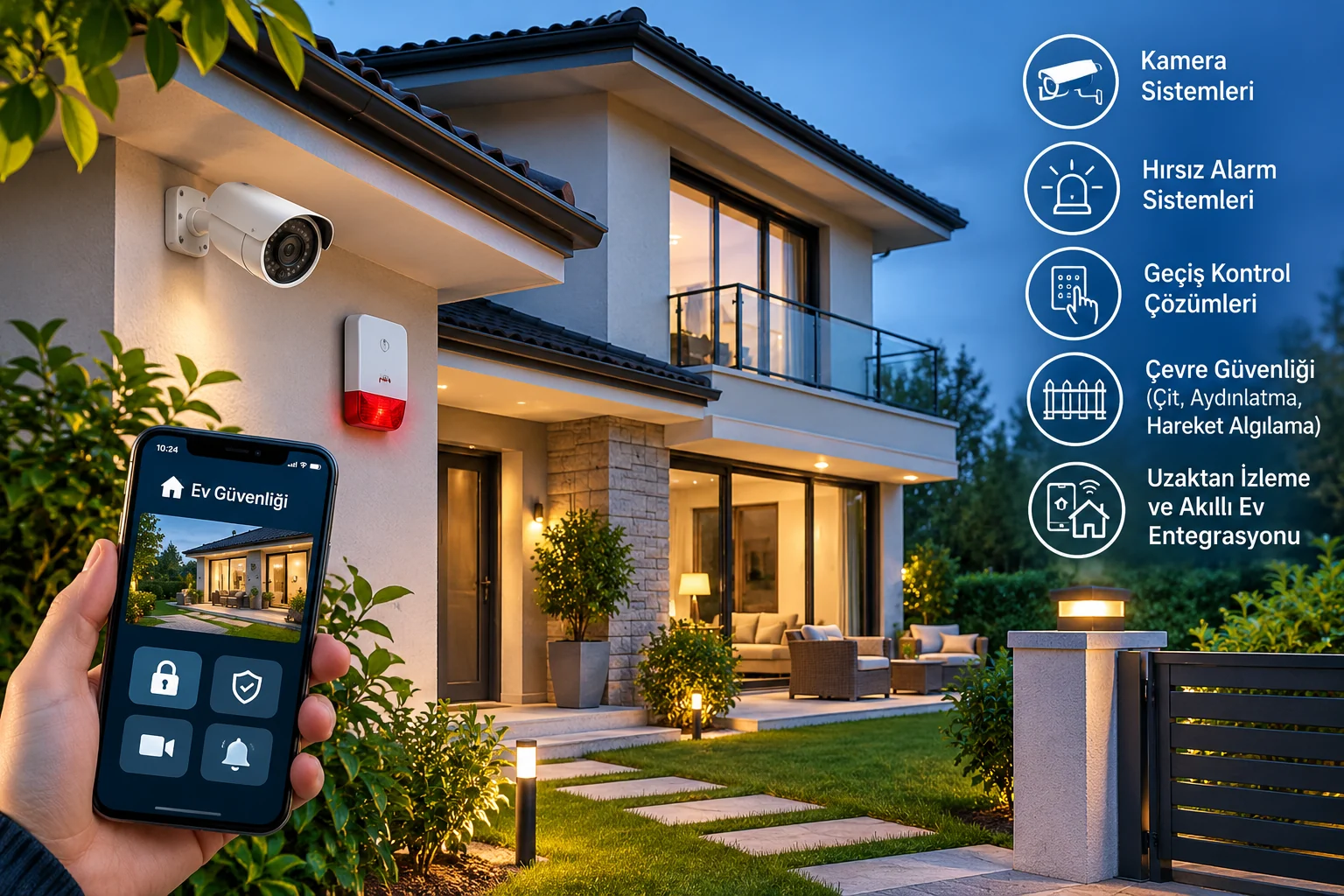
Detached-house security systems comprise the physical and electronic solutions used to protect a residence against different security risks, from garden boundaries and building entrances to living spaces and utility areas. IP security cameras, burglar alarm systems, outdoor motion detectors, smart door locks, video intercoms and fire-detection equipment are their main components.
Unlike apartments, detached houses may have multiple entrance doors, a garden, garage, terrace, balcony, basement and separate structures, all of which can increase security requirements. The absence of security staff around the property or long periods when it is unoccupied can also make early-warning and remote-monitoring systems more important.
But securing a detached house is not simply a matter of installing high-resolution cameras. Capturing camera footage, detecting unauthorized entry, sending an alarm to the relevant person and initiating a response when necessary are distinct functions.
A secure detached house should have an integrated setup in which physical protection, early detection, video verification, reliable alarm notification and an appropriate response plan work together.
This guide examines how to choose security systems for detached houses and villas, camera and alarm placement, perimeter protection, video-recording capacity, smart-home integrations and the technical criteria to consider during installation.
What Is a Detached House Security System?
A detached-house security system is a combination of physical, electronic and software systems used to protect a residence’s indoor and outdoor areas against specific security threats.
The main objectives are:
Make unauthorized entry more difficult.
Detect suspicious movement as early as possible.
Obtain reliable camera footage from the required areas.
Generate alerts for burglary and certain emergencies.
Provide residents with remote status information.
Record security incidents appropriately.
Reduce the effects of power and internet outages.
Protect the privacy of living spaces.
No single technology can address every risk in a detached house. A successful security project consists of complementary layers of protection.
Five Layers of Protection for Detached Houses
Detached-house security can be considered in five basic layers.
MULTI-LAYERED RESIDENTIAL SECURITY ARCHITECTURE
1. Perimeter security
Garden boundaries, fences, walls, lighting and suitable outdoor detection
2. Building-entry security
Exterior doors, windows, balconies, garage and access control
3. Early alarm detection
Magnetic contacts, PIR detectors, outdoor sensors and alarm panel
4. Video verification of incidents
IP cameras, NVR, suitable video analytics and recording management
5. Notification and response
Siren, mobile notification, suitable alarm-monitoring service and emergency plan
These layers do not need to be installed to the same extent in every home.
For example, door-and-window security and an appropriate alarm system may be priorities in a home with a small garden, while perimeter protection and a multi-zone alarm design may be important for a villa on a large plot.
How to Identify Security Risks in Detached Houses
Before designing a security system, assess the home’s architectural features, how it is used and its environmental conditions.
Area to protect | Main risk | Possible solution |
|---|---|---|
Main entrance door | Unauthorized entry | Sturdy door, lock, contact, camera |
Garden gate | Unauthorized access | Physical protection, lighting, camera |
Side and rear garden | Movement outside the field of view | Suitable IP camera, outdoor detector |
Terrace and balcony | Alternative entry point | Door contact, suitable motion detection |
Windows | Forced entry and opening | Magnetic contact, suitable glass-break detection |
Garage | Vehicle and property security | Garage-door contact, camera |
Basement and utility room | Uncontrolled access, technical risks | Contact, fire and water-leak detection |
Home left unoccupied for long periods | Incident detected late | Remote alarm notification, backup communications |
This table is not a definitive product selection. The final system should be determined following a site survey and risk assessment.
What Should a Detached House Camera System Include?
Detached-house camera systems should be designed to capture sufficient image detail at designated security points.
Before deciding on the number of cameras, determine which areas need to be viewed and for what purpose.
Main Entrance Camera
A main entrance camera can be used to view visitors and incidents around the entrance.
Camera placement should take into account whether faces can be seen in sufficient detail, the effect of lighting above the door and the field of view.
A camera installed at a steep angle above the doorway may not show people’s faces in sufficient detail.
Garden and Perimeter Cameras
Garden cameras can be used to view designated access points and vulnerable perimeter areas.
However, do not assume that a single wide-angle camera will provide sufficient detail across the entire garden.
When a large area is viewed, distant targets may occupy fewer pixels in the image.
Garage Camera
In garages and parking areas, the aim may be to monitor entries and exits, door movement and specific security incidents.
If vehicle plates need to be read, do not assume that a camera providing a general view will be sufficient.
Terrace and Rear-Door Cameras
Terraces, verandas and rear garden doors may provide a second or third access point in some detached homes.
Camera placement in these areas should be considered alongside suitable door and window sensors.
How Many Cameras Does a Detached House Need?
There is no fixed camera count that applies to every detached house.
Factors determining camera requirements:
Number of floors and architectural design.
Main and side access points.
Garden size.
Garage location.
Blind spots around the building.
Camera resolution and lens specifications.
Required image detail.
Night-time lighting conditions.
Sample Camera Plan for a Detached House
The following example can be considered for a two-storey home with a garden and a separate garage.
Area | Example camera requirement | Purpose of view |
|---|---|---|
Main entrance | 1 | Door and approach area |
Vehicle entrance/garage | 1 | Vehicle passage and garage surroundings |
Side garden | 1 | Side access corridor |
Rear garden/terrace | 1 | Rear access point |
Second perimeter point | 1 | Area outside the field of view |
Additional critical area | 0–1 | Subject to site survey |
In this example, approximately 5–6 cameras can be considered.
However, this is neither a standard nor a mandatory recommended camera count for all detached houses.
Fewer cameras may be sufficient in a smaller home. A villa with a large, complex design may require different solutions.
DORI and PPM Analysis for Detached House Cameras
Megapixel count alone is not enough when designing a professional camera system.
The image detail a camera provides at the target distance must also be assessed.
PPM (Pixels Per Meter) indicates how many pixels represent a one-metre horizontal area on the target plane.
PPM = Horizontal pixel count of image ÷ Horizontal field width at target plane
For example, if a camera with 2560 horizontal pixels views a 10-metre-wide area at the entrance:
2560 ÷ 10 = 256 PPM
is the result.
This value indicates the theoretical horizontal pixel density at that distance.
But by itself, it does not guarantee that a person can be identified.
Lens quality, focus, light, motion blur and compression settings also affect the result.
For CCTV systems, IEC 62676-4:2025, it is the current international code of practice for planning, designing, installing, testing and maintaining video surveillance systems.
In new detached-house projects, imaging objectives should be assessed in line with the current approach of this standard.
For more detailed technical selection criteria, consult the article What to Consider When Choosing a Security Camera? . The article may be consulted.
IP Camera or Wi-Fi Camera for a Detached House?
Detached-house camera systems may use wired IP, Wi-Fi or hybrid connections.
PoE IP Cameras
Suitable PoE cameras can carry data and receive power over an Ethernet cable.
They may be considered in new buildings or homes where cabling can be installed.
Their main advantages, with suitable infrastructure, are a stable data connection and centralized power management.
Wi-Fi Cameras
Wi-Fi cameras communicate over a suitable wireless network.
However, Wi-Fi connectivity does not mean the camera works without electricity.
Many Wi-Fi cameras also require an adapter or another power source.
Battery-Powered Cameras
Battery-powered models can reduce the need for cabling at certain locations.
However, some battery-powered cameras record only when an event is detected to save energy.
Therefore, do not assume that all battery-powered cameras provide continuous 7/24 video recording.
Comparison of Connection Technologies
Criterion | PoE IP camera | Wi-Fi camera | Battery-powered camera |
|---|---|---|---|
Data connection | Ethernet | Wireless network | Wi-Fi or 4G, depending on model |
Power | Compatible PoE | Usually an adapter | Battery |
Continuous recording | On suitable models | On suitable models | Model-dependent |
Network stability | Depends on wired infrastructure | Depends on Wi-Fi coverage | Depends on Wi-Fi/4G and power |
Maintenance | Network and device maintenance | Network and device maintenance | Additional battery management |
Use | Permanent installation | Locations where cabling is difficult | Areas with limited infrastructure |
In detached houses, wired IP infrastructure may be considered especially for locations requiring permanent installation and continuous recording.
The final choice, however, depends on the architecture, infrastructure and security requirements.
Burglar Alarm Systems in Detached Houses
Security cameras and burglar alarm systems serve different purposes.
Cameras provide views and recordings of designated areas, while alarm systems assess events from suitable sensors and generate alerts.
An alarm system in a detached house may typically include:
Alarm control panel.
Magnetic door and window contacts.
PIR motion detectors.
Suitable glass-break detectors.
Outdoor detectors.
Indoor or outdoor siren.
Keypad and user control units.
Suitable IP or cellular communications module.
Backup power components.
For alarm systems, IEC 62642-1:2010, it is one of the international standards setting out core requirements for building-type intrusion and hold-up alarm systems.
When choosing an alarm system, assess not only device specifications but also the appropriate security grade, installation and maintenance requirements.
How Should Alarm Zones Be Planned in Detached Houses?
Dividing an alarm system into zones can make it easier to use in multi-storey homes.
For example:
Alarm zone | Area protected | Example use |
|---|---|---|
Zone 1 | Main entrance and exterior doors | Door-opening detection |
Zone 2 | Ground-floor windows | Protection of perimeter openings |
Zone 3 | Indoor motion sensors | Indoor protection while the home is empty |
Zone 4 | Garage and utility areas | Separate-area monitoring |
Zone 5 | Suitable outdoor sensors | Early warning in the garden |
Separate security functions | Smoke, gas and water detection | Continuous monitoring depending on product and system type |
This layout is an example only.
In an actual project, determine the number of zones supported by the alarm panel, sensor technology, user requirements and detector operation.
Using the Alarm While at Home
In supported alarm systems, certain indoor motion zones can be disabled while perimeter protection remains active.
This approach can help monitor designated access points while residents are indoors.
However, proper installation and scenario configuration are required.
Using the Alarm When the Home Is Empty
When the home is empty, suitable systems can activate indoor motion detectors and other designated alarm zones.
However, windows accidentally left open by users or inadequate zone configuration can affect system use.
Garden and Perimeter Security Systems
Perimeter security in detached houses can help detect incidents early at the garden boundary or around the building.
Technologies that may be used include:
Suitable outdoor PIR detectors.
Dual-technology outdoor motion detectors.
Active infrared barriers.
Camera-based virtual-boundary analytics.
Physical fencing and landscaping.
Motion-activated lighting.
These are among the options.
Outdoor detection, however, may be affected by more environmental variables than indoor motion detection.
Why Do False Alarms Occur in Gardens?
Sources of false alarms may include:
Movement of pets and wild animals.
Plants moving in the wind.
Sudden temperature changes.
Rain and severe weather.
Unsuitable sensor placement.
Incorrect configuration of the detection zone.
These factors may be involved.
Product features such as “pet immunity” or “AI human detection” do not mean that all false alarms will be prevented.
Outdoor detectors should therefore be tested under actual site conditions.
For more information about technology options for large areas, consult the article What Are Perimeter Security Systems? . The article may be consulted.
Using AI-Powered Cameras in Detached Houses
AI-powered security cameras can automatically assess certain visual events.
Suitable camera and software systems can provide:
Human detection.
Vehicle detection.
Entry into a defined zone.
Crossing specified virtual boundaries.
Event-based recording and notifications.
These functions may be available.
For example, a mobile notification can be sent to the user when a designated area in the garden is breached.
However, a camera maker’s “human detection” feature does not mean it will perform reliably at every distance or in all lighting conditions.
Camera placement, image quality and the analysis objective must be validated under actual site conditions for AI analytics.
Especially in large gardens, do not expect one camera to provide both a general view and highly accurate detection of small, distant targets at the same time.
Smart Locks and Video Intercoms in Detached Houses
Suitable lock systems and video door-phone solutions can be used to secure the main entrance.
Smart Door Locks
Depending on the model, smart locks may offer PIN, card, mobile-app or other authentication methods.
Some models also allow temporary user permissions to be assigned through suitable software.
When choosing a smart lock, however, consider:
Compatibility with the door and mechanical lock.
User authorization.
Authentication security.
Battery and power-outage behavior.
Mechanical access in an emergency.
Emergency-evacuation requirements.
Software-update support.
These factors should be assessed.
Video Intercom
Video intercoms can help users see visitors at the door on a suitable screen and, in supported systems, communicate with them by voice.
Some IP-based models can also receive visitor calls through a mobile app.
However, a video intercom’s use of a mobile app does not automatically mean it supports every video-recording function or full integration with other CCTV systems.
Fire, Gas and Water-Leak Safety in Detached Houses
Detached-house security is not limited to burglary and unauthorized-entry risks.
Hazards such as fire, carbon monoxide, fuel-gas leaks and flooding should also be assessed.
Smoke Detection
Suitable smoke alarms in homes can provide warning at an early stage of a fire.
AFAD recommends installing smoke detectors in homes, checking them regularly and preparing a fire-evacuation plan.
Carbon Monoxide Detectors
The risk of carbon monoxide should be assessed separately in buildings containing certain fuel-burning heaters and appliances.
A carbon monoxide sensor is not used for the same purpose as a natural-gas or LPG leak detector.
The gas detected, certification and installation conditions differ between these devices.
Water-Leak Sensors
Suitable water-leak sensors can be used in basements, utility rooms, water-tank areas or specific wet rooms.
In supported systems, water-shutoff scenarios can be configured with a suitable motorized valve.
However, assess the behavior of automatic valves during power outages, the option of manual control and safe operating conditions.
Are Fire and Burglar Alarms the Same System?
No.
Fire detection and burglar alarms assess different types of hazards.
Some integrated products support more than one type of alarm; that does not automatically mean they meet fire-safety conditions required by specific regulations or standards.
Camera Recording Duration and HDD Calculation in Detached Houses
Video-recording capacity should be calculated according to the home’s security requirements and the video bit rate of the devices used.
Key parameters:
Number of cameras.
Average video bit rate.
Continuous or event-based recording method.
Number of recording days.
Video compression.
Storage reserve.
Recorder capacity limits.
Example: Detached House with Six Cameras
Assume that each of the six cameras records continuously for 15 days at an average bit rate of 3 Mbps.
Parameter | Value |
|---|---|
Number of cameras | 6 |
Average bit rate | 3 Mbps/camera |
Total video traffic | 18 Mbps |
Theoretical daily data | 194.4 GB |
Theoretical data for 15 days | 2916 GB |
Approximate recording data | 2.92 TB |
Calculation:
6 × 3 Mbps × 10.8 GB × 15 days = 2,916 GB
In this example, 15 days of continuous video recording requires approximately 2.92 TB of theoretical storage.
Additional capacity should be allowed for the disk’s actual usable capacity, the file system, recorder requirements and variable bit rates.
The disk should therefore not be selected at a capacity equal only to the theoretical recording volume.
Important: This is an example of technical capacity. It does not mean that keeping recordings for 15 days is mandatory for all detached houses in Türkiye or legally appropriate in every case.
For information on setting retention periods, consult the article How Many Days Should Security Camera Footage Be Kept? . The article may be consulted.
Differences Between NVR, Memory Card and Cloud Recording
Video recordings in detached houses can be stored in different media.
Feature | NVR | microSD | Cloud |
|---|---|---|---|
Recording location | Local recorder | Card in the camera | Remote service infrastructure |
Management of multiple cameras | On suitable systems | Usually per camera | Service-dependent |
Internet requirement | May not be required for local recording | May not be required for local recording | Required for cloud upload |
Central capacity | Depends on disk and device capacity | Limited by card capacity | Depends on subscription plan |
Main risk | NVR failure or loss | Loss of camera or card | Dependence on internet and service |
Remote access | With suitable network configuration | Product-dependent | Suitable internet and account access |
In detached houses, local NVR or in-camera recording can, with a suitable system design, reduce the effect of internet outages on recording.
Local recording and remote monitoring are nevertheless different functions.
Being unable to connect to a camera by phone because of an internet outage does not necessarily mean that all camera recording has stopped.
Do Detached House Security Systems Work During a Power Outage?
How a system behaves during a power outage depends on the power supplies of the devices used.
The alarm panel may have a backup battery. A suitable uninterruptible power supply can also be considered for camera and NVR systems.
However, powering one device through a UPS does not guarantee that the entire security system will continue operating.
For example, if the PoE switch loses power while the NVR continues operating, the cameras may stop transmitting video.
Similarly, if the internet modem shuts down while the alarm panel remains operational, mobile notifications may be affected.
The following components should therefore be considered together in a backup-power plan:
Alarm panel.
Critical detectors and communication modules.
PoE switch.
IP cameras.
NVR.
Modem and router.
Gateway and other control devices, if required.
Backup duration should be calculated according to the devices’ actual power consumption and the usable capacity of the power source.
How Are Alarm Notifications Sent if the Internet Goes Down?
Some alarm panels support cellular communications in addition to Ethernet or Wi-Fi connectivity.
In suitable systems, an alternative communications channel can be considered if one connection is unavailable.
However, having a 4G/LTE module does not guarantee that a notification will be delivered in the following situations:
Mobile-network coverage is inadequate.
The cellular communications service is interrupted.
The SIM card or subscription is inactive.
The communications device has lost power.
The alarm service or receiving system is unavailable.
Alternative communications therefore require actual site testing and periodic checks, not just a product feature.
Security for Holiday Homes and Houses Left Unoccupied for Long Periods
Holiday homes and seasonally used houses require special consideration among detached residences.
In buildings left empty for long periods, the risk is not limited to unauthorized entry.
A power, internet or equipment failure going unnoticed for days is also a significant problem.
In such homes, consider:
Alarm-system status notifications.
Power-outage alerts.
Suitable cellular communications.
Local video recording.
Smoke and water-leak detection.
Incident notifications to a trusted authorized person.
Regular physical inspections.
These options may be considered.
Do not assume that a system relying only on mobile-app notifications will provide adequate protection in every circumstance.
It should also be determined who will assess a security incident, how they will do so and within what time.
Cybersecurity in Detached House Security Systems
Cybersecurity becomes important when IP cameras, alarm systems and smart locks connect to the home network or the internet.
The UK National Cyber Security Centre (NCSC) recommends measures for safe use of smart-home devices, including strong authentication, software updates and disabling unnecessary remote access.
In detached-house security systems:
Change default passwords.
Use strong authentication for every device and account.
Enable two-step verification on supported accounts.
Keep camera and alarm software up to date.
Place security devices on an appropriate network segment.
Disable unnecessary internet access and services.
Check the manufacturer’s support period for the devices.
Limit access permissions for recording devices and user accounts.
Disable unused remote-management features.
Serious cybersecurity risks can arise, especially with cameras and recorders exposed to direct internet access.
Remote access should be provided through the manufacturer’s secure connection methods or appropriate professional network configuration.
Detached House Security Cameras and KVKK
When considering camera use in detached houses, distinguish the personal-use exemption from the processing of images of third parties.
The personal or family-activity exemption in Article 28 of Personal Data Protection Law No. 6698 does not apply unconditionally to every camera use.
For example, cameras confined to areas used personally by family members may raise different legal issues from systematically filming neighboring homes, streets or other people’s private spaces.
The following principles should be considered when designing a camera system:
Aim cameras at areas necessary for security purposes.
Do not film the interiors of neighboring homes.
Keep unnecessary street and surrounding areas out of view as far as possible.
Use privacy masking on suitable models.
Assess intrusive features such as audio recording and facial recognition separately.
Restrict access to recordings.
Do not share footage with unauthorized people.
Identify the applicable legal obligations for relevant data-processing activities.
The Personal Data Protection Authority’s 2026 notice on security cameras in apartment buildings and residential complexes emphasizes privacy, purpose limitation and avoiding unnecessary audio recording, especially when monitoring common areas.
However, the private garden of a detached home and the common areas of multi-unit housing do not always have the same legal status.
The legal assessment should therefore depend on the circumstances of use.
How to Design a Detached House Security System
The following process can be followed for a professional detached-house security system.
1. Site Survey
Assess the home’s architecture, access points, garden, garage and utility areas.
2. Risk Assessment
Identify the areas to protect and specific security incidents to address.
3. Camera Placement
Set imaging objectives. Assess lens selection, night-time performance and the required image detail.
4. Alarm and Detector Plan
Create zones for doors, windows, indoor motion and, where needed, outdoor detection.
5. Physical Security
Assess physical security features such as doors, windows, locks, garage doors and exterior lighting.
6. Recording and Communications
Determine NVR, disk capacity, network connection and alternative communications requirements.
7. Backup Power
Prepare a backup-power plan for critical devices based on actual consumption data.
8. Commissioning and Site Testing
Verify camera images, alarm detection, notifications, recording and outage scenarios.
9. User Training
Explain alarm arming and disarming, notification assessment and emergency procedures to residents.
10. Periodic Maintenance
Establish a regular inspection plan for cameras, alarms, recording, network and power components.
Common Mistakes in Detached House Security Systems
Increasing the number of cameras without assessing blind spots and lens angles.
Using cameras alone instead of a burglar alarm.
Ignoring sources of false alarms in the garden.
Mistaking night-vision range for a reliable facial-identification distance.
Failing to calculate recording capacity.
Connecting a UPS only to the NVR for power outages.
Failing to plan how alarm notifications will be delivered during an internet outage.
Neglecting the mechanical security and emergency-access features of a smart lock.
Pointing camera views unnecessarily toward neighboring properties.
Failing to test detection and recording after installation.
Many of these mistakes can be reduced through proper surveys, design and system verification.
Technical Checklist for Detached House Security Systems
- Has a risk analysis been carried out for the home and garden?
- Have all entrance doors and accessible windows been inspected?
- Have garage, basement, terrace and balcony entrances been assessed?
- Have the physical security of doors and locks been checked?
- Have camera viewing angles and blind spots been identified?
- Were camera lenses selected to suit the target distance?
- Were daytime and night-time image tests conducted?
- Was camera and NVR compatibility verified?
- Were retention duration and disk capacity calculated?
- Were door and window alarm sensors planned?
- Were indoor and outdoor alarm zones separated?
- Were garden detectors tested under real conditions?
- Were smoke-detection and suitable gas-detection needs assessed?
- Was a backup-power plan prepared for power outages?
- Was communications behavior tested during an internet outage?
- Were mobile notifications and alarm-access permissions checked?
- Was emergency access considered for smart locks?
- Were cybersecurity measures implemented?
- Were camera locations and KVKK requirements assessed?
- Was a post-installation testing and maintenance plan prepared?
Frequently Asked Questions About Detached House Security Systems
What is the best security system for a detached house?
No single system is best for every home. A reliable solution may combine physical door-and-window security, a suitable burglar alarm, cameras at necessary viewing points and reliable notification methods.
How many cameras should be installed in a detached house?
The number depends on the home’s size, access points, garden, garage and viewing objectives. There is no fixed number.
Which matters more for villa security: cameras or an alarm?
The two technologies have different functions. Cameras provide views and help verify incidents, while an alarm system detects certain unauthorized-entry events. Using them together can be considered in suitable designs.
Is an outdoor motion sensor necessary for a detached house?
It can be useful in homes that need early detection in the garden and perimeter. It is not necessary for every residence; environmental conditions and false-alarm risks should be assessed.
Should a wired or wireless alarm be chosen for a detached house?
Wired infrastructure can be considered in new buildings. Wireless or hybrid systems may offer installation flexibility in existing homes. The choice depends on the area of use and device compatibility.
Do security cameras keep recording if the internet goes down?
Cameras and NVR systems with suitable local recording infrastructure can continue recording during an internet outage. Remote monitoring, however, may be affected.
Does the alarm work during a power outage?
Suitable alarm panels with backup batteries may continue operating for a limited period. That period depends on device consumption and battery condition.
Can detached-house security cameras film a neighbor’s garden?
Unnecessarily filming neighbors’ private spaces may create privacy and personal-data-protection issues. Camera placement and, where necessary, masking settings should be planned to reduce this risk.
Do detached houses need a 4G alarm system?
It may be considered in homes where fixed internet is unreliable or alternative communications are needed. Mobile-network coverage and power requirements must be verified.
Which security measures are important for holiday homes?
Remote alarm notifications, continuous camera recording, suitable backup power, smoke and water-leak detection, and regular physical inspections can be especially important.
How much does a detached-house security system cost?
Cost depends on the number of cameras and detectors, cabling, recorder, storage, alarm panel, communications subscription and installation conditions. A sound budget should be drawn up after a site survey and assessment of technical requirements.
Conclusion: Effective Detached-House Security Requires Layered Protection
Detached-house security systems require different security risks to be assessed together, from the outer perimeter to living spaces.
IP cameras provide viewing and recording, while alarm systems can detect certain unauthorized entries. Smart locks, video intercoms, physical door-and-window protection, and fire- and water-leak-detection solutions can complement this architecture.
But the technical specifications of cameras, alarms or smart-home products alone do not guarantee security.
An effective detached-house security system is suited to actual risks, accounts for blind spots, has verified alarm and imaging functions, is prepared for power and communications outages, and protects privacy.
Security investments in villas and detached houses should therefore be planned around site surveys, sound engineering, commissioning tests and sustainable maintenance—not the number of devices or the initial cost alone.