
Ajax EN54 Wireless Fire Detection Systems: Models, Features and Selection Guide
Ajax EN54 Line is a product family of wireless, addressable fire detection and alarm systems developed for commercial and public buildings. We examine the EN54 Fire Hub Jeweller control panel, smoke and heat detectors, sirens, visual alarm devices, manual call points, and wireless integration modules in terms of their technical specifications. We compare EN 54-25 compatibility, communication capacity, battery life, system architecture, and application criteria in Türkiye.
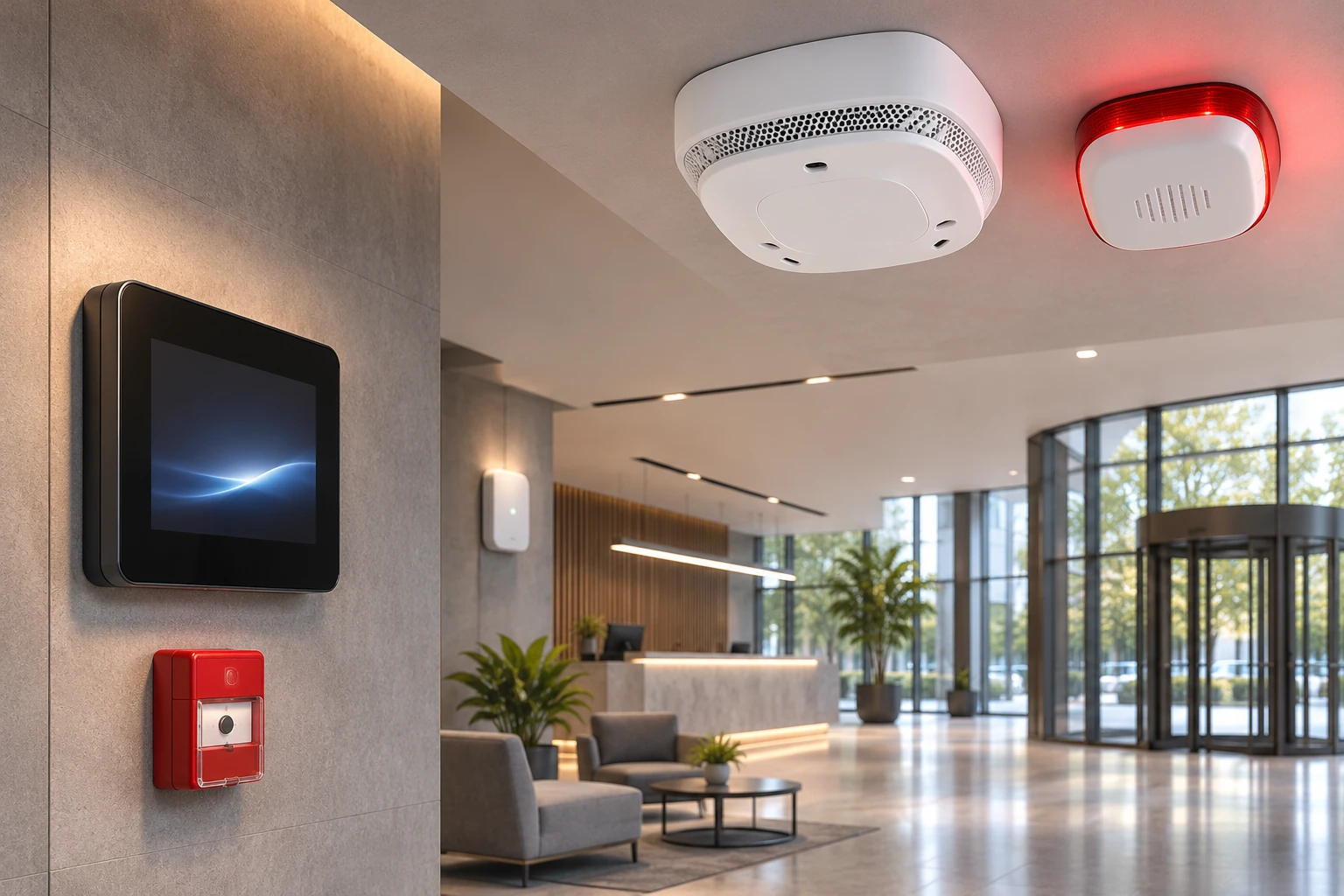
Ajax EN54 Line is a family of wireless, addressable fire detection and alarm system products designed to detect fires, manage alarm conditions and alert building occupants in commercial and public buildings. Developed by Ajax Systems, this solution brings together a control panel, smoke and heat detectors, fire call points, audible and visual alarm devices, and input-output modules within the same system architecture.
At the heart of the system is EN54 Fire Hub Jeweller, which serves as the fire alarm control and indicating equipment (CIE). It establishes two-way wireless communication with supported devices, enabling the central management of fire alarms, system faults and device status.
One of the standout features of Ajax EN54 Line is that commercial fire detection functions can be used within the same ecosystem as compatible Ajax intrusion-protection and video-surveillance technologies. However, fire safety functions are subject to technical and regulatory requirements separate from those governing other security functions.
The most important advantage of wireless fire detection systems is that they can reduce the need for new detection-circuit cabling, particularly in existing buildings. However, wireless communication does not mean that the system operates entirely on wireless power or that an engineering design is unnecessary.
What Is Ajax EN54 Line?
Ajax EN54 Line comprises professional fire detection and alarm products developed to comply with the relevant parts of the EN 54 standards family.
Unlike conventional wired addressable fire alarm systems, field devices connect to the central panel via supported Jeweller radio communication.
The system offers an addressable architecture capable of monitoring fire alarms, device connection status, battery levels, tampering and certain system faults.
The manufacturer lists the following key system specifications:
Up to 200 compatible addressable devices.
40 fire zones.
Up to 5 EN54 Fire ReX range extenders.
10.1-inch touchscreen control display.
Supported communication options via Ethernet, Wi-Fi and dual SIM.
Backup operation for 24 or 72 hours with a suitable battery.
Two-way, supervised Jeweller wireless communication.
Management functions supported by Ajax mobile and desktop applications.
These capacities are product limits specified by the manufacturer. The size of a real-world site that can be supported cannot be determined by the total number of devices alone. Fire zones, radio coverage, detection and evacuation requirements must also be assessed.
Ajax EN54 Fire Hub Jeweller Control Panel
EN54 Fire Hub Jeweller is the central control and indicating equipment for the Ajax EN54 Line system.
The panel evaluates information from fire detection devices, displays the relevant fire zone, manages alarm and fault conditions, and performs supported notification or control operations.
EN54 Fire Hub Jeweller Technical Specifications
Technical specification | Manufacturer information |
|---|---|
Control display | 10.1-inch touchscreen |
Addressable devices | Up to 200 |
Fire zones | 40 |
Range extenders | Up to 5 |
Wireless communication | Jeweller |
Network connection | Ethernet, Wi-Fi |
Cellular connection | 2 SIMs, supported 2G/4G |
Backup power | 24 or 72 hours with a suitable battery |
Fire panel standards | EN 54-2, EN 54-4 and other relevant parts |
The manufacturer's EN54 Line technical documentation also includes conformity information for the panel under EN 54-13, EN 54-21 and EN 54-25.
Key Panel Functions
EN54 Fire Hub Jeweller enables the central display of fire alarm conditions and system faults.
In supported configurations, fire safety can be integrated with intrusion protection and video surveillance.
An appropriate internet connection is required for remote access and Ajax Cloud services. However, the behavior of local fire alarm functions during a connection outage must be assessed separately.
Important: The panel's backup battery is selected separately. Do not assume that batteries other than the manufacturer's compatible EN54 Internal Battery options can be used.
Ajax EN54 Wireless Smoke and Heat Detectors
Ajax EN54 FireProtect Jeweller products comprise addressable detectors designed to detect different physical indicators of fire.
The product family includes smoke, heat and combined detection options. Some models also feature a built-in sounder.
EN54 FireProtect (Smoke) Jeweller
A wireless point smoke detector.
The manufacturer's documentation highlights dual-spectrum optical detection and the HazeFlow 2 algorithm. Under certain conditions, this approach may help distinguish smoke from factors such as water vapour.
Key features:
Point smoke detection under EN 54-7.
Wireless communication under EN 54-25.
Addressable device architecture.
Central monitoring of device status.
Battery life of up to 5 years under the conditions specified by the manufacturer.
It can be considered for offices, corridors and indoor spaces where environmental conditions are suitable.
However, where there is heavy dust, vapour or smoke-like particles, other detection methods may be needed because of the risk of false alarms.
EN54 FireProtect (Heat) Jeweller
EN54 FireProtect (Heat) is a wireless fire detector designed to detect changes in temperature.
It was developed to meet the relevant EN 54-5 heat detector requirements.
It can be used in certain areas where smoke detectors are unsuitable because of environmental conditions.
For example, heat detection can be considered in areas where there is a high likelihood of false smoke alarms caused by vapour or particles.
However, in some fire scenarios, heat detectors may trigger an alarm later than smoke detectors.
EN54 FireProtect (Heat/Smoke) Jeweller
Listed in the 2026 product catalogues, this model is a wireless detector that combines smoke and heat detection in one device.
Having two different detection methods in the same housing may help diversify the detection strategy in suitable applications.
However, combined detection does not guarantee that every type of fire will be detected earlier or without error.
The product's alarm decision logic, configurable detection options and current certification documents should be verified before installation.
Detector Models with Built-in Sounders
The Ajax EN54 Line also includes the following combination devices:
EN54 FireProtect (Smoke/Sounder) Jeweller: Smoke detection and audible alert.
EN54 FireProtect (Heat/Sounder) Jeweller: Heat detection and audible alert.
These models combine detection and audible alarm functions in the same device.
However, the presence of a sounder in the detector does not automatically prove that the space is alerted at the required sound pressure level. Audible evacuation design must be assessed separately.
Comparison of Ajax EN54 Detector Models
Model | Smoke | Heat | Built-in sounder |
|---|---|---|---|
FireProtect (Smoke) | Yes | No | No |
FireProtect (Heat) | No | Yes | No |
FireProtect (Heat/Smoke) | Yes | Yes | No |
FireProtect (Smoke/Sounder) | Yes | No | Yes |
FireProtect (Heat/Sounder) | No | Yes | Yes |
All rows belong to the Ajax EN54 Line product family. The table compares device functions; it is not a recommendation for detection distance or coverage area.
Which Detector Should You Choose?
The following factors should be considered when selecting a detector type:
The expected pattern of fire development.
The properties of the combustible material.
The likely behavior of smoke and heat in the environment.
Ventilation and air currents.
Ceiling height and architectural obstructions.
Environmental factors such as dust, humidity and vapour.
Relevant TS EN 54 standards and project requirements.
Choosing the same detector type for every space is not the right approach.
Ajax EN54 Wireless Sounders and Visual Alarm Devices
The Ajax EN54 Line product family also includes audible and visual alarm devices for alerting building occupants during a fire.
EN54 FireProtect (Sounder) Jeweller
A wireless fire alarm sounder.
It is assessed against the relevant EN 54-3 audible alarm device requirements and EN 54-25 wireless communication requirements.
Manufacturer documentation states that the standalone siren family can produce sound output of up to 100 dB. This value does not represent the sound level that will be achieved at every installation point.
EN54 FireProtect (VAD) Jeweller
VAD (Visual Alarm Device) refers to a visual fire alarm device.
It is associated with the visual alert requirements under EN 54-23.
Visual alarm devices are important in evacuation design, particularly in areas where audible alerts alone are insufficient.
When selecting a VAD, consider not only whether the light is visible, but also the coverage class, mounting height and placement criteria stated by the manufacturer.
EN54 FireProtect (Sounder/VAD) Jeweller
Combines audible and visual alerts in a single device.
Combining the supported EN 54-3 and EN 54-23 functions may reduce the number of separate sounders and visual alarm devices in some projects.
Nevertheless, device placement must be verified both for audibility of the audible alarm and for the coverage conditions of the visual alarm.
Ajax ManualCallPoint (Red) Jeweller Fire Call Point
ManualCallPoint (Red) Jeweller is a wireless, resettable call point intended to let users trigger the fire alarm manually.
The manufacturer's EN54 Line documentation lists EN 54-11 and EN 54-25 conformity for the red model.
The device must be positioned appropriately, with mechanical protection and accessibility requirements met.
Ajax also offers manual call point products in different colours. However, the other colour options should not be assumed to have the same intended use and conformity under EN 54-11 as the red fire call point.
Ajax EN54 Fire ReX Jeweller Range Extender
EN54 Fire ReX Jeweller is a product designed to extend communication coverage between wireless field devices and the fire control panel.
It can be considered for buildings with thick walls, reinforced-concrete structural elements and long corridors.
In addition to wireless communication, the manufacturer's documentation describes a suitable Ethernet connection option for EN54 Fire ReX.
When selecting a range extender, consider:
The radio coverage map.
Device connection level.
The effect of building materials on the signal.
Power supply.
Backup battery.
Fault and connection-loss behavior.
must be checked.
The stated communication range of up to 1,800 meters in open areas is not a guaranteed operating range inside buildings. Actual coverage should be assessed through on-site radio measurements.
Ajax EN54 I/O Module (2X2) Jeweller
The EN54 I/O Module (2X2) Jeweller is a wireless input/output module designed to exchange signals between a fire alarm system and compatible external equipment.
The device has two inputs and two outputs.
With a suitable project design, it can be used to receive status information from supported external systems or to activate specific control scenarios.
For example, it may be considered when integration with door control, specific fire automation systems or other systems is required.
However, connecting critical fire-safety functions to any relay output is not sufficient. The safe operating behavior, control signal, fault monitoring and required conformity documents for the relevant equipment must be verified.
EN54 Indicator Jeweller: Remote Alarm Indicator
Added to the Ajax EN54 Line product family in 2026, the EN54 Indicator Jeweller was designed to display remotely the alarm status of fire detectors in locations that are concealed or difficult to access.
For example, it can help make it easier to notice an alarm from detectors inside suspended ceilings or enclosed technical areas.
The manufacturer's announcement states that the device has a red LED indicator and different light-display modes.
This product should not be considered a fire alarm sounder or a VAD replacement. Its primary purpose is to display the alarm status of connected detectors remotely.
Ajax EN54 Line System Components and Relevant Standards
Product group | Relevant EN 54 sections |
|---|---|
Fire Hub control panel | EN 54-2, 4, 13, 21, 25 |
Wireless smoke detector | EN 54-7, 25 |
Wireless heat detector | EN 54-5, 25 |
Combined smoke detector/sounder | EN 54-3, 7, 25 |
Combined heat detector/sounder | EN 54-3, 5, 25 |
Wireless sounder | EN 54-3, 25 |
Visual alarm device | EN 54-23, 25 |
Combined sounder and VAD | EN 54-3, 23, 25 |
Red manual call point | EN 54-11, 25 |
EN54 Fire ReX | EN 54-4, 18, 25 |
EN54 I/O Module (2X2) | EN 54-18, 25 |
The table summarizes the basic product conformities stated in the manufacturer's EN54 Line documentation. The latest product declarations of performance and certificate versions for the newly added Heat/Smoke and Indicator models should also be checked separately.
What standards mean for fire detection systems, and how certification should be verified, What Is the EN 54 Standard? is explained in detail in the article.
Ajax EN54 Line Compared with Traditional Wired Fire Alarm Systems
Criterion | Ajax EN54 Line | Wired addressable system |
|---|---|---|
Field communication | Jeweller radio | Wired loop |
New detection circuit cabling | Usually not required | Usually required |
Field device power supply | Mostly battery-powered | Mostly via the loop |
Communication monitoring | Wireless connection monitoring | Circuit and device monitoring |
Expansion | Limited by panel and radio capacity | Limited by loop and panel capacity |
Maintenance priorities | Battery, radio and detection tests | Cable, loop and detection tests |
Key installation risk | Radio environment and coverage | Cable routing and circuit integrity |
One of the key advantages of wireless technology is that it can reduce the need for new fire-detection circuit cabling in existing buildings.
Conversely, radio signals can be affected by building materials, while battery management creates additional engineering and maintenance requirements.
Wired systems should not automatically be considered more reliable in every project. In both technologies, system design, redundancy, device compatibility and operational quality are decisive.
Can Ajax EN54 Line Be Used in Türkiye?
In Türkiye, the compliance of fire detection and alarm systems cannot be determined solely by the presence of the term EN 54 in a manufacturer's product brochure.
Article 74 of the Regulation on the Protection of Buildings from Fire regulates the manufacture, design, installation and operation of fire detection systems and their components in accordance with TS EN 54 requirements.
Accordingly, the following points should be checked in an Ajax EN54 Line project:
Conformity documents for the exact product model and variant.
Up-to-date declarations of performance and applicable CE documents.
The relevant EN 54-25 conformity of wireless components.
System compatibility between the fire panel and its components.
Requirements in Türkiye for wireless frequencies and device use.
Fire-zone layout and detector placement.
Alarm and evacuation scenarios.
Integration with any other required fire systems.
Requirements for approval by the authorized project authority, acceptance and operation.
Articles 75 and 76 of the regulation also contain important provisions on detection and alarm systems.
Therefore, a system comprising compliant products should not be assumed to automatically meet all fire-safety obligations across a building.
Which Buildings May Be Suitable for Ajax EN54 Line?
The Ajax EN54 Line product family may be considered for the following use cases:
Shops and commercial businesses: Spaces where preserving the existing interior layout is important.
Offices and business centers: Facilities requiring addressable detection and centralized notification.
Museums and historic buildings: Spaces where new cable routes are restricted for architectural or preservation reasons.
Hotels and accommodation facilities: Buildings requiring detection and alarm designs suited to their different spaces.
Educational and public buildings: Facilities requiring zoned fire alarms and centralized system supervision.
Warehouses and industrial facilities: Spaces that may be considered where environmental conditions, coverage and fire risk are suitable.
Standard point detectors may not be sufficient in facilities such as high-ceiling warehouses, explosive atmospheres, heavily dusty environments or sites with specialized detection needs.
Such areas may require different detection methods and specially certified products.
What Should Be Considered When Installing an Ajax EN54 Wireless Fire System?
A technical site survey should be conducted before installation to ensure that a wireless fire detection system operates correctly.
1. Radio Communication Coverage
Adequate radio coverage should be ensured throughout the building.
Reinforced-concrete walls, metal surfaces, machinery and other physical obstacles can affect communication quality.
Do not plan device placement solely on the basis of the manufacturer's open-area range figure.
2. Detector Placement
Mounting points for smoke and heat detectors should be selected with the detection objective and building characteristics in mind.
Ceiling geometry, air movement and potential fire development should be assessed.
3. Battery and Power Planning
Ajax EN54 Line field devices are specified to have battery life of up to five years, subject to the manufacturer's conditions.
Actual battery life can vary depending on device type, communication conditions, alarm use and temperature.
Mains power and backup battery requirements for the control panel and range extenders should be planned separately.
4. Audible and Visual Alarm Coverage
Sounders and VADs should be specified so that appropriate warning is provided in the required areas of the building.
Looking only at the number of sounders or their catalogue sound-level rating is not sufficient.
5. Alarm Scenarios and Integration
It should be determined which warnings a fire alarm will trigger in each area, how the relevant automation systems will respond, and which safe state will be maintained in the event of a fault.
Manufacturer compatibility and the relevant standards should guide critical control functions.
6. Testing and Commissioning
After installation, tests should be carried out for detectors, manual call points, audible and visual alarms, communication loss, low battery, loss of panel power and relevant integrations.
The fact that devices appear online in a mobile app does not mean that all fire-safety functions of the system have been verified.
Ajax EN54 Fire Detection System Selection Checklist
- Have the building's fire risks and regulatory requirements been identified?
- Has the compatibility of the devices to be used with EN54 Line been verified?
- Have the control panel limits of 200 devices and 40 zones been assessed?
- Have detector types been selected separately for each space?
- Has radio coverage been measured?
- Have battery life and backup power requirements been calculated?
- Has the placement of sounders and VADs been assessed?
- Have critical automation and evacuation scenarios been prepared?
- Have current certificates and declarations of performance been checked?
- Have maintenance and periodic testing procedures been established?
This checklist is intended for pre-project assessment. It does not replace the implementation design or the technical requirements in force.
Frequently Asked Questions About Ajax EN54 Line
Is Ajax EN54 Line completely wireless?
A significant proportion of field devices operate via Jeweller radio communication. However, the fire control panel, certain range extenders and external integration equipment may require electrical connections. It should therefore not be assumed that the system contains no cables at all.
How many devices does Ajax EN54 Fire Hub Jeweller support?
According to the manufacturer's documentation, the system supports up to 200 compatible addressable devices, 40 fire zones, and 5 range extenders.
How long do Ajax EN54 detectors' batteries last?
The manufacturer states that supported detectors can have battery life of up to five years under suitable conditions. Actual operating time depends on the conditions.
Are Ajax FireProtect 2 and EN54 FireProtect the same?
No. The FireProtect 2 product family and EN54 Line fire detectors should be assessed under different application and conformity scopes. It should not be assumed that a residential Ajax fire detector can be used directly in place of a commercial EN54 fire alarm system.
Do Ajax EN54 systems work without the internet?
Local fire alarm functions should be distinguished from remote access and notification services provided through Ajax Cloud. The effect of an internet outage on each system function should be assessed against the manufacturer's documentation and tested during commissioning.
Do Ajax EN54 products comply with regulations in Türkiye?
Compliance depends on the relevant certificates for each product, as well as the system architecture, design, installation and acceptance requirements. The EN 54 conformity of a specific product alone does not demonstrate that the facility meets all fire-safety regulations.
Conclusion: Who Is Ajax EN54 Line Suitable For?
Ajax EN54 Line is a product family for professional fire detection systems that combines wireless communication, addressable device management and centralized system monitoring.
It may be considered for reducing new detection-circuit cabling in existing buildings, limiting architectural interventions and meeting integration needs with compatible security systems.
Nevertheless, the key criterion when selecting the right fire detection system is not wired or wireless technology; it is detecting a fire at the appropriate time, transmitting alarms reliably, alerting building occupants correctly and ensuring the system operates in compliance with regulations.
When selecting Ajax EN54 Line products, the manufacturer's current technical documentation, required certificates, on-site radio coverage tests, detection design and operational requirements should all be assessed together.