
Hikvision NVR Models and Features: Series, Technologies and Comparison
Hikvision NVR recorders offer a broad product range with different channel capacities, storage options and AI-powered analytics technologies. We compare the Value, Pro, AcuSense, Ultra, DeepinMind and VPro series in terms of technical specifications, model differences and use cases.
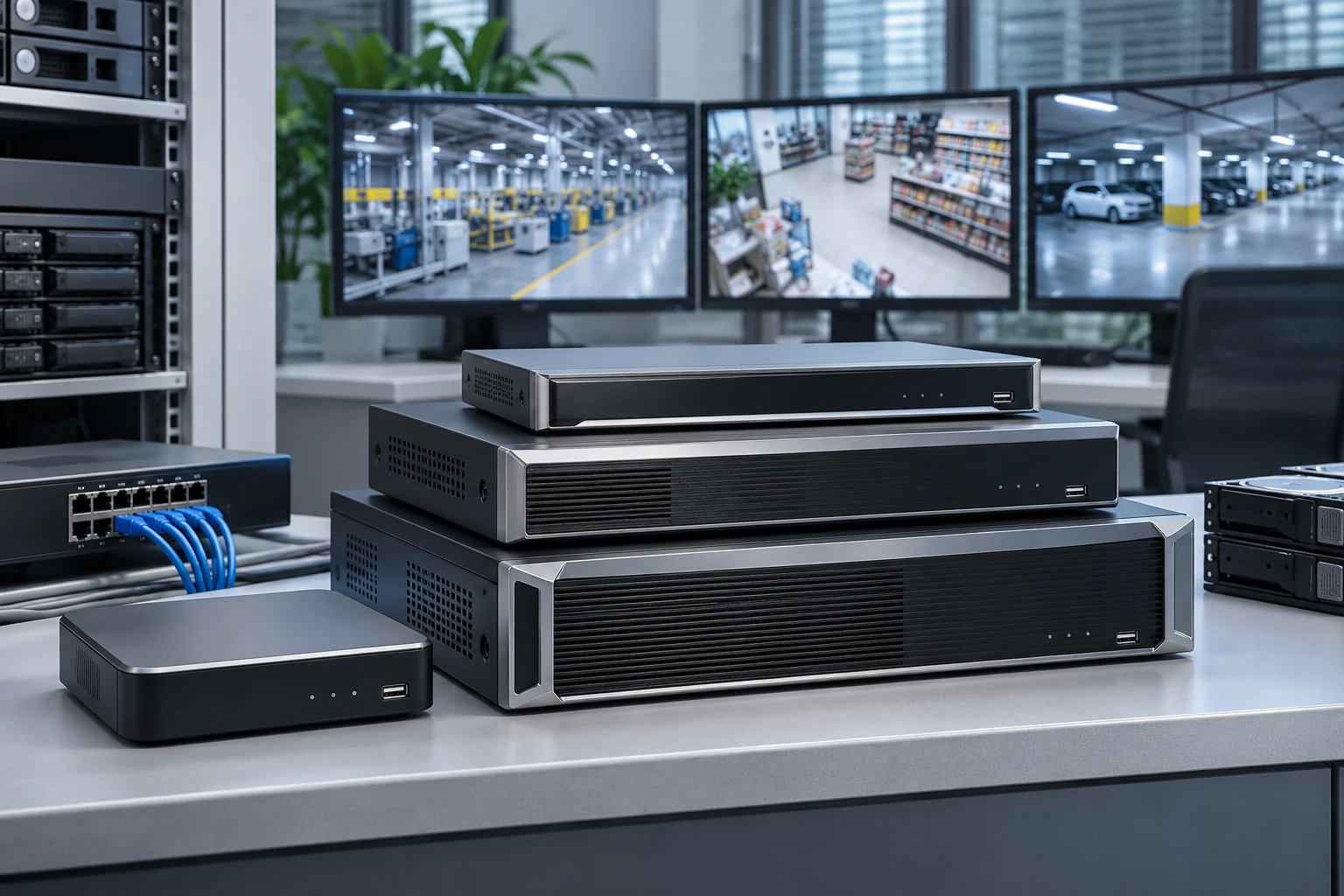
Hikvision NVR recorders are network-based video recording systems designed to record, manage and view video streams from IP security cameras. Suitable for a range of settings, from small businesses to industrial facilities with many cameras, these devices are divided into different product families according to channel count, video-processing capacity, storage infrastructure and AI features.
Hikvision’s NVR portfolio includes entry-level budget models, as well as AcuSense-enabled recorders, the high-capacity Ultra series, DeepinMind models with advanced video analytics, and next-generation VPro systems with AcuSeek.
However, two Hikvision NVR models with the same number of channels may not deliver the same recording and viewing performance. Incoming bandwidth, video decoding capacity, the number of SATA drive bays, built-in PoE connections and AI functions that can run on the device create significant technical differences.
What Is a Hikvision NVR and How Does It Work?
An NVR (Network Video Recorder) is a device that transfers digital video streams received from IP cameras over an Ethernet network to a recording medium and manages them centrally.
In a typical Hikvision IP camera system, video is encoded by the camera and sent over the network to the recorder. The NVR stores the video and provides live viewing and playback of recorded footage.
Depending on the model, NVR devices may provide the following features:
Recording IP camera video continuously 24/7 or based on events.
Processing H.264, H.265 and, on supported models, H.265+ video streams.
Local monitor connection via HDMI and VGA.
Powering IP cameras through built-in PoE ports.
Supported remote access and management features through Hik-Connect.
Motion detection and classification of people and vehicles.
On supported models, facial analysis, perimeter protection and smart search of recordings.
Monitoring of hard-drive, network and system faults.
When selecting an NVR, assess not only how many cameras can be connected, but also whether the system can record continuously at the target resolution and frame rate.
What Are the Hikvision NVR Series?
Hikvision offers several NVR product families for different security projects.
1. Hikvision Value Series NVR Models
The Value series comprises budget-friendly NVR devices focused on basic IP camera recording requirements.
This series may be suitable for homes, small offices, shops and projects using a limited number of IP cameras.
Example models:
DS-7104NI-Q1/4P — 4 channels, with 4 built-in PoE connections.
DS-7108NI-Q1/M — 8 channels, an entry-level NVR with a single SATA bay.
DS-7108NI-Q1/8P/M — 8 channels, with 8 built-in PoE connections.
For the DS-7108NI-Q1/M model, the manufacturer specifies incoming bandwidth of up to 60 Mbps and one SATA drive connection.
The main advantage of the Value series is its ability to meet the recording needs of small systems with limited hardware complexity.
However, as the number of high-resolution cameras, simultaneous video-decoding requirements and need for storage expansion increase, upgrading to more advanced series may be necessary.
2. Hikvision Pro Series NVR Models
The Pro series comprises recorders that offer more advanced video management and a range of hardware options compared with entry-level products.
The product family includes models with different resolution support, channel capacities, PoE connections and disk configurations.
They may be suitable for medium-sized businesses, retail chains and professional CCTV projects.
However, do not assume that all Pro series models have the same AI or storage features.
3. Hikvision AcuSense NVR Models
Hikvision NVR devices with AcuSense offer video analytics that help distinguish people and vehicles from other moving objects.
Under suitable image conditions, this technology may help reduce some unwanted motion alerts caused by environmental effects such as moving leaves and rain.
Example models:
DS-7608NXI-K2/8P(D)
DS-7616NXI-K2/16P(D)
DS-7732NXI-K4(D)
DS-7608NXI-K2/8P(D) offers 8 IP camera channels, 8 built-in PoE ports, incoming bandwidth of up to 80 Mbps and two SATA drive bays.
DS-7616NXI-K2/16P(D), by contrast, is intended for projects requiring more cameras, with 16 camera channels, 16 PoE ports and incoming bandwidth of up to 160 Mbps.
The point to note with AcuSense systems is that AI analysis performed on the NVR and analysis performed on the camera have different capacity limits.
For example, do not assume that a 16-channel AcuSense NVR can perform all AI analyses on the device across all channels simultaneously. The manufacturer’s datasheet values for AI by NVR and AI by Camera separately.
4. Hikvision Ultra Series NVR Models
The Ultra series comprises professional NVR devices developed for high camera capacity, powerful video processing and extensive storage requirements.
Products in this series may be suitable for large industrial facilities, shopping malls, campuses, hotels and security centers with many cameras.
Example model: DS-9664NI-M8
Key specifications stated by the manufacturer:
64 IP camera channels.
Incoming bandwidth of up to 400 Mbps.
Outgoing bandwidth of up to 400 Mbps.
8 SATA drive connections.
8K video output in supported configurations.
Multi-monitor and advanced recording-management options.
These features make the DS-9664NI-M8 a noteworthy option for high-capacity recording projects.
However, a high channel count does not mean that all cameras can be decoded simultaneously at maximum resolution. The product’s decoding capacity and disk-write performance should also be assessed.
5. Hikvision DeepinMind NVR Models
DeepinMind is Hikvision’s product family for advanced AI and video analytics.
Supported devices in this group may include features such as facial analysis, perimeter protection, video structuring and smart search.
Example model: iDS-7716NXI-M4/X
According to official technical information, this model:
16 IP camera channels.
256 Mbps incoming bandwidth.
4 SATA disk interfaces.
Facial analysis and comparison under supported conditions.
Perimeter protection analytics.
Video structuring.
AcuSearch support.
and similar features.
DeepinMind devices may be suitable for systems that need to perform certain video analytics centrally in addition to recording.
The ability to run AI functions simultaneously may vary depending on the enabled analytics engines and camera resolution.
6. Hikvision VPro and AcuSeek NVR Models
Hikvision’s next-generation VPro series highlights AI functions designed to make searching video recordings faster.
AcuSeek technology helps users search recordings in supported systems, using natural language to look for specific characteristics of people, vehicles or objects.
For example, in suitably configured systems, a recording search can be based on the characteristics of the described target rather than being limited to specific time ranges.
Example model: DS-7608NXI-K1/VPro
8 IP camera channels.
Incoming bandwidth of up to 80 Mbps.
One SATA drive connection.
Supported AcuSearch and AcuSeek functions.
Video analytics focused on people and vehicles.
Using AcuSeek across all channels may require compatible cameras, activation of the relevant features and an appropriate system configuration.
Therefore, purchasing an AcuSeek-enabled NVR does not guarantee that the same advanced search capabilities can be used with all existing IP cameras.
Technical Comparison Table of Hikvision NVR Models
The table below compares specific model variants listed in Hikvision’s official product information.
Hikvision NVR model | Channels | Incoming bandwidth | SATA | Built-in PoE |
|---|---|---|---|---|
DS-7104NI-Q1/4P(D) | 4 | 40 Mbps | 1 | 4 ports |
DS-7108NI-Q1/M(D) | 8 | 60 Mbps | 1 | None |
DS-7608NXI-K2/8P(D) | 8 | 80 Mbps | 2 | 8 ports |
DS-7616NXI-K2/16P(D) | 16 | 160 Mbps | 2 | 16 ports |
DS-7732NXI-K4(D) | 32 | 256 Mbps | 4 | None |
DS-7608NXI-K1/VPro | 8 | 80 Mbps | 1 | None |
iDS-7716NXI-M4/X | 16 | 256 Mbps | 4 | None |
DS-9664NI-M8 | 64 | 400 Mbps | 8 | None |
Important notes about the table: Bandwidth figures are upper limits stated by the manufacturer. The number of SATA connections does not directly indicate the total usable recording capacity. The supported capacity per drive should be verified separately against the product revision and the manufacturer’s compatibility list. Models without built-in PoE can work with IP cameras through suitable network switches.
Specifications may vary between different hardware revisions or regional variants of the same product. Before purchase, check the complete model code and the current product datasheet.
What Do Hikvision NVR Model Codes Mean?
The model codes used on Hikvision recorders provide some clues about the product’s capacity and hardware features.
For example, in the DS-7616NXI-K2/16P model:
DS: A prefix used in Hikvision product naming.
76: The model group that identifies the NVR product family in this example.
16: Indicates the product’s 16-channel variant.
NXI: Used in this product family’s naming for AI-enabled NVRs.
K2: Indicates a configuration in the relevant K series with two SATA connections.
16P: Indicates that this variant has 16 built-in PoE connections.
Suffixes such as (D), (E), /S, /X or /VPro on some products may identify differences in hardware, software or product family.
However, these suffixes should not be assumed to have one fixed meaning across all Hikvision products. Specifications should be verified using the complete product code.
Which Technical Specifications Should You Check When Choosing a Hikvision NVR?
1. Camera channels and incoming bandwidth
The number of cameras supported by an NVR indicates only one capacity limit of the system.
For example, if each of 16 IP cameras generates a 4 Mbps video stream, the average total data flow is:
16 × 4 Mbps = 64 Mbps
This is the result.
An appropriate operating margin should be allowed above this load. High-resolution cameras, multiple video streams and variable bit-rate use can particularly increase bandwidth requirements.
2. Video decoding capacity (Decoding)
The number of cameras an NVR can record is not the same as the number of high-resolution video streams it can display on a monitor simultaneously.
For example, a 16-channel NVR may record from 16 cameras but may not be able to decode the 4K main streams from all of them simultaneously on a local monitor.
Therefore, the manufacturer’s Decoding Capability table should be checked.
3. HDD capacity and SATA connections
Hikvision NVRs may have one, two, four, or eight drive bays, or more in certain professional models.
When calculating storage capacity, take into account the number of cameras, video bit rate, frame rate, recording duration, audio recording, and recording method.
A higher number of drive bays alone does not guarantee a longer recording duration. The capacity of the drives in use, drive support, and any RAID configuration are important.
For details on calculating recording duration and bandwidth, see GüvenlikOnline’s NVR Selection: A Guide to Channels, Bandwidth, and HDDs article.
4. PoE Ports and Power Budget
NVR models with built-in PoE can supply power, as well as a data connection, to compatible IP cameras.
However, having 8 or 16 PoE ports on an NVR does not mean that all ports can support their maximum power draw simultaneously.
The total PoE power budget should be verified when PTZ cameras, devices with IR illumination, or specialized cameras with high power requirements are used.
5. Artificial Intelligence Features
The artificial intelligence capabilities of Hikvision NVR models vary by product family and hardware capacity.
AcuSense focuses on human and vehicle classification, while DeepinMind can offer more advanced video analytics. VPro/AcuSeek emphasizes advanced recording search in compatible systems.
What matters is not merely whether an AI feature is available, but also the resolution and number of channels at which it operates, and which camera models it works with.
6. ONVIF and Third-Party Camera Compatibility
Integration of third-party IP cameras with Hikvision NVR devices depends on supported protocols and product compatibility.
ONVIF support does not mean that all camera features will work fully.
Compatibility of live view, recording, main stream, substream, audio, motion events, and AI metadata should be tested separately.
Integration testing before installation is recommended, particularly for professional projects using IP cameras from different manufacturers.
Which Projects Are Hikvision NVR Series Suitable For?
Project type | Series to consider | Primary requirement |
|---|---|---|
Homes and small offices | Value | Basic IP recording |
Small retail store | Value or Pro | Cost-effective recording and PoE |
Medium-sized business | Pro / AcuSense | Incident management, human/vehicle analytics |
Warehouse and manufacturing facility | AcuSense / Ultra | Multi-camera recording, capacity |
Shopping mall and large campus | Ultra | High bandwidth and storage |
Advanced video analytics project | DeepinMind | Centralized AI analytics |
Smart video search requirement | VPro / AcuSeek | Compatible camera and recording search infrastructure |
This table is a preliminary assessment guide. It does not constitute a definitive model selection for a specific facility. For every project, the number of cameras, recording quality, viewing workstations, disk requirements, and security policies should be considered together.
Technical Checklist for Hikvision NVR Installation
The following checks are recommended for a professional Hikvision NVR installation:
- Have the number of cameras and future expansion requirements been determined?
- Has the total incoming video bandwidth been calculated?
- Have the main stream and substream resolutions been checked?
- Has the video decoding capacity required for the local monitor been verified?
- Have HDD recording duration and total capacity been calculated?
- If PoE is built in, have the port and total power budgets been checked?
- Have the channel limits for AI analytics on the cameras and NVR been verified?
- Have ONVIF and third-party camera compatibility been tested?
- Have the latest firmware, user permissions, and network security been configured?
- Have live viewing, recording playback, and export tests been completed?
Especially in large systems, it is important to conduct site acceptance tests using actual camera streams rather than selecting a recording device solely by consulting its technical data sheet.
Frequently Asked Questions About Hikvision NVR Models
How many channels do Hikvision NVR models have?
Hikvision’s product portfolio includes 4-, 8-, 16-, 32-, and 64-channel models, as well as recording solutions for different scales and architectures. Channel capacity should be verified against the full model number.
Do Hikvision NVR devices support H.265+?
Supported Hikvision NVR models can work with H.265+ video streams. However, both the camera and the recording device must support the relevant encoding method. The storage savings achieved with H.265+ vary depending on video content and system settings.
What is the difference between an AcuSense NVR and a standard NVR?
Under suitable conditions, AcuSense-enabled models can classify events with a focus on people and vehicles. Standard NVR models may focus primarily on basic video recording and management needs. Exact features depend on the model.
Can Hikvision NVR record without an internet connection?
Yes. Recording without an internet connection is possible in properly configured systems, as long as the IP cameras and NVR can operate on the same local network. Internet access may be required for remote access and certain online services.
Can cameras from other brands be connected to Hikvision NVR devices?
Some third-party IP cameras that support compatible network protocols and the relevant ONVIF profiles can be connected. However, compatibility of live viewing, recording, and advanced event features should be tested according to the model and software version.
Conclusion: How to Choose the Right Hikvision NVR Model
The Hikvision NVR product family offers options for a range of use cases, from basic IP camera recording to advanced artificial intelligence analytics.
The Value series may be considered for small systems, AcuSense models for projects requiring more advanced event analysis, the Ultra series for high-capacity recording infrastructure, and DeepinMind or VPro models for advanced video analytics requirements.
However, the product series or number of channels alone does not determine the right NVR choice. Incoming bandwidth, video decoding performance, HDD capacity, PoE power budget, camera compatibility, and actual site conditions should all be assessed together.
For more information about Hikvision’s other camera technologies and security solutions, see the Hikvision Camera Systems and Technologies Guide and the Hikvision Hardware Catalog can be consulted.