
AI-Powered Video Analytics Solutions for Occupational Health and Safety
How do AI-powered video analytics systems contribute to occupational health and safety? We examine hard-hat and reflective-vest checks, forklift–pedestrian proximity, hazardous-zone violations, fall detection, and monitoring of industrial risks in light of technical criteria, field validation, and KVKK requirements.
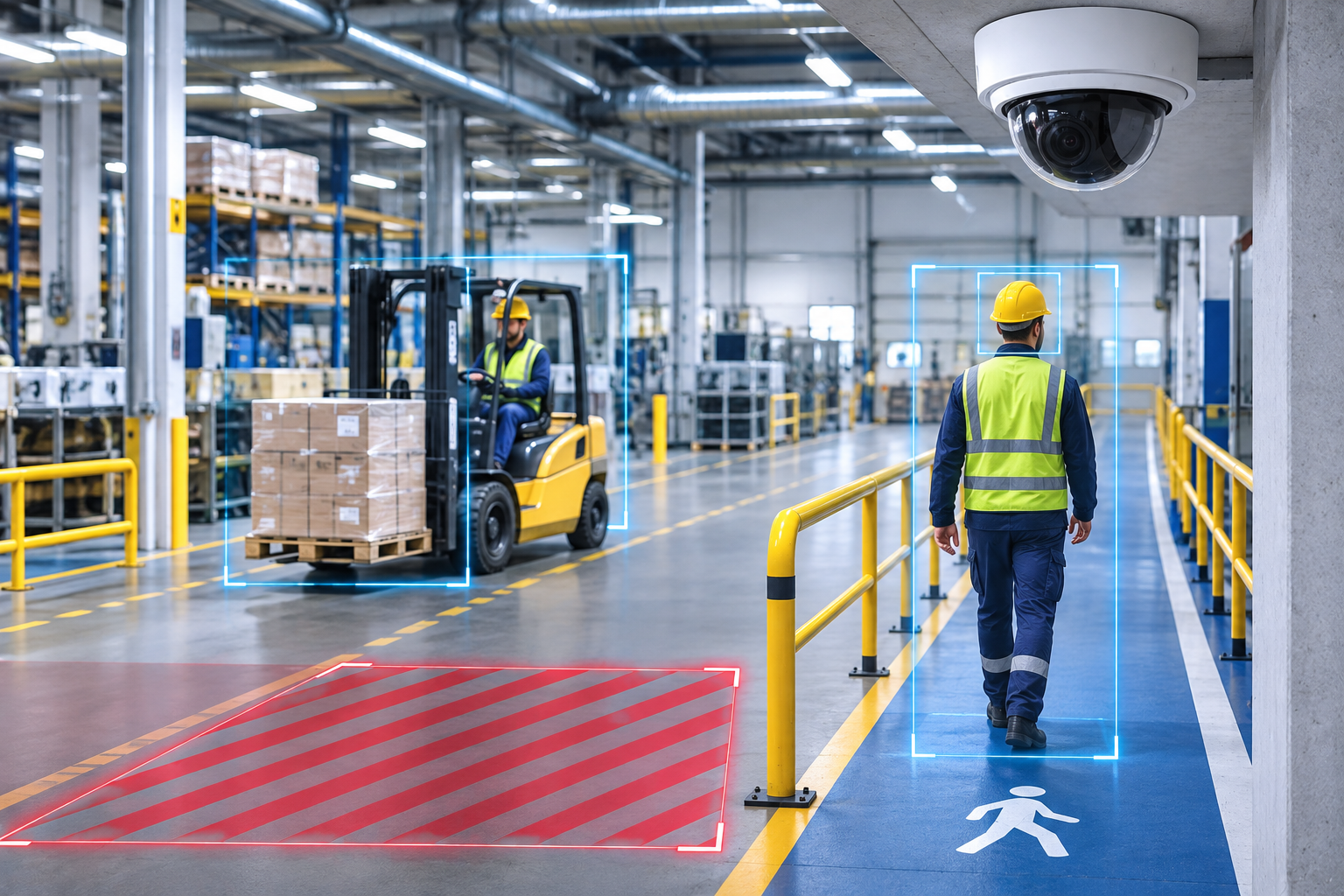
Occupational health and safety (OHS) comprises preventive activities aimed at protecting employees from workplace accidents and occupational diseases. In addition to traditional safety measures, digital technologies are also used to manage risks encountered at industrial facilities, factories, warehouses, logistics centers, and production sites.
AI-powered video analytics systems process images from security cameras using computer vision algorithms and can help detect specific hazardous situations or predefined events.
Examples include identifying a person not wearing a protective hard hat in a production area, detecting a pedestrian entering a forklift route, or detecting unauthorized entry into a hazardous area.
These technologies can provide occupational safety teams with faster information about specific events and make it easier to investigate risky situations.
However, video analytics systems do not replace the risk assessments, physical protective measures, machine safety systems, or employee training required under occupational health and safety regulations. Video analytics solutions should be regarded as complementary technologies that support existing OHS management.
What Is Video Analytics for Occupational Health and Safety?
Video analytics for OHS is the automated evaluation of camera footage according to specific workplace safety scenarios.
While traditional CCTV systems primarily provide viewing and recording, video analytics systems can classify objects and events in an image according to specific rules.
In this context, suitable algorithms can be used to detect:
Visual indicators related to the use of personal protective equipment,
Hazardous proximity between people and vehicles,
Entry into prohibited or controlled areas,
Certain fall-like events,
The presence of people around moving equipment,
Certain indicators of flame and smoke
These algorithms can be used to detect such conditions.
Not all of these functions are available in every camera or analytics software.
OHS video analytics projects should first identify which risk is to be monitored, then select the algorithm and imaging infrastructure suited to that risk.
How Do AI-Powered OHS Video Analytics Systems Work?
1. Capturing Camera Footage
The system receives a video stream from an IP security camera or another supported image source.
Image resolution, lens characteristics, frame rate, mounting angle, and lighting conditions affect analytics performance.
2. Human and Object Detection
The AI algorithm attempts to detect people, forklifts, vehicles, or specific types of personal protective equipment in the image.
This process is generally carried out using trained object-detection and classification models.
3. Analysis of Risky Situations
Detected objects are compared with predefined rules.
For example:
A person believed to be without a hard hat entering a designated area,
A pedestrian in a forklift route,
Crossing the boundary of a controlled area,
Detection of a particular falling movement
These types of events can be assessed.
4. Generating an Alert
When a defined condition occurs, the system can generate an alert or event record, depending on the integrations it supports.
These notifications can be sent to a security control center, authorized OHS personnel, or suitable incident-management software.
5. Reviewing Events
Authorized personnel can assess generated alerts and investigate whether an event posed a genuine hazard.
The system's findings can therefore be used in risk assessment, site inspections, and corrective-action processes.
Applications of Video Analytics Systems for OHS
Personal Protective Equipment (PPE) Detection
Personal protective equipment analytics aims to assess from images whether specific equipment is being worn by an employee.
With suitable algorithms, the following equipment can be analyzed:
Protective hard hat
Reflective vest
Certain types of protective eyewear
Some types of gloves and masks
Certain workwear
However, it should not be assumed that every software package supports all of this equipment.
Detecting small objects such as gloves and protective eyewear can be more difficult than detecting hard hats or reflective vests.
Detecting in an image that an employee is wearing a hard hat does not guarantee that the hat is suitable for the relevant hazard, undamaged, or being worn correctly.
Video analytics systems should therefore not be presented as solutions that automatically carry out the entirety of PPE compliance inspections.
Forklift–Pedestrian Proximity Analysis
In factories and logistics centers, forklifts and pedestrians sharing the same areas can create significant safety risks.
At suitable camera positions, video analytics systems can detect people and forklifts and assess simultaneous entry into particular zones or proximity in the image plane.
For example, an alert can be sent to the operator when a pedestrian enters an area designated as a forklift route.
However, with a single standard 2D camera, the actual physical distance between objects that appear close together in the image cannot always be determined reliably.
If actual distance or collision risk is to be calculated, camera calibration, perspective transformation, depth information, or suitable additional sensors may be needed.
In safety-critical applications intended to prevent forklift collisions, standard CCTV analytics alone should not be relied on; appropriate engineering measures, traffic segregation, and necessary safety systems should be the basis.
Hazardous-Zone Violation
Video analytics systems can be used to detect people entering designated areas.
For example:
Around robot work cells,
Controlled machine areas,
Loading and unloading areas,
Specific sections of high-voltage facilities,
Technical areas where unauthorized access is restricted
Virtual zones can be defined for these areas.
However, video-based zone-intrusion detection does not replace certified light curtains, safety laser scanners, interlocked guards, or safety control systems used in machine safety.
Fall and Inactivity Analysis
Some AI-powered video analytics solutions attempt to detect fall-like events by using changes in a person's posture and movement in the image.
In suitable work areas, such systems can help certain events be noticed more quickly.
However, fall-detection algorithms may not always correctly distinguish an actual fall from bending, sitting, or lying down.
Furthermore, a person appearing motionless in an image does not mean that their health condition has been determined with certainty.
These systems should be assessed alongside emergency procedures in particular.
Flame and Smoke Analysis
Some specialized video analytics systems can detect signs of flame or smoke in images.
In large industrial areas, they can support early detection of incidents in locations with suitable camera coverage.
However, a standard AI camera's ability to detect smoke-like images does not mean it can be used instead of a certified fire-detection system.
Fire safety projects should be based on the relevant legislation, standards, and required conformity assessments.
Comparison of OHS Video Analytics Technologies
Type of analysis | Purpose | Key technical limitation |
|---|---|---|
Hard-hat detection | Visual check of hard-hat use | Occlusion, viewing angle, and inability to verify correct equipment use |
Reflective-vest detection | Detection of specific workwear | Lighting and similarly colored clothing |
Forklift–pedestrian analysis | Identifying risky interactions in shared areas | Actual distance and movement estimation |
Hazardous-zone violation | Detecting people entering a designated zone | Blind spots and missed events |
Fall analysis | Identifying fall-like events | False positives and missed falls |
Flame/smoke analysis | Detecting visual signs of fire | Viewing conditions and suitability for fire-system use |
This comparison is intended to help with technology selection. Definitive performance values should be determined according to the product, site conditions, and validation results.
Can Existing Security Cameras Be Used for OHS Video Analytics?
Yes. Under suitable technical conditions, footage from existing IP security cameras can be processed using external video analytics software.
However, not every existing camera is suitable for every OHS scenario.
For example, a security camera covering a large factory floor may provide adequate footage for general person and vehicle detection, but not enough detail to detect a small pair of protective glasses.
Camera Placement
The camera should capture the area to be analyzed and the target object from a suitable angle.
For hard-hat checks, it is important for the person's head to be visible.
For forklift–pedestrian analysis, routes of movement and risk areas must be covered adequately.
Lens and Pixel Density
The number of pixels occupied by a target object in an image is one factor affecting analytics performance.
However, high pixel density alone does not mean that AI analysis will be successful.
Particularly for PPE detection, manufacturers' tests should verify the size and viewing angles at which the algorithm can recognize the target equipment.
Edge AI and Server-Based Analytics
In some systems, analytics are performed directly on the camera.
This approach is called Edge AI.
Other solutions process video streams from existing IP cameras on a central server.
With suitable software and processing capacity, a server-based architecture can make it possible to leverage existing camera infrastructure.
However, software licenses, GPU capacity, network bandwidth, and integration requirements must be calculated.
Can Video Analytics Systems Prevent Workplace Accidents?
Video analytics systems can support preventive workplace safety activities by making certain risky situations easier to detect.
However, an algorithm detecting a hazardous situation does not mean that a workplace accident will necessarily be prevented.
For example, the system can generate an alert when it detects a pedestrian on a forklift route.
The alert's contribution to accident prevention depends on detection time, delivery of the warning, the operator's response, and physical safety measures at the site.
Video analytics systems should therefore be regarded as auxiliary control mechanisms that can contribute to risk reduction.
Field Validation
A sample validation plan includes:
Define the risk to be monitored and the event to be detected.
Verify the camera's field of view and the analysis zone.
Prepare safe, controlled test scenarios.
Have authorized personnel record reference events.
Compare the results generated by the algorithm.
Analyze false and missed alerts.
Assess daytime, nighttime, and different operating conditions.
Report results against the acceptance criteria.
Update system settings if required.
Plan periodic performance checks.
Actual hazardous situations must not be created during testing, and machine safety measures must not be disabled.
Alert Management in OHS Video Analytics Systems
Detecting a risky event is only the first stage of the system's operation.
The alert must reach the right person on time, and an appropriate response procedure must be in place.
Professional projects should assess the following:
The conditions under which an alert will be generated
Which personnel will receive the notification
Alert priority level
Operator verification procedure
Retention of event records
Management of recurring alerts
Behavior in the event of system failure or loss of connection
Corrective actions to be taken after an alert
In critical areas in particular, alert delay and missed events should be measured during field testing.
What Facilities Use OHS Video Analytics Systems?
Factories and Production Facilities
Hard-hat checks, controlled-area violations, and certain visual indicators of human–machine interactions can be analyzed.
Warehouses and Logistics Centers
Forklift–pedestrian movements, loading areas, and certain safety zones can be monitored.
Construction Sites
With suitable camera placement, certain PPE use and controlled-zone violations can be assessed.
However, video analytics cannot be used instead of fall-protection systems for work at height.
Energy and Industrial Infrastructure
Unauthorized entry into areas, certain site movements, and suitable visual risk scenarios can be analyzed.
Ports and Heavy Industry Facilities
Visual analytics in areas where pedestrian and vehicle movements intersect can help assess operational risks.
OHS Video Analytics Systems and KVKK
Using video analytics in workplaces may involve processing employees' personal data.
KVKK obligations should be assessed, particularly when individuals' images are recorded, their individual behavior is monitored, or events are associated with specific employees.
Data Minimization
Collection of personal data that is not required for OHS purposes should be avoided.
For example, if the only requirement is to detect a person entering a hazardous zone, facial recognition or individual identification may not be necessary in every case.
Duty to Inform
If personal data is processed, the relevant data subjects must be informed within the framework of Article 10 of KVKK.
Continuous Monitoring of Employees
Expanding a system used for OHS so that it continuously assesses employees' performance or individual movements may give rise to different personal-data processing risks.
Data-processing purposes should therefore be clearly defined, and the principle of proportionality should be taken into account.
Cloud and Third-Party Transfers
If video footage or analysis data that can be associated with an individual is transferred to cloud infrastructure, data-processor relationships and, where necessary, the conditions for transferring data abroad should be assessed.
Regulatory Status of OHS Video Analytics Systems in Türkiye
The fundamental legal framework for occupational health and safety in Türkiye is Occupational Health and Safety Law No. 6331.
Employers must conduct or commission risk assessments, take the necessary measures, inform employees, and fulfill the relevant OHS obligations.
Installing an AI-powered video analytics system does not remove these obligations.
Risks must also be identified and control measures planned under the Regulation on Risk Assessment in Occupational Health and Safety.
Video analytics systems should therefore be treated as one of the appropriate complementary measures identified through risk assessment.
What to Consider When Selecting an OHS Video Analytics System
Selection criterion | Point to check |
|---|---|
Risk scenario | Which hazard or event will be detected? |
Algorithm | Is the relevant object and event class supported? |
Camera | Is the target visible in sufficient detail? |
Night performance | Has it been tested under actual operating conditions? |
False alarms | Have FP and FN results been measured? |
Integration | Is it compatible with VMS and incident-management systems? |
Alert delay | Has the time from event to notification been measured? |
Cybersecurity | Are access, encryption, and update processes adequate? |
KVKK | Have data-processing and retention policies been defined? |
Validation | Has a field test been conducted against acceptance criteria? |
This table is intended for preliminary technical assessment. The final system design should be developed in conjunction with the facility's risk assessment and relevant engineering requirements.
Technical Checklist for OHS Video Analytics Systems
- Have the hazards to be monitored been identified in the OHS risk assessment?
- Has the complementary role of video analytics been defined?
- Have camera placement and target visibility been verified?
- Has it been checked that the algorithm supports the relevant PPE or risk scenario?
- Have false-positive and false-negative results been measured?
- Have alert delay and the operator response process been tested?
- Has integration with the existing VMS and incident-management systems been verified?
- Have the limits of operation independently of machine safety systems been defined?
- Have KVKK and data-security requirements been assessed?
- Have periodic calibration, validation, and maintenance been planned?
Frequently Asked Questions
Can AI cameras detect employees who are not wearing hard hats?
Certain cases of hard-hat use can be detected with a suitable algorithm and imaging conditions. However, each product performs differently, and results should be verified through field testing.
Can existing security cameras be used for OHS analysis?
IP cameras with suitable resolution, viewing angle, and software compatibility can be used. However, not every camera is adequate for every type of analysis.
Can forklift–pedestrian collisions be prevented with video analytics?
Video analytics can detect certain risky approaches and issue alerts. However, it does not guarantee that collisions will be prevented and does not replace necessary physical safety measures.
Do video analytics systems completely prevent workplace accidents?
No. These systems can help identify certain hazardous situations. Preventing workplace accidents requires comprehensive risk management and appropriate control measures.
How is accuracy measured in OHS video analytics systems?
True-positive, false-positive, and false-negative events are measured by comparing actual events with system results. Metrics such as Precision, Recall, and alert delay can be assessed.
Are video analytics systems used for OHS subject to KVKK?
If images or other data relating to identified or identifiable individuals are processed, KVKK provisions apply. The purpose and legal basis of processing, the duty to inform, and security requirements should be assessed.
Conclusion: What Determines Success in OHS Video Analytics Systems?
AI-powered video analytics solutions can contribute to monitoring certain workplace safety risks and assessing incidents more quickly at industrial facilities.
Applications such as PPE detection, forklift–pedestrian analysis, hazardous-zone violation detection, and fall detection address different risk scenarios.
However, a system's success depends on more than the sophistication of its AI algorithm.
Correct camera placement, a suitable analytics model, alert management, field validation, data security, and OHS procedures should all be considered together.
The best approach is not to use video analytics in place of existing safety measures, but as a complementary technology that helps risks be recognized earlier and preventive activities be supported.