
AI-Powered Security Cameras in Food Processing Plants: Hygiene, Production Safety and AI Video Analytics
How are AI-powered security cameras used in food processing plants? We examine AI video analytics, hygiene monitoring, detection of hairnets and workwear, foreign-object analysis, forklift safety, HACCP integration and KVKK requirements.
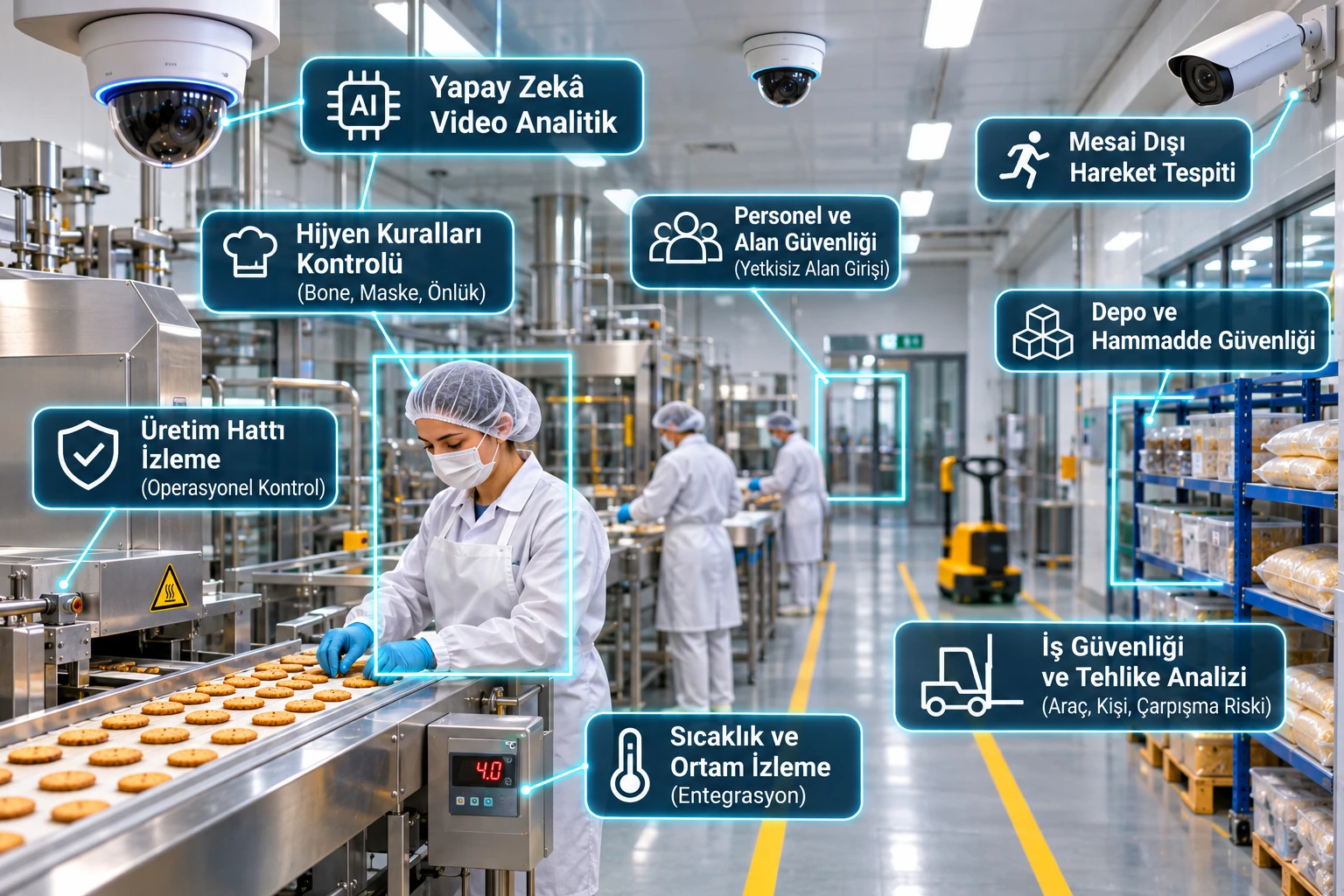
In food processing plants, security camera systems are assessed not only for monitoring theft and unauthorized entry, but also for securing production areas, protecting employees and detecting certain operational risks early. AI-powered video analytics can add capabilities to traditional CCTV infrastructure, such as object detection, motion analysis, visual checks for specific hygiene equipment and automated incident alerts.
Hygiene, product safety and production continuity are critical in diverse sectors, including meat, dairy, baked goods, ready meals, beverages, confectionery and packaged food.
For example, under certain conditions, suitable AI systems can detect when designated protective workwear is not being worn in a production area, when a forklift enters a pedestrian zone, or when an unauthorized person enters a controlled production area.
However, AI-powered security cameras do not replace food safety management systems or mandatory hygiene checks. Image analysis can assess only events that are visually detectable; it cannot by itself verify microbiological contamination, invisible allergen residues or that a product is safe.
Successful implementation requires considering camera placement, image quality, the analysis algorithm, the physical conditions of the production environment, field validation and personal data protection together.
What Is an AI-Powered Security Camera in Food Processing Plants?
An AI-powered security camera system is a hardware and software solution designed to detect specific objects and events by analyzing video footage from food production facilities using computer vision algorithms.
Depending on the system architecture, analysis can be performed directly in the camera, on a local AI analytics device or on a central server.
The main applications include:
Detecting unauthorized entry into production areas
Detecting people, vehicles and forklifts
Visual checks for hairnets, masks or specific protective equipment
Tracking entry into controlled hygiene zones
Detecting violations involving forklift and pedestrian areas
Analyzing visible product or packaging defects on packaging lines
Visually detecting specific foreign objects
Warehouse and dispatch security
Analyzing out-of-hours movement and perimeter violations
Searching video recordings by incident
Not all these functions are available in a standard AI security camera. Some applications require specially trained algorithms, industrial imaging equipment or separate machine vision systems.
How Do AI Camera Systems Work in Food Production Facilities?
1. Capturing Images
IP security cameras or specialized industrial cameras capture images of designated areas.
Camera selection should be based on the production line layout, ambient temperature, humidity, washdown procedures and the size of the objects to be captured.
2. Object Detection
The AI algorithm classifies the supported objects in the image.
For example:
People
Forklifts
Pallets
Vehicles
Specific occupational safety equipment
Products and packaging
can be detected.
However, it should not be assumed that a standard person-detection algorithm can detect hairnets, gloves or packaging defects.
3. Defining Analysis Rules
Specific security or operational rules are configured in the system.
For example, an alert can be generated when a pedestrian is detected on a forklift route or when someone enters a controlled production area outside working hours.
4. Detecting an Event
The algorithm analyzes the image and assesses whether the defined condition has occurred.
5. Generating an Alert
With suitable integration, a detected event can be sent to a VMS, NVR or alarm management system.
6. Verification by Authorized Personnel
The event is assessed by security, occupational health and safety, or quality assurance personnel.
An alert generated by AI is not definitive proof of a hygiene violation or food contamination. Decisions concerning product safety in particular should be based on validated procedures.
Applications of AI Cameras in Food Processing Plants
Checking Hygiene Equipment in Production Areas
In food production facilities, workers’ use of appropriate protective clothing is important for production hygiene.
Specific computer vision systems can be developed to check for the visible presence of the following equipment:
Hairnet
Beard cover
Mask
Apron
Protective workwear
Specific types of gloves
Shoe covers or appropriate footwear
However, seeing equipment through a camera does not guarantee that it is being used correctly or that all hygiene conditions are fully met.
For example, a worker wearing gloves does not mean that the gloves are clean. Likewise, detecting a hairnet in camera footage does not always verify that all the hair is properly covered.
Visual Analysis of Hand Hygiene Procedures
Some specialized video analytics systems can be developed to track specific movement patterns or procedural steps at handwashing stations.
However, image analysis cannot verify that hands have actually been cleaned or are microbiologically safe.
Hand hygiene analytics can therefore support training and procedure checks, but does not replace hygiene validation or other required checks.
Entry to Controlled Hygiene Zones
Production areas in food facilities can be divided into zones with different hygiene levels.
For example, specific personnel and equipment rules may apply when entering a production area requiring a high level of hygiene.
In suitable scenarios, AI cameras can detect entry events into controlled zones.
However, camera footage alone may not be sufficient to verify that a person has fully completed hygiene procedures.
Forklift and Pedestrian Safety
Forklifts and pallet trucks may be heavily used to move raw materials, packaging and finished products in food processing plants.
AI-powered cameras can analyze events such as:
Forklift detection
Pedestrian detection
Entry into a designated safety zone
A pedestrian on a forklift route
Controlled-area violations
and similar events.
However, camera-based warning systems should not be used in place of machine-guarding systems requiring safety certification, physical barriers or mandatory occupational safety measures.
Warehouse and Dispatch Security
The movement of products into and out of food warehouses, vehicle docking areas and controlled access points can be monitored.
Suitable video analytics systems can detect out-of-hours human movement or violations in designated areas.
Cold Storage Rooms
The choice of cameras and enclosures is especially important in cold storage rooms.
Low temperatures, condensation, ice formation and temperature fluctuations can affect image quality and device reliability.
The operating temperature, humidity resistance and suitable enclosure characteristics of the equipment to be used should therefore be verified against manufacturer documentation.
Can AI Detect Foreign Objects?
Foreign-object inspection in food production is an important aspect of product safety.
Some specialized industrial image-processing systems can help detect foreign objects visible on a product or production line.
For example:
Plastic pieces of a specific color and size
Visible packaging residue
Foreign objects on a surface
Visual defects in specific products
can be analyzed using suitable cameras and algorithms.
However, an important technical distinction must be made here.
A standard CCTV camera does not perform the same function as an industrial foreign-object detection system.
Foreign objects inside products or invisible in the image may not be detectable by an ordinary visible-light camera.
Comparing AI Cameras, Metal Detectors and X-Ray
Technology | Primary use | Limitation |
|---|---|---|
Standard AI CCTV | Area security and specific visual events | Does not verify foreign objects inside products |
Industrial machine vision | Visible surface defects and specific objects | Limited by field of view and optical properties |
Metal detector | Supported metal contaminants | Cannot detect non-metallic substances |
X-Ray inspection | Foreign objects distinguishable by X-rays | Limitations depend on material, density and product structure |
Hyperspectral imaging | Analysis of specific spectral differences | Application-specific calibration and cost |
Inspection systems used for food safety should be validated in accordance with defined hazards and acceptance criteria.
AI in Food Packaging Lines
AI-based image analysis on packaging lines can support specific visual quality checks.
Visual Inspection of Packaging Integrity
In suitable systems, specific tears, deformations or visible sealing defects can be detected.
However, a package that appears visually intact cannot be declared leakproof with certainty.
Label Inspection
Industrial imaging systems can assess whether a label is present, its position or any legible text.
OCR and specialized quality-control algorithms can be used for these tasks.
Product Counting
The number of packages or products can be counted automatically on certain production lines.
Rejecting Defective Products
With suitable automation integration, products with detected visual defects can be rejected.
However, the correct operation of the product rejection and separation mechanism must also be verified.
How Are AI-Powered Security Cameras Integrated with HACCP Systems?
HACCP is an abbreviation for Hazard Analysis and Critical Control Points.
In Turkish, it is rendered as Tehlike Analizi ve Kritik Kontrol Noktaları.
The HACCP approach is based on identifying food safety hazards and implementing appropriate control measures.
AI-powered camera systems can support the visual monitoring of specific procedures or the recording of incidents.
For example, specific protective clothing can be visually checked when entering a controlled hygiene area.
However, a camera system detecting such an event does not mean that the relevant HACCP critical control point has been validated.
The Difference Between HACCP and AI Video Analytics
Topic | HACCP / food safety management | AI video analytics |
|---|---|---|
Primary purpose | Control food safety hazards | Analyze visual objects and events |
Scope | Biological, chemical and physical hazards | Conditions the algorithm can detect visually |
Critical limit | Defined according to the hazard analysis | May be a visual alert threshold |
Validation | Through food safety procedures | Through algorithm and field testing |
Evidence of contamination | Depends on appropriate testing and inspection methods | Not sufficient on its own |
Decision-making authority | Authorized food safety personnel | Decision-support output |
An AI camera can be a supporting component of a properly designed food safety control system.
How Should Camera Placement Be Planned in Food Processing Plants?
In food production facilities, camera placement should not be determined solely by security coverage.
Production Areas
The camera should be positioned so that it does not interfere with production equipment or hygiene procedures.
Washdown Areas
In areas subject to high-pressure washing or heavy moisture, equipment should be selected with an appropriate protection rating and resistance to cleaning chemicals.
Packaging Lines
For visual quality inspection, camera angle, lighting, product speed and the size of the target defect should be assessed together.
Warehouses
The camera’s field of view should be determined with potential blind spots caused by racks and pallets taken into account.
Dispatch Areas
Moving objects and obstructions to the view should be assessed in areas where vehicles, people and loading operations are present.
Choosing IP Cameras for Food Production Facilities
IP Protection Rating
In damp or washdown areas, it is important for the camera to have an appropriate IP protection rating.
Ratings such as IP66, IP67 or IP69 indicate different exposure conditions to water and dust.
However, a high IP rating does not guarantee that a device is resistant to all cleaning chemicals.
Enclosure Material
Stainless steel or other suitable materials for food production environments can be considered.
Material selection should be based on cleaning and corrosion conditions.
Resolution
The image detail needed to detect people and vehicles differs from that required to detect small packaging defects.
Cameras should therefore not be selected solely on the basis of a high megapixel count.
Lens and Field of View
A wide field of view can cover larger areas, but may reduce pixel density for distant targets.
Frame Rate
FPS and exposure time are important on fast-moving production lines.
However, the frame rate, optics or triggering capability of standard CCTV cameras may be inadequate for industrial quality-control applications.
Lighting
Stainless steel surfaces, glossy packaging and transparent films can cause reflections in the image.
Controlled industrial lighting is therefore required for some quality-control applications.
Edge AI, AI NVR and Server Architectures in Food Facilities
Architecture | Application | Advantage | Limitation |
|---|---|---|---|
Edge AI camera | Area and perimeter security | Local analytics | Camera processing capacity |
AI NVR | Central recording and supported analytics | Existing CCTV integration | Channel and algorithm limitations |
GPU analytics server | Multiple cameras and specialized AI models | Flexible analytics capacity | Hardware and licensing costs |
Industrial vision system | Product and packaging quality control | Controlled imaging | Requires specialized integration |
Hybrid architecture | Large production facilities | Joint management of different tasks | Integration complexity |
Particularly for applications such as checking hygiene equipment and analyzing product defects, the requirements for standard camera analytics should be distinguished from those for specially trained models.
How Is Accuracy Measured in AI Camera Systems?
The performance of AI systems in food production facilities should not be assessed solely by the general accuracy percentage in the manufacturer’s catalogue.
Precision
Precision = TP / (TP + FP)
It assesses what proportion of events that triggered an algorithm alert were actually target events.
Recall
Recall = TP / (TP + FN)
It shows what proportion of actual target events were detected.
False Alarm Rate
False alarms can increase operational workload.
Missed Event Rate
Failure to detect real events can pose a critical risk, particularly in security and quality-control applications.
Production Line Delay
On high-speed lines, the detection result must be delivered to the product separation mechanism in time.
Field Validation
Performance measurements should be conducted under actual production conditions.
For example, a hairnet-detection algorithm should be tested with different hairnet colors, lighting conditions, head angles and visual obstructions.
AI Camera Systems and KVKK in Food Processing Plants
Security cameras in food production facilities may process employees’ personal data.
In Türkiye, the purpose, legal basis and proportionality of camera use should be assessed under Personal Data Protection Law No. 6698.
The statement on workplace camera use published by the Personal Data Protection Authority in 2026 draws an important distinction between keeping employees under constant performance surveillance and using cameras for specific security purposes.
Purpose of Camera Use
The security or operational purpose for which the camera system will be used should be clearly defined.
Continuous Monitoring of Employees
Using cameras to monitor employees’ productivity or discipline in a general and continuous manner may create legal risks.
Hygiene Monitoring
Using cameras to visually check specific hygiene equipment may also constitute the processing of personal data.
The necessity and proportionality of such use, its legal basis and less intrusive alternatives should therefore be assessed separately.
Private Areas
Cameras should not be installed in private areas such as toilets, changing rooms, prayer rooms and rest areas.
Audio Recording
Audio recording may be a separate and more intrusive form of personal data processing than video recording.
It should not be enabled automatically on general security grounds.
Retention Period
Camera recordings should not be retained longer than necessary.
Retention periods should be determined according to the specific purpose and applicable legal requirements.
Access Authorization
Only people whose duties and authority require it should be able to access the footage.
How Should an AI Security Camera Project Be Prepared for a Food Processing Plant?
1. Risk Analysis
The facility’s physical security, occupational safety and visual inspection needs are identified.
2. Separating Usage Objectives
Security surveillance, hygiene procedure analysis and product quality control are treated separately.
3. Camera Placement
Camera locations are planned with production processes and hygiene requirements in mind.
4. Algorithm Selection
Suitable algorithms are selected for functions such as detecting people, forklifts, protective equipment or product defects.
5. Image Quality
DORI, PPM, lens, resolution and lighting requirements are assessed.
6. Integration
Integration with NVR, VMS, alarms, access control and suitable production systems is planned.
7. Pilot Implementation
A limited-scope test is conducted under actual production conditions.
8. Validation
False alarms, missed events, detection delay and operational performance are measured.
9. Data Protection
KVKK, access authorization and retention policies are assessed.
10. Periodic Maintenance
The camera, analytics and recording infrastructure are checked regularly.
Technical Checklist
- Have the facility’s security and production risks been identified?
- Has the specific purpose of camera use been defined?
- Have security and quality-control applications been separated?
- Has the need to detect hygiene equipment been identified?
- Have forklift and pedestrian safety scenarios been created?
- Is the camera enclosure suitable for the production environment?
- Have cleaning and chemical resistance properties been verified?
- Have lens and PPM calculations been completed?
- Have daytime and different lighting conditions been tested?
- Has the algorithm’s real-world field accuracy been measured?
- Have false alarm and missed event rates been determined?
- Has the relationship with HACCP and quality assurance processes been defined?
- Has it been verified that the camera system is not being used in place of critical safety controls?
- Have KVKK requirements been assessed?
- Have periodic maintenance and revalidation been planned?
Frequently Asked Questions
What are AI-powered security cameras used for in food processing plants?
They can help detect specific security incidents, the movement of people and vehicles, and, in suitable systems, violations of specific visual hygiene or production procedures.
Can AI cameras detect whether employees are wearing hairnets?
Algorithms developed and tested appropriately can detect the visible presence of certain types of hairnets. However, not every camera supports this feature.
Can AI cameras monitor hand hygiene?
Specific movements or procedural steps can be analyzed. However, camera footage alone cannot verify that hands are microbiologically clean.
Can an AI camera detect foreign objects?
Certain visible foreign objects can be detected using specialized imaging systems. However, different inspection technologies may be needed for foreign objects hidden inside products.
Do AI cameras replace HACCP systems?
No. AI cameras can support specific visual checks, but they do not replace the HACCP system or the required validation processes.
Can AI cameras be used in cold storage rooms?
They can be used with cameras and enclosures that have suitable temperature and environmental resistance characteristics.
Can AI be added to existing CCTV cameras?
Some functions can be added using a suitable IP video stream, analytics server or AI NVR infrastructure. However, industrial imaging may be needed for specialized quality-control applications.
Is camera use in food production facilities compliant with KVKK?
Compliance depends on the system’s purpose of use, legal basis, proportionality and data security measures.
Conclusion
In food processing plants, AI-powered security camera systems can help visually analyze specific security and operational risks beyond the capabilities of traditional CCTV infrastructure.
Applications of these technologies include detecting people and forklifts, violations in controlled areas, visually checking certain protective equipment and analyzing visible defects on production lines.
However, food production is a sector with specific technical and hygiene requirements.
Standard security camera analytics should therefore not be confused with industrial quality-control systems.
The real benefits of AI systems come from the right use case, appropriate camera placement, algorithm validation, reliable integration and measurable performance.
The success of a professional AI camera project in a food facility should be assessed not only by its ability to detect incidents, but also by how well it supports production safety, manages false alarm risks and reliably complements food safety processes.