
AI-Powered Camera Systems in Currency Exchange Offices: AI Video Analytics and Security Guide
How do AI-powered camera systems work in currency exchange offices? We examine AI video analytics, teller and cash security, smart alarms, event-based recording search, DORI/PPM, the two-year recording retention requirement, and KVKK requirements.
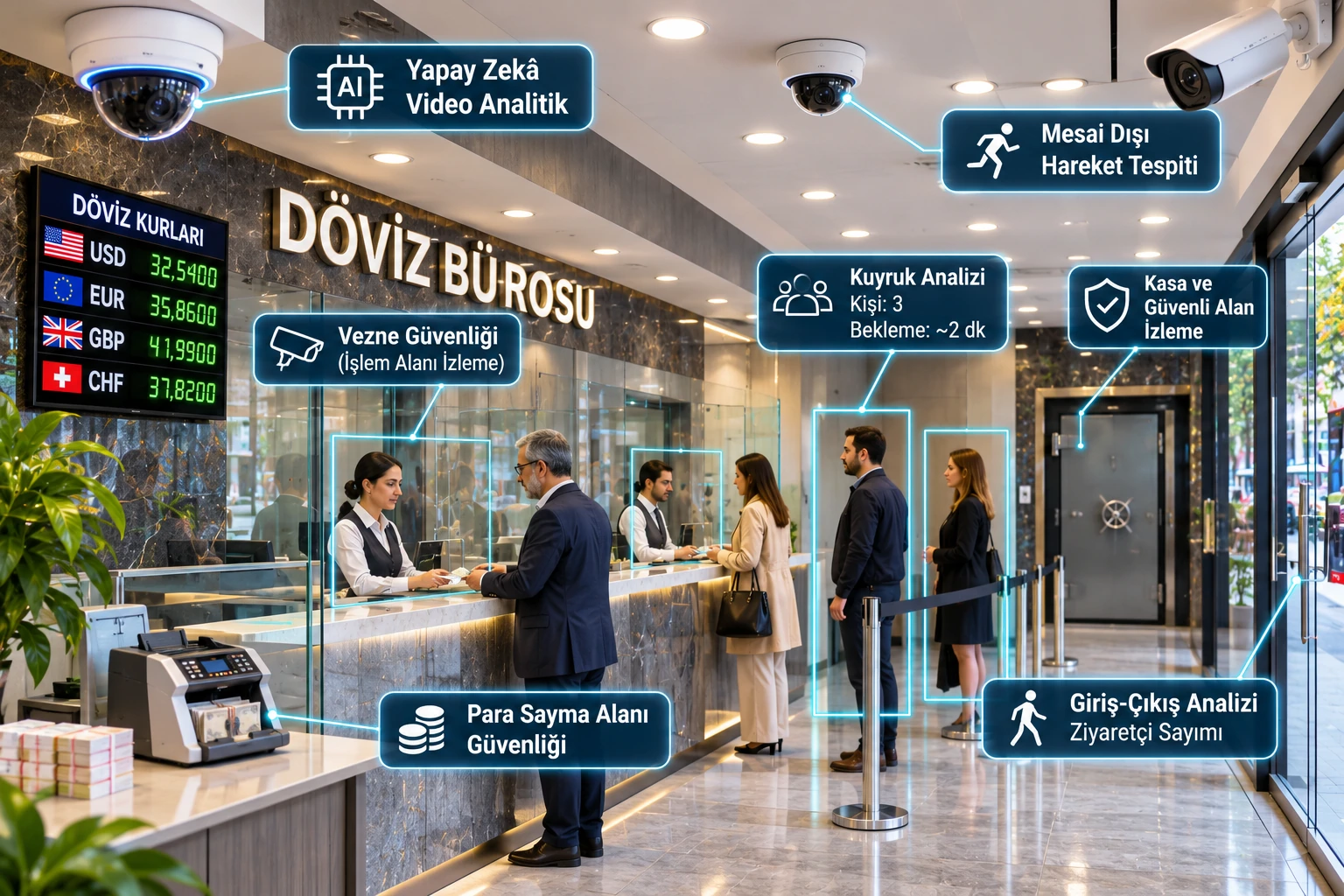
Currency exchange offices are financial businesses that handle high-value cash transactions, experience heavy customer and staff traffic, and must manage physical security alongside legal record-keeping obligations. Camera systems must therefore do more than capture incidents: they should also support transaction security, record integrity, and reliable access to past footage when needed.
While traditional CCTV systems provide viewing and recording, AI-powered security cameras can automatically analyze specific objects and events, offering security staff additional capabilities such as early alerts, smart alarm verification, and event-based video search.
AI-powered video analytics can be considered particularly for teller areas, cash-counting points, around the vault, customer entrances, and controlled staff areas.
It should not be assumed that AI cameras can determine with certainty a person's intent to commit a crime, reliably detect counterfeit money from standard CCTV footage, or predict every attempted robbery.
A professional security project for a currency exchange office should address camera placement, AI analytics accuracy, alarm integration, recording security, two-year archiving, and KVKK requirements together.
What Is an AI-Powered Camera System in Currency Exchange Offices?
An AI-powered camera system for a currency exchange office is an integrated security solution combining IP cameras, AI video analytics software, NVR/VMS recording infrastructure, and, where needed, alarm or access-control systems.
In these systems, AI can analyze camera footage using computer-vision algorithms to detect predefined objects and events.
Key applications include:
Human and vehicle detection
After-hours movement detection
Controlled-area intrusion
Virtual line crossing
Dwell-time analysis in specified areas
Smart video search
Visual verification of alarm events
Camera tampering or video-loss alerts
Object tracking on supported systems
Centralized security management
Do not assume that every AI camera includes all these features. Capabilities depend on the camera model, analytics software, licences, and integration infrastructure.
Differences Between Traditional CCTV and AI Camera Systems
Feature | Traditional CCTV | AI-powered CCTV |
|---|---|---|
Live viewing | Yes | Yes |
Video recording | Yes | Yes |
Human and vehicle classification | Limited or model-dependent | Possible with supported algorithms |
Virtual boundary breach | Model-dependent | Common application |
After-hours human detection | Basic motion analysis | Analysis with object classification |
Smart video search | Limited | Possible with a suitable VMS/NVR |
Alarm verification | Manual | Automatic event notification and human verification |
Multi-camera event management | Product-dependent | Possible with a suitable platform |
False-alarm reduction | Basic rules | Classification and filtering support |
AI-powered systems can reduce false alarms, but they do not eliminate them entirely.
How Do AI Camera Systems Work in Currency Exchange Offices?
1. Capturing Images
Cameras at teller counters, vaults and cash-counting areas, entrances, and other necessary security points capture footage.
2. AI Analysis
The camera, NVR, or central server analyzes supported objects and movements in the footage.
3. Setting Security Rules
For example, an event rule can be set to detect a person in a staff area outside business hours.
4. Generating an Alarm
When the defined condition occurs, a notification is sent to the security system.
5. Verification by Video
Authorized staff review the relevant footage and assess the nature of the event.
6. Recording and Event Management
The event can be associated with its date, time, camera, and relevant video recording.
This setup can help operators focus on specific events instead of continuously monitoring numerous cameras manually.
Applications of AI Camera Systems in Currency Exchange Offices
Teller Security
Teller counters are the main points where cash purchases and sales take place in currency exchange offices.
Camera systems should capture every teller counter where transactions take place and the people involved, as required by regulations.
AI video analytics can be used to classify specific events in this footage or to search past recordings more quickly.
The claim that customers' facial expressions can reveal criminal intent or a propensity to commit fraud is unreliable.
Security of Cash-Counting Areas
Areas containing cash-counting machines are important for transaction security and post-incident review.
Camera placement should be designed to cover the cash-counting machine, transaction point, and relevant people with the required image detail.
AI systems can analyze specific access or movement events in these areas.
Standard security cameras are not devices that verify the accuracy of banknote-counting machines or the authenticity of banknotes.
Vault and Controlled-Area Security
Physical security, access control, and electronic alarm systems should be planned together for vaults and cash-storage areas.
With AI cameras:
After-hours human detection
Controlled-area intrusion
Movement detection at specified doors or access points
Alarm-video matching
These functions, among others, can be implemented.
A camera system does not replace physical vault security.
Customer Entrances and Exits
Customer entrances should be assessed both for security and for camera-placement obligations.
Human detection at entrances, linking specific events to recordings, and after-hours movement analysis can be implemented.
However, customer counting or density analysis is different from biometric identification.
Staff Entrances
Card access, door contacts, and suitable video analytics integration can be used for staff areas.
A person passing through a door and verifying that the person is authorized are not the same operation.
An AI camera should therefore complement, not replace, the access-control system.
Building Exterior and Perimeter Security
The entrance frontage, shutter area, and controlled outdoor areas of a currency exchange office can be monitored using suitable security analytics.
Applications such as after-hours human detection and virtual-zone intrusion can provide early warning.
Care should be taken to avoid unnecessarily broad surveillance of sidewalks or public areas.
Can AI Prevent Robberies at Currency Exchange Offices?
AI-powered cameras can help detect certain security events more quickly and verify alarms.
However, they cannot predict a robbery with certainty in advance or prevent one on their own.
For example, an AI camera can detect a person entering a controlled area while the business is closed.
By contrast, interpreting normal customer movements during business hours as criminal intent is unreliable.
AI security systems should not be used to classify people as criminals based on their appearance or ordinary movements.
Reducing robbery risk requires camera systems to work alongside physical protection, alarms, staff training, and emergency procedures.
Smart Alarms and Video Verification in Currency Exchange Offices
Integrating the security camera system with the intruder alarm can strengthen event management.
For example, when a door contact or motion detector triggers an alarm, the relevant camera footage can automatically appear on the operator's screen.
This approach can speed up event assessment.
Alarm Components That Can Be Used
Magnetic door and window contacts
Motion detectors
Glass-break detectors
Impact and vibration sensors
Panic alarm
Electronic access control
Alarm communication systems
Video verification platforms
Each of these components is designed to detect different risks.
Having an AI camera does not mean independent alarm detectors are unnecessary.
Is Suspicious-Behaviour Analysis Reliable in Currency Exchange Offices?
Some commercial video analytics software offers features intended to detect certain movement patterns or unusual events.
However, the term “suspicious behaviour” should be used with technical care.
For example, a person waiting for a long time in front of a teller counter does not, by itself, indicate a security threat.
Similarly, moving quickly, turning back, or stopping in a particular area is not evidence of criminal intent.
For this reason, currency exchange offices should favour concrete, measurable event rules.
Examples:
Entry into a controlled area outside business hours
Human movement accompanying an unauthorized door opening
Breach of a defined security boundary
Obstruction of the camera view
An event occurring simultaneously with an alarm detector
AI outputs should be subject to human verification.
Object Tracking and Smart Video Search in Currency Exchange Offices
In traditional recording systems, finding a specific event may require reviewing footage over a long period.
AI video analytics systems can facilitate the recording search process using supported metadata.
For example:
Footage in which a person was detected during a specified time period
Events involving entry into a controlled area
Movement in specified camera zones
Video clips associated with an alarm
can be filtered.
Object Tracking
Multi-object tracking algorithms can analyze the movements of people or vehicles in successive frames.
However, obstructions, crowds, camera angles, and changes in lighting affect tracking performance.
RE-ID Technology
RE-ID (Re-Identification) refers to methods for matching specific objects again across different images.
However, RE-ID does not mean that a person's identity can always be determined with certainty.
Tracking customers across different cameras should be assessed separately, particularly in relation to personal-data protection.
Should Facial Recognition Be Used in Currency Exchange Offices?
Facial recognition can perform identity verification or identification using biometric characteristics.
However, an obligation to install cameras in currency exchange offices does not automatically authorize biometric recognition of customers.
Face detection and facial recognition are different technologies.
Face detection may determine whether a face is present in an image.
Facial recognition, by contrast, can verify or determine identity using people's biometric characteristics.
Processing biometric data requires specific consideration under KVKK.
For general security purposes, non-biometric camera and alarm solutions should therefore be considered first.
Choosing Cameras for Currency Exchange Offices
IP Camera
IP cameras can connect to an NVR or VMS system over a suitable network infrastructure.
Dome Camera
Can be considered for teller counters and indoor applications.
Varifocal Camera
Can allow the field of view to be adjusted for specific target distances.
WDR Camera
Can help manage contrast differences between glass façades, strong daylight, and indoor lighting.
Low-Light Camera
Can be used in after-hours imaging conditions.
AI-Powered Camera
Can run human detection, line crossing, and other supported analytics on the camera itself.
Camera selection should be based not only on megapixel count but also on actual image detail and applicable regulatory requirements.
How Should Camera Placement Be Planned in Currency Exchange Offices?
The Ministry of Treasury and Finance's Circular No. 2025/2 on Camera and Video Recording Systems sets out detailed obligations concerning camera placement and recording systems in authorized establishments.
Camera placement should be assessed to cover every teller counter where transactions take place, areas where currency is bought and sold, the vault, transaction points, and the people conducting transactions.
Teller Cameras
People conducting transactions at teller counters and the relevant transaction area should be recorded with sufficient image detail.
General-Area Cameras
Customer movements and an overall view of transaction areas should be covered appropriately.
Vault Cameras
Vaults and related controlled areas should be assessed in line with security requirements.
Entrance Cameras
Entrances and exits should be filmed from suitable angles for incident investigation.
Blind-Spot Analysis
The number of cameras should not be determined solely by the size of the premises.
Glass partitions, counters, columns, cash-counting equipment, and other obstructions to the view should be taken into account.
DORI Levels
The DORI approach represents four basic viewing objectives:
Detection – Detect
Observation – Observe
Recognition – Recognize
Identification – Identify
These levels can provide guidance in camera-system design.
However, the image coverage and quality conditions required by regulations in currency exchange offices must also be met separately.
Operational KPIs
The following indicators can be monitored in currency exchange offices:
False alarms per camera
Real-event detection rate
Alarm notification delay
Operator verification time
Recording continuity
Image quality
Camera availability
Time synchronization
Archiving and backup success
How Many Years Should Camera Recordings Be Kept in Currency Exchange Offices?
Türkiye has specific regulations concerning camera recordings for authorized establishments.
Under the regulation published on 6 March 2025, numbered 2025-32/73, the retention period for camera recordings was set at a minimum of two years.
Under the Ministry of Treasury and Finance's Circular No. 2025/2:
Camera recordings must be kept for at least two years from the recording date.
Recordings must be backed up weekly to a different physical location or to the cloud.
Backups must preserve the same image quality.
Backup recordings must also be retained for at least two years.
Camera and recording systems must be checked regularly to ensure they are working.
Faults must be reported in accordance with the applicable legislation.
The times on the camera system and transaction system must be aligned.
AI analytics do not remove these recording and backup obligations.
For capacity calculations, NAS, RAID, cloud backup, and technical architecture related to retaining camera recordings for two years, consult the separately prepared 2 Years of Camera Recordings in Currency Exchange Offices guide.
Two-Year Recording Infrastructure for AI Camera Systems
The long-term recording requirement is a fundamental component of AI camera project design.
NVR
Records footage from IP cameras and can manage supported analytics.
NAS or Archive Server
Can be used for long-term video storage and archive management.
Off-Site Backup
Suitable backup infrastructure can be established at a physical location independent of the primary recording system.
Cloud Archiving
Cloud services that comply with regulatory and data-protection obligations can be considered.
Video Metadata
Event metadata generated by AI analytics can make the recording search process easier.
However, retaining metadata does not replace retaining the required video footage.
Can AI Cameras Reduce the Cost of Two-Year Recording Retention?
Some camera manufacturers offer smart compression and scene-adaptive encoding features.
These technologies can reduce data volumes under suitable conditions.
However, reducing recording costs by lowering image quality can create risks for regulatory compliance and incident investigation.
Preserving the necessary image detail is particularly important in teller and transaction areas.
It should not be assumed that AI event recording or recording only when motion is detected meets the relevant continuous-recording obligations.
Recording capacity should be calculated using actual camera bit rates, and mandatory retention and backup periods should be verified.
Detecting Camera Tampering and System Failures in Currency Exchange Offices
Keeping camera systems operational is an important requirement for currency exchange offices.
Some VMS and camera systems can detect the following:
Camera connection loss
Video signal loss
Image darkening
Obstruction of the camera's view
Storage failure
Disk-capacity problem
Recording stoppage
However, not all these functions require AI. Some are provided by conventional system-health monitoring mechanisms.
Daily System Check
Daily checks of camera and recording systems under the applicable regulations are important for authorized establishments.
Fault Reporting
Circular No. 2025/2 sets out specific procedures for reporting faults.
The obligation to report through YMBS no later than 48 hours after the fault begins should be taken into account.
An automatic fault alert does not replace the responsibility to make an official report.
Time Synchronization in Currency Exchange Offices
In currency buying and selling transactions, it is important to align the timestamps on transaction documents with those on camera footage.
NTP (Network Time Protocol) can be used to synchronize the time of the camera, NVR and related systems.
However, enabling NTP alone is not sufficient.
Actual time alignment and operation in the correct time zone should be checked regularly.
Recording AI event metadata with accurate timestamps also makes past-event reviews easier.
AI and KVKK in Currency Exchange Offices
Camera use in currency exchange offices should be assessed in light of both sector-specific regulations and personal-data protection.
The Personal Data Protection Board's decision dated 24 November 2022, No. 2022/1249, addresses camera recording in a currency exchange office and sharing those recordings with third parties.
The decision highlights the legal distinction between the obligation to have cameras and sharing footage for other purposes.
Purpose of Camera Use
Footage should be processed for specific, explicit, and legitimate purposes.
Duty to Inform
Customers and employees should be appropriately informed about camera use.
Sharing Recordings
Sharing footage on social media, in messaging groups, or with media outlets should not be considered lawful merely because the footage was recorded lawfully.
Facial Recognition and Biometric Data
Biometric recognition of customers is a different and higher-risk data-processing activity than standard security recording.
Audio Recording
Audio recording should be assessed separately from video recording. A general camera obligation does not, by itself, make audio recording lawful.
Recording Security
Access to footage should be restricted, recording integrity protected, and appropriate cybersecurity measures implemented.
Cloud and International Data Transfers
For cloud services, the location where data is stored and whether it is transferred abroad should be assessed separately.
Architecture of an Integrated AI Security System in Currency Exchange Offices
IP Cameras
Teller, vault, entrance, and transaction areas
Alarm System
Detectors, panic alarm, and door alarm
AI Video Analytics
Event detection and metadata
Access Control
Authorized staff areas
NVR / VMS / Central Management
Video recording, alarm matching, and event search
Two-Year Video Archive
Retention, access security, and recording integrity
Off-Site / Cloud Backup
Weekly backup and retention for at least two years
AI Camera System Selection Guide for Currency Exchange Offices
Criterion | Technical assessment |
|---|---|
Regulatory compliance | Communiqué 2018-32/45 and Circular 2025/2 |
Camera placement | Every teller counter, vault, and transaction area |
Image quality | Lens, resolution, DORI, and PPM |
AI analytics | Human detection, zone intrusion, and event search |
Alarm integration | Detectors, panic alarm, and video verification |
Recording | Retention for at least two years |
Backup | Weekly to a different location or the cloud |
Time synchronization | Camera and transaction-system time alignment |
System health | Monitoring camera, disk, and recording failures |
Cybersecurity | Access, encryption, and network security |
KVKK | Purpose, notification, and authorization |
Maintenance | Contract, daily checks, and periodic testing |
How Should an AI Camera System Be Designed for a Currency Exchange Office?
1. Regulatory Analysis
The applicable Communiqué and Circular provisions are reviewed.
2. Physical Security Risk Analysis
Security needs are identified for teller counters, vaults, customer areas, and controlled zones.
3. Camera Placement
Required viewing areas and blind spots are assessed.
4. DORI and PPM Calculations
Target distances and the required image detail are calculated.
5. AI Analytics Scenarios
Analytics rules are created for concrete security events.
6. Alarm Integration
Cameras, intruder alarms, and access-control systems are linked.
7. Recording and Backup
Two-year retention and weekly off-site backup requirements are planned.
8. Cybersecurity and KVKK
User permissions, data security, and personal-data processing procedures are assessed.
9. Field Validation
AI detection accuracy, false alarms, and recording continuity are tested.
10. Periodic Maintenance
System health, archive access, time synchronization, and alarm integrations are checked regularly.
Technical Checklist for Currency Exchange Offices
- Has the camera system been assessed against the relevant Communiqué and Circular?
- Are every teller counter and transaction area being filmed appropriately?
- Is the coverage of the vault and people conducting transactions sufficient?
- Has a blind-spot analysis been conducted?
- Have DORI/PPM calculations been completed?
- Have AI analytics scenarios been defined?
- Have false-alarm and missed-event rates been measured?
- Has the intruder-alarm and video-verification integration been tested?
- Has infrastructure for retaining recordings for at least two years been established?
- Is weekly backup to a different location or the cloud working?
- Is image quality preserved in backups?
- Are camera and transaction-system times aligned?
- Are camera-failure and recording-loss alerts enabled?
- Are daily-check and fault-reporting procedures in place?
- Are maintenance-contract requirements being met?
- Have KVKK notification and access security requirements been met?
- Has restoration of recordings been tested?
Frequently Asked Questions
What is an AI-powered camera system used for in currency exchange offices?
It can automatically detect specific security events, enabling alarm verification, smart recording search, and centralized event management.
Can AI cameras prevent a robbery at a currency exchange office?
They cannot predict or prevent a robbery with certainty. However, by detecting specific events, they can provide security staff with early alerts.
Are AI cameras mandatory in currency exchange offices?
The relevant regulations set out obligations concerning camera and video-recording systems. However, it should not be concluded that a specific AI analytics algorithm is mandatory for all authorized establishments.
How many years should camera recordings be kept in currency exchange offices?
Authorized establishments must retain camera recordings for at least two years. They are also required to back them up weekly to a different location or the cloud.
Can AI cameras detect counterfeit money?
Standard CCTV cameras are not counterfeit-money verification devices. Appropriate, validated specialist devices should be used to verify banknotes.
Can AI be added to existing cameras in a currency exchange office?
Some video analytics functions can be added to suitable IP video streams using an AI NVR or analytics server.
Can facial recognition be used in currency exchange offices?
Biometric facial recognition entails personal-data protection requirements different from those for standard camera recording. Its legal basis and necessity should be assessed separately.
Does using an AI camera change the two-year recording-retention requirement?
No. AI features do not remove the mandatory recording-retention and backup requirements.
Conclusion
AI-powered camera systems in currency exchange offices can add capabilities such as smart event detection, alarm verification, and advanced search in video recordings to traditional CCTV infrastructure.
They can help assess specific security events more quickly, particularly in teller, vault, and transaction areas and controlled staff zones.
However, AI systems do not replace physical security or independent alarm solutions.
In addition, camera-placement, two-year recording-retention, weekly backup, and system-maintenance obligations applicable to authorized establishments in Türkiye must be met independently of AI features.
The success of a professional security system for a currency exchange office is determined less by the use of high-resolution cameras or advanced algorithms than by compliant recording infrastructure, correct camera placement, reliable alarm management, and measurable field performance.