
People Counting Systems
What is a people counting system and how does it work? We examine 3D people counting sensors, AI-powered human detection, entry-exit counting, and real-time occupancy tracking technologies. We explain the advantages, technical selection criteria, installation conditions, and how counting accuracy is measured for people counting systems used in shopping malls, hospitals, museums, schools, factories, and public buildings.
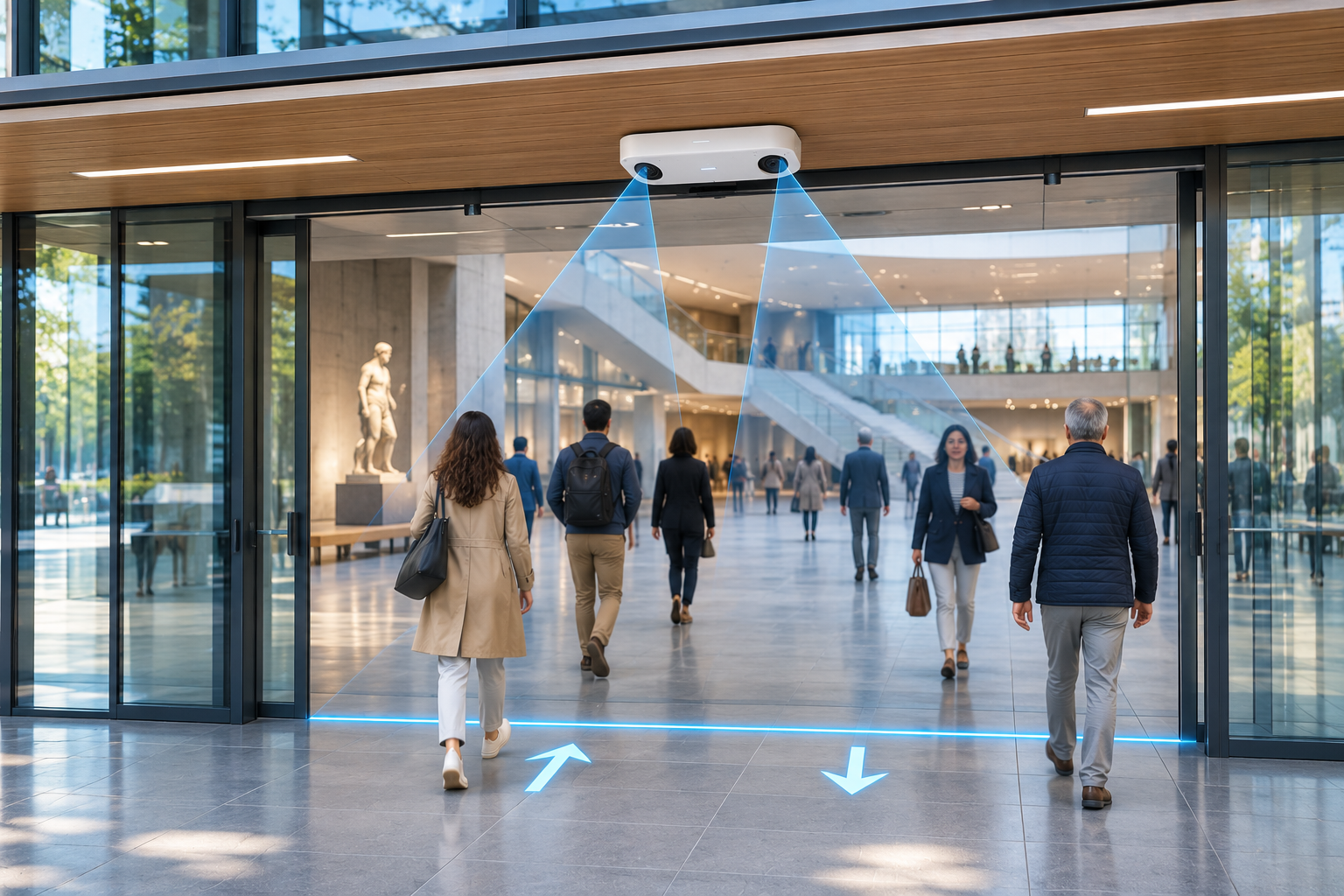
People counting systems are technological solutions that help analyze human movement in physical areas, including entry-exit traffic, visitor density, and the number of people in specific zones.
Today, they are used in various environments such as shopping malls, stores, hospitals, museums, airports, schools, factories, and public buildings.
Thanks to technologies like 3D stereoscopic sensors, depth measurement, and AI-powered image processing algorithms, modern people counting systems can offer more advanced analytical functions than traditional turnstile counters.
For example, people counting sensors installed at the entrances of a shopping mall can measure how many people entered and exited within a specific time frame. When this data is combined with appropriate software, the facility's real-time occupancy estimation and peak visitor hours can be evaluated.
However, installing a people counting system does not automatically guarantee accurate and reliable counting data.
Sensor technology, mounting height, entrance width, human density, software algorithms, and proper system configuration can directly affect counting performance.
So, what is a people counting system, how does it work, what technologies does it use, and how is the right system selected?
What is a People Counting System?
A people counting system is an electronic system that enables the automatic detection, counting, and conversion of measurement results into digital data for people within a specific physical area or at entry-exit points.
In international technical literature, terms such as People Counting System, People Counter, Footfall Counting, and depending on the purpose of use, Occupancy Monitoring System are encountered.
People counting systems can generate different types of information depending on their purpose:
Number of people passing through a specific point.
Separate counting based on entry and exit directions.
Hourly, daily, and monthly human traffic.
Estimated real-time number of people in a specific area.
Density and area utilization trends.
Human mobility in different zones.
Queue and waiting area analysis in suitable systems.
Visit duration statistics under specific conditions.
However, not all people counting devices support all these features.
Basic people counting, real-time occupancy measurement, and human movement analytics are distinct technical capabilities.
For instance, a device that only measures entries might not be sufficient on its own to reliably determine the real-time occupancy of the same area.
How Does a People Counting System Work?
The operating method of people counting systems depends on the sensor and analysis technology used.
In modern systems, the basic process can consist of the following stages.
1. Human Detection
A sensor placed in the designated area attempts to detect people entering its field of view or detection zone.
Depending on the technology used, this process can be carried out via infrared beams, 2D image processing, thermal detection, or 3D depth measurement.
2. Separation of People from Other Objects
In advanced systems, detection algorithms may attempt to distinguish people from specific objects.
For example, special classification and filtering methods can be used to prevent shopping carts, luggage, or other objects from being counted as people.
However, the success of differentiation depends on sensor technology, software, and environmental conditions.
3. Tracking Movements
In video or depth-based systems, a person's movement within the detection zone can be tracked for a certain period.
This allows the system not only to detect the presence of a person but also to evaluate their direction of movement.
4. Generation of a Counting Event
When a person crosses the defined counting line or zone and meets the necessary movement conditions, a counting event is generated.
For example:
Entry: IN +1
Exit: OUT +1
The position of the counting line and the characteristics of the tracking algorithm are crucial for accurate event generation.
5. Transfer of Counting Data
Counting data can be transferred via an appropriate network connection to a local server, central software, or cloud-based reporting platform.
In some systems, data can be temporarily stored on the device if the internet connection is lost.
However, this feature is not available on all devices, and actual data storage capacity must be verified per product.
6. Reporting and Analysis
The collected data can be reported hourly, daily, weekly, or monthly.
In suitable software, measurements from different entrances, floors, or facilities can be evaluated together.
What Technologies Are Used in People Counting Systems?
People counting solutions can be implemented with various sensor technologies.
Infrared (IR) People Counting Systems
In traditional IR counters, a passing event can be detected by the interruption of a specific light beam.
These systems can be used for simple passages.
However, separating people walking side-by-side, distinguishing movements in opposite directions, and complex passage behaviors can pose problems for some IR systems.
2D Camera-Based People Counting
In 2D systems, camera images are analyzed using image processing algorithms.
Suitable devices may include functions such as human detection, movement tracking, and virtual line crossing.
This technology can also be used with existing IP camera infrastructures.
However, camera angle, lighting, people obscuring each other, and complex movements in the scene can affect counting performance.
3D Stereoscopic People Counting
3D stereoscopic sensors can analyze the three-dimensional structure of a scene by obtaining depth information from two different optical perspectives.
This approach can particularly help distinguish people from specific objects or from individuals close to each other.
In suitable systems:
Determining entry and exit directions.
Separating people walking side-by-side.
Evaluating crowded passages.
Filtering objects like shopping carts or luggage.
Tracking specific movement patterns.
may be possible.
However, 3D stereoscopic technology alone does not guarantee flawless counting.
Sensor mounting height, optical field of view, and algorithm quality are important.
ToF (Time of Flight) People Counting
ToF technology performs depth measurement by utilizing time or phase information related to light traveling to a target and returning.
This technology can be used in specific people counting and area occupancy applications.
However, sensor range, ambient light, surface reflections, and operating geometry can affect performance.
Thermal People Counting
Thermal sensors can be used to detect thermal differences created by people in an environment.
In certain applications, the ability to count without generating detailed visible light images can be an advantage.
However, conditions such as ambient temperature, sensor resolution, and people being very close to each other can affect performance.
AI-Powered People Counting
AI-powered systems can use algorithms trained for human detection, classification, and tracking from image or sensor data.
Some systems perform 2D image analysis, while others may combine AI with 3D depth information.
Therefore, AI and 3D people counting are not opposing technologies. They can coexist in the same system.
Comparison of People Counting Technologies
| Technology | Main Advantage | Technical Limitation |
|---|---|---|
| IR beam counter | Simple structure and use in specific narrow passages | Limitations in separating simultaneous and opposite-direction passages |
| 2D video analytics | Usable with suitable IP cameras | Perspective, lighting, and occlusion issues |
| 3D stereoscopic sensor | Depth-based human separation | Mounting geometry and device coverage area |
| ToF sensor | Direct depth measurement | Affected by range, light, and surface properties |
| Thermal sensor | Thermal detection and certain privacy advantages | Temperature conditions and sensor resolution |
| AI-powered analytics | Advanced human detection and event analysis | Model performance and dependence on field conditions |
The comparison is for general technical evaluation purposes. Final technology selection should be made based on actual facility conditions and field tests.
What is the Difference Between People Counting and Real-time Occupancy Tracking?
Two concepts often confused in people counting systems are passage counting and real-time occupancy.
Passage counting measures how many people have passed through a specific point.
Real-time occupancy is the measurement or estimation of how many people are present in an area at a given moment.
For example, 2,000 people entering a building throughout the day does not mean that the building is occupied by 2,000 people at the same time.
To determine the real-time number of people, entry and exit data must be combined appropriately.
How is Real-time Occupancy Calculated?
The basic calculation is as follows:
Estimated real-time occupancy = Initial number of people + Total entries − Total exits
For example, at a specific hour in a museum:
Initial number of people inside: 100
Entries in the subsequent period: 240
Exits: 190
Estimated real-time occupancy = 100 + 240 − 190 = 150 people
This calculation assumes that the initial count is accurate and all relevant entry-exit movements are measured completely.
However, measurement errors can occur in real systems.
Especially in buildings with multiple entrances, all doors must be covered, and data must be combined correctly.
Axis Communications' people counting documentation also points out that errors can accumulate over time in occupancy calculations based on simple entry-exit differences.
Therefore, the calculated real-time occupancy value should be evaluated together with the accuracy limits of the system used.
How is Density Analysis Performed with People Counting Systems?
Human density analysis can relate the number of people in an area to the area size and usage conditions.
For example, let's assume there are 100 people in a 200 square meter area.
Average density = 100 / 200 = 0.5 people/m²
This value represents the average density of the area.
However, it does not mean that people are evenly distributed throughout the physical space.
For example, high density might occur in front of the entrance door, while other parts of the area might be empty.
Therefore, for density and queue tracking, some projects may require regional sensors, camera analytics, or additional data sources.
How is Occupancy Rate Calculated?
If there is a capacity value determined by the operator or specified by relevant regulations, the occupancy rate can be calculated.
Occupancy rate (%) = Estimated real-time occupancy / Defined capacity × 100
For example, if an area with a defined capacity of 200 people has an estimated 150 people:
Occupancy rate = 150 / 200 × 100 = 75%
The capacity in this example is used for calculation purposes only.
The occupancy measured by a people counting system does not automatically determine the maximum permissible occupancy for fire safety of the building.
Important: General-purpose people counting systems should not be used as the sole decision source for emergency evacuation or life safety systems without necessary safety verification and appropriate design.
Where Are People Counting Systems Used?
Shopping Malls
Visitor traffic and peak hours can be measured at mall entrances and exits.
Data obtained from different doors can be evaluated together with an appropriate central reporting infrastructure.
Hospitals and Healthcare Facilities
Analyzing human density at hospital entrances, outpatient areas, and specific waiting zones can contribute to service planning.
However, people counting data alone is not sufficient to determine medical service queues or patient priority.
Museums and Exhibition Areas
Museum visitor numbers, exhibition area utilization density, and visitor movements during different time periods can be evaluated.
Airports and Transportation Terminals
Human traffic at entry points and specific waiting areas can assist in operational resource planning.
Schools, Universities, and Libraries
Campus entrances, libraries, and common area densities can be analyzed.
Factories and Industrial Facilities
Movement density in specific production areas, entry points, and common use zones can be examined.
However, a people counting sensor does not perform the same function as a time and attendance (PDKS) system that verifies staff identity or calculates working hours.
Hotels and Conference Areas
Visitor density in lobbies, meeting, and event areas can be evaluated for operational planning purposes.
Public Buildings
Reports on human traffic for citizen reception points, waiting areas, and service units can be generated.
Hardware and software requirements may vary across these examples.
How is People Counting Done in Multi-Entrance Buildings?
One of the most important technical requirements for people counting systems in large facilities is the accurate measurement of multiple entry and exit points.
For example, if a shopping mall has four main entrance doors, installing sensors at only one entrance may not be sufficient to determine the total building traffic.
In this case, the physical characteristics of each entrance must be evaluated.
How is the Number of Sensors Determined?
The required number of sensors depends on the following criteria:
Number of entry and exit points.
Width of the doors.
Ceiling height.
Horizontal coverage area of the sensor.
Density of people passing simultaneously.
Cooperative operation features of multiple devices.
Counting and reporting objective.
Integration of Multiple Sensors
Sensors can generate independent counting data.
However, in multi-entrance facilities, all data must be combined with time synchronization and correct zone definitions.
Specifically, the same person passing through two different areas within the building might generate two different regional passage events.
Therefore, it should not be assumed that summing all counts from different regions yields the number of unique visitors.
Entry traffic, regional passages, real-time occupancy, and unique visitor counts require different data definitions.
What Should Be Considered During People Counting System Installation?
In people counting systems, mounting geometry is one of the key factors affecting counting accuracy.
Mounting Height
The operating height specified by the sensor manufacturer must be considered.
Not every 3D people counting sensor operates at the same height or with the same field of view.
Width of the Counting Area
The sensor's coverage area at a specific mounting height must be compared with the actual passage width.
Multiple sensors may be required for wide areas.
Entry and Exit Directions
Counting lines or zones should be positioned to represent actual human movement.
Door Movements
Automatic doors, revolving doors, or swing doors can affect the detection area.
Therefore, the moving parts of the door and the sensor's field of view must be evaluated together.
Lighting and Environmental Conditions
Depending on the sensor technology, sunlight, reflections, temperature changes, or optical obstructions must be evaluated.
Points Where People Wait
People stopping and waiting at the entrance, turning back, or re-entering the counting zone within a short period can cause incorrect counts in some systems.
Therefore, the counting zone and tracking area must be positioned correctly.
Network and Power Infrastructure
PoE or other power sources, data transmission connections, and necessary backup conditions must be evaluated.
How is Counting Accuracy Measured in People Counting Systems?
The actual performance of a people counting system should not be evaluated solely by looking at the accuracy rate stated in manufacturer catalogs.
Counting accuracy must be verified with appropriate reference measurements at the installed facility.
Manual Reference Counting
During a specific test period, people entering and exiting can be manually counted using an appropriate method.
The obtained reference data is compared with the counts reported by the sensor.
Total Counting Deviation
Simplified calculation:
Absolute counting error (%) = |Sensor count − Reference count| / Reference count × 100
For example:
Actual entry count: 500
Sensor entry count: 480
Absolute counting error = 20 / 500 × 100 = 4%
Accordingly, the accuracy indicator based on the total count difference can be expressed as 96%.
However, this rate does not prove that 96% of all individual passage events were detected correctly.
Because missed passages and overcounts can balance each other out.
Event-Based Accuracy
In more detailed verification studies:
Correctly counted passages.
Missed passages.
Overcounted passages.
Passages associated with the wrong direction.
Duplicate counts.
can be evaluated separately.
Different Traffic Scenarios
Verification should not be performed only at an empty or low-density entrance.
Necessary tests should evaluate normal traffic, dense passages, opposite-direction movements, people walking side-by-side, and U-turns.
In a successful people counting project, counting accuracy must be verified with field tests where acceptance criteria are predetermined, and the results must be documented.
What are Calibration and Validation in People Counting Systems?
In people counting projects, the concepts of calibration and validation are often used together.
However, technically they refer to different processes.
Calibration and Field Configuration
In the people counting industry, the term calibration is used in most applications to mean adjusting the device according to installation conditions.
These operations may include mounting height, counting lines, tracking zones, and detection parameters supported by the manufacturer.
This usage is not the same as traceable device calibration in a metrological sense.
Validation
Validation is the evaluation, through field tests, of whether the system provides the expected performance for its defined purpose of use.
For example, whether a system at a museum entrance provides accurate entry-exit counts during peak visitor periods can be compared with a manual reference.
When Should Calibration and Validation Be Renewed?
The system may need to be re-evaluated in the following situations:
Changing the sensor's position.
Changes in entrance or door architecture.
Significant updates to sensor software.
Changing counting lines.
Formation of new physical obstacles.
Observed deterioration in accuracy indicators.
These processes help maintain data reliability throughout the lifespan of the people counting system.
How Are People Counting Systems Integrated with AI and Video Analytics?
Some people counting solutions can be integrated with video management software, automation platforms, or central data analytics systems.
In this context:
Entry and exit events.
Regional people count.
Defined density threshold notifications.
Specific object counting events.
System status and fault notifications.
can be transferred to other platforms via appropriate interfaces.
What is ONVIF Profile M?
ONVIF Profile M defines standard interfaces for transferring video analytics metadata and events between compatible devices and clients.
Profile M includes interfaces that support object counting events.
However, it should not be assumed that every camera with ONVIF Profile M compliance has an advanced people counting algorithm.
The device's people counting feature, supported events, and software integration must be checked on a product-by-product basis.
Are People Counting Systems Subject to KVKK?
The answer to this question depends on what data the system processes.
Some people counting sensors may only generate anonymous or aggregated counting results.
In contrast, solutions that record video images, associate people's movements, or process data that can identify individuals may be subject to different personal data protection requirements.
Specifically, the following questions should be evaluated:
Does the system create video recordings?
Is only counting data stored?
Are images temporarily recorded for accuracy testing?
Is data processed that could enable the identification of a person?
Is the data stored on a local server or in the cloud?
Who has access to the data?
How are data retention and deletion processes managed?
According to KVKK regulations on anonymization, for personal data to be considered anonymized, it must be rendered incapable of being re-associated with a specific or identifiable natural person.
Therefore, the mere absence of a facial recognition feature does not automatically mean that a people counting system is outside the scope of KVKK.
The correct approach is to evaluate the actual data processing architecture and purpose of use of the people counting system and determine the necessary technical and legal measures.
What to Consider When Choosing a People Counting System?
In professional people counting systems, product selection should not be based solely on device price or the accuracy rate stated by the manufacturer.
Primary evaluation criteria include:
The primary purpose of the system.
Number of entry and exit points.
Entrance width and mounting height.
Sensor operating principle and coverage area.
Human separation performance in dense passages.
Separate measurement of entry and exit directions.
Real-time occupancy feature and calculation method.
Multi-sensor data merging capability.
Field verification and acceptance criteria.
Data protection when network connection is lost.
Software and reporting features.
API and other integration possibilities.
Cybersecurity and KVKK requirements.
Technical service, maintenance, and total cost of ownership.
Is a 3D People Counting System Necessary for Every Project?
No.
Simple IR counters may be sufficient for certain narrow passages.
However, in applications requiring high accuracy and detailed analysis where many people move side-by-side or in opposite directions, advanced 3D or suitable AI-based solutions can be considered.
The final decision should be made based on the system's actual needs and verified field performance.
Common Mistakes in People Counting System Installation
Some of the significant mistakes encountered in people counting projects include:
Not selecting the device appropriate for the entrance width.
Mounting the sensor outside the manufacturer's specified operating height.
Incorrect positioning of entry and exit lines.
Not considering door movements and physical obstacles.
Not performing accuracy tests in crowded passages.
Excluding some doors from counting in multi-entrance facilities.
Interpreting regional passages as unique visitor counts.
Incorrect determination of the initial value for real-time occupancy.
Not noticing data loss during network outages.
Accepting that the device appears to be working as sufficient for accuracy confirmation.
Professional site survey, correct sensor selection, field configuration, and regular validation are important in reducing these errors.
People Counting System Technical Checklist
Is the facility's people counting purpose determined?
Are entry and exit points identified?
Are entrance width and ceiling height measured?
Is the sensor's actual coverage area verified?
Are entry and exit directions correctly defined?
Are normal and dense traffic scenarios tested?
Is the data merging logic for multi-entrance areas checked?
Is the real-time occupancy calculation method verified?
Is manual reference counting performed?
Are entry and exit accuracies reported separately?
Are unwanted and duplicate counts examined?
Is data behavior during network and power outages tested?
Are reporting and integration functions verified?
Are personal data processing requirements evaluated?
Is a maintenance and re-validation plan created?
This checklist is for general technical evaluation. It does not replace product-specific installation instructions and project engineering.
Frequently Asked Questions
What is a people counting system?
A people counting system is an electronic sensor and software solution that detects people passing through specific entry-exit points or present in defined physical areas, generating counting data.
How does a people counting system work?
Depending on the technology used, it detects people and generates counting events via infrared beams, camera images, thermal detection, or 3D depth data.
Are people counting system and person counting system the same thing?
In general usage, yes. The two terms mostly refer to the same family of technologies. However, actual features depend on the sensor and application software used.
What is a 3D people counting system?
A 3D people counting system is a technology that performs counting by analyzing the position and movement of people using depth information. Methods such as stereo imaging or ToF can be used.
How accurate are people counting systems?
There is no single accuracy rate applicable to all systems. Actual accuracy varies depending on device technology, installation conditions, human density, and the algorithms applied. It must be verified with field tests.
Do people counting systems show real-time occupancy?
Suitable models can show estimated real-time occupancy using entry-exit data or specific regional analysis methods. However, not every basic people counter supports this feature.
Can a people counting system work without internet?
Some systems can operate on a local network or store data in the device's memory if the internet connection is lost. This feature depends on the device's technical capacity.
Do people counting systems perform facial recognition?
Facial recognition is not necessary for basic people counting. Some advanced analytic systems may have different functionalities; however, people counting and identity recognition are separate technologies.
How many sensors are needed for a people counting system?
The number of sensors depends on the entrance width, ceiling height, number of entrances, and the device's coverage area. Multiple sensors may be required for wide entrances.
What determines the prices of people counting systems?
Prices can vary based on sensor technology, number of sensors, software license, installation, reporting, integration, calibration, and maintenance services.
Can people counting systems replace security cameras?
Not in all cases. People counting devices focus on generating visitor and density data, while security cameras perform imaging and recording functions. Some camera systems can support both functions simultaneously.
Conclusion: People Counting Systems Transform Physical Spaces into Measurable Data
People counting systems are important technological solutions that enable the measurement of human movements in buildings and various physical areas.
Thanks to 3D depth sensors, AI-powered analytics, and central reporting software, entry-exit data, real-time occupancy estimations, and area utilization trends can be evaluated in more detail.
However, a successful people counting project is not completed merely by purchasing the correct device.
Sensor selection, mounting height, passage area, accuracy measurement, data integrity, and reporting infrastructure must be planned together.
Especially in shopping malls, hospitals, museums, airports, factories, and public buildings, reliable people counting data can contribute to operational and capacity planning.
The true value of a people counting system comes not just from measuring how many people pass, but from helping to manage physical spaces more effectively with reliable and verifiable data.