
Vulnerability in SonicWall SSL-VPN Allowing MFA Bypass: Urgent Warning from CISA
The CVE-2026-19868 vulnerability discovered in SonicWall's SonicOS SSL-VPN service can lead to the bypass of SAML authentication and multi-factor authentication (MFA) under specific conditions. CISA added the vulnerability to its list of actively exploited vulnerabilities on November 6, 2026. SonicWall has released a security update for affected devices.
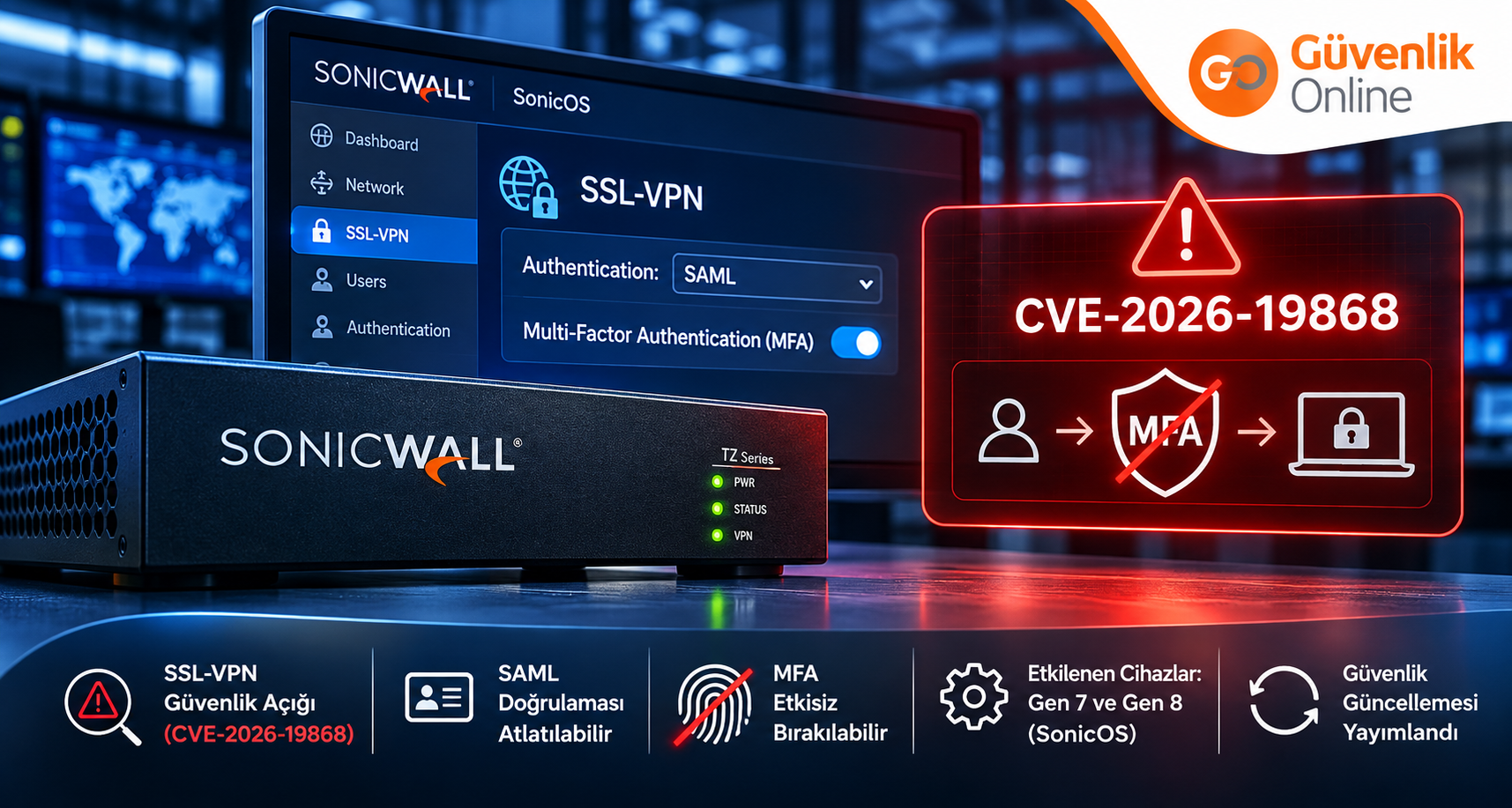
Cybersecurity vendor SonicWall has released an update for a vulnerability affecting the SSL-VPN component of its SonicOS operating system, which could allow certain authentication controls to be bypassed.
The vulnerability, tracked as CVE-2026-19868, was publicly disclosed on November 6, 2026. On the same day, the U.S. Cybersecurity and Infrastructure Security Agency (CISA) added the vulnerability to its Known Exploited Vulnerabilities (KEV) catalog.
SonicWall's security advisory, SNWLID-2026-0014, covers multiple security issues found in SonicOS Gen 7 and Gen 8 firewalls.
Among these, CVE-2026-19868 specifically concerns SSL-VPN configurations where SAML authentication is used.
While the vendor states it is investigating a report of potential exploitation, CISA's KEV entry indicates evidence of active exploitation in real-world attacks. However, detailed public information regarding the scope of attacks or affected organizations is not available.
What is the CVE-2026-19868 Vulnerability?
The vulnerability relates to how the SonicOS SSL-VPN service implements authentication controls.
SSL-VPN is among the technologies that enable users to establish secure remote connections to corporate network resources over the internet.
In corporate systems, these connections can be managed by centralized authentication mechanisms such as Security Assertion Markup Language (SAML).
SAML helps users perform authentication through an identity provider. Multi-factor authentication (MFA) can also be mandated during this process.
However, CVE-2026-19868 can allow individuals with valid account credentials for an alternative authentication method to bypass SAML controls under specific conditions.
In the event of successful exploitation, the MFA mechanism mandated via SAML can also be disabled.
Important distinction: This vulnerability does not mean that any attacker can access all SonicWall VPN systems without any account credentials. The exploitation scenario requires valid credentials for an alternative authentication method.
Which SonicWall Devices Are Affected?
According to SonicWall's statement, the relevant security updates cover physical and virtual versions of Gen 7 and Gen 8 firewalls.
The primary condition for CVE-2026-19868 is that SAML authentication must be enabled for SSL-VPN logins.
Affected and patched SonicOS versions are as follows:
| Platform | Affected versions | Patched version |
|---|---|---|
| Gen 7 | SonicOS 7.3.3-7015 and earlier | SonicOS 7.3.4-7013 or higher |
| Gen 8 | SonicOS 8.2.2-8015 and earlier | SonicOS 8.2.3-8015 or higher |
Affected product families include Gen 7 TZ, NSa, NSsp, and NSv, as well as Gen 8 TZ, NSa, and NSv firewalls.
However, merely belonging to one of these product families does not mean the product has a risky configuration regarding the CVE-2026-19868 vulnerability. SSL-VPN authentication settings must also be reviewed.
SonicWall recommends updating the relevant versions, taking corporate maintenance processes into account.
Why Did CISA Add the Vulnerability to the Actively Exploited List?
On November 6, 2026, CISA included CVE-2026-19868 in its catalog of known and proven exploited vulnerabilities.
The KEV catalog is not merely a database listing theoretical risks. It aims to prioritize vulnerabilities known to be exploited in real-world attacks.
Therefore, the addition of CVE-2026-19868 to the catalog increases the update priority for security teams.
CISA's entry specifies a remediation due date of November 20, 2026, for relevant U.S. federal civilian agencies.
This date is not a directly applicable legal deadline for private sector organizations in Turkey. However, it serves as an important indicator that the risk requires urgent assessment.
SonicWall's vendor assessment states a CVSS 3.1 score of 7.1 for the vulnerability. CVE data records also include a calculation of 7.5 from different assessment sources.
Therefore, instead of assessing device risk levels based on a single CVSS score, information on active exploitation, system internet exposure, and authentication configuration should be considered together.
Why is Multi-Factor Authentication Bypass Significant?
MFA is one of the fundamental security controls used to make unauthorized access to a user account difficult, even if a password is compromised.
However, if a security system fails to apply consistent authentication rules across different login methods, it can reduce the effectiveness of this protection.
The core issue in CVE-2026-19868 is that a connection that should pass through SAML authentication can be evaluated via an alternative authentication path.
This situation requires attention, especially in corporate VPN infrastructures where different user authentication methods are supported simultaneously.
Security teams need to check not only whether MFA appears to be enabled but also whether the expected policies are applied across all access paths.
What Measures Should SonicWall Users Take?
SonicWall recommends upgrading affected devices to the patched SonicOS versions.
The vendor's security advisory does not describe a verified workaround that substitutes for the update for this CVE.
Therefore, organizations using these systems should first review their device inventories.
Recommended control steps include:
Determine the model and current SonicOS version of SonicWall firewalls.
Check if the SSL-VPN service is enabled.
Verify whether SAML authentication is used for SSL-VPN logins.
Install the vendor's patched software version for affected systems.
Review VPN access logs and identity provider login records.
Initiate incident response procedures if suspicious connections are observed.
Review unused remote access methods and unnecessary account privileges.
Comparing VPN logs with identity provider records can help investigate connections that did not pass through the expected authentication process.
However, any discrepancy in log records should not be considered proof of a successful attack on its own.
It is important to perform update procedures by taking configuration backups and planning for potential service interruptions.
Significance for the Security Sector in Turkey
Businesses, security integrators, and multi-location organizations in Turkey can utilize VPN solutions for remote access.
Network security is critically important in facilities where remote maintenance access is provided to IP camera, video management system (VMS), access control, and building automation infrastructures.
CVE-2026-19868 is not a vulnerability directly found in IP cameras or NVR devices. The issue lies within the SonicOS SSL-VPN authentication mechanism.
Nevertheless, in environments where security management servers or facility networks are accessed via VPN, the security of the remote connection layer contributes to the protection of the physical security infrastructure.
Therefore, integrators must regularly audit the software versions and authentication policies of the firewalls they use for remote access to customer systems.
There is no verified information regarding the number of organizations in Turkey attacked due to this vulnerability.
Updates and Access Control Should Be Evaluated Together
SonicWall's released security update aims to address the identified software vulnerability.
However, corporate remote access security is not solely about keeping devices updated.
Authentication policies, user privileges, network segmentation, monitoring of access logs, and incident response processes must be evaluated together.
The addition of CVE-2026-19868 to the list of actively exploited vulnerabilities indicates that organizations must promptly check their SonicWall SSL-VPN configurations and current SonicOS versions.
Sources
SonicWall — November 3, 2026; last updated November 6, 2026
SonicOS 7.3.4 and 8.2.3 security advisory
https://www.sonicwall.com/support/notices/kA1VN000002eBLN0A2
SonicWall PSIRT — November 6, 2026
SNWLID-2026-0014 security bulletin
https://psirt.global.sonicwall.com/vuln-detail/SNWLID-2026-0014
CISA — November 6, 2026
Known Exploited Vulnerabilities catalog
https://www.cisa.gov/known-exploited-vulnerabilities-catalog
CVE Program — November 6, 2026
CVE-2026-19868 vulnerability record
https://www.cve.org/CVERecord?id=CVE-2026-19868
BleepingComputer — November 6, 2026
Possible exploitation of SonicWall SSL-VPN vulnerability and security updates
https://www.bleepingcomputer.com/news/security/sonicwall-warns-of-new-ssl-vpn-mfa-bypass-flaw-exploited-in-attacks/