
Vehicle Armoring Applications: Ballistic Protection, Standards and Security
Vehicle armoring applications are engineering solutions developed to protect cars, SUVs and special-purpose vehicles against specified ballistic threats. We examine VPAM-BRV VR1–VR10 classes, ballistic glass and body armor, VPAM-ERV blast resistance, weight and driving safety, certification criteria, and requirements for vehicle modifications in Türkiye.
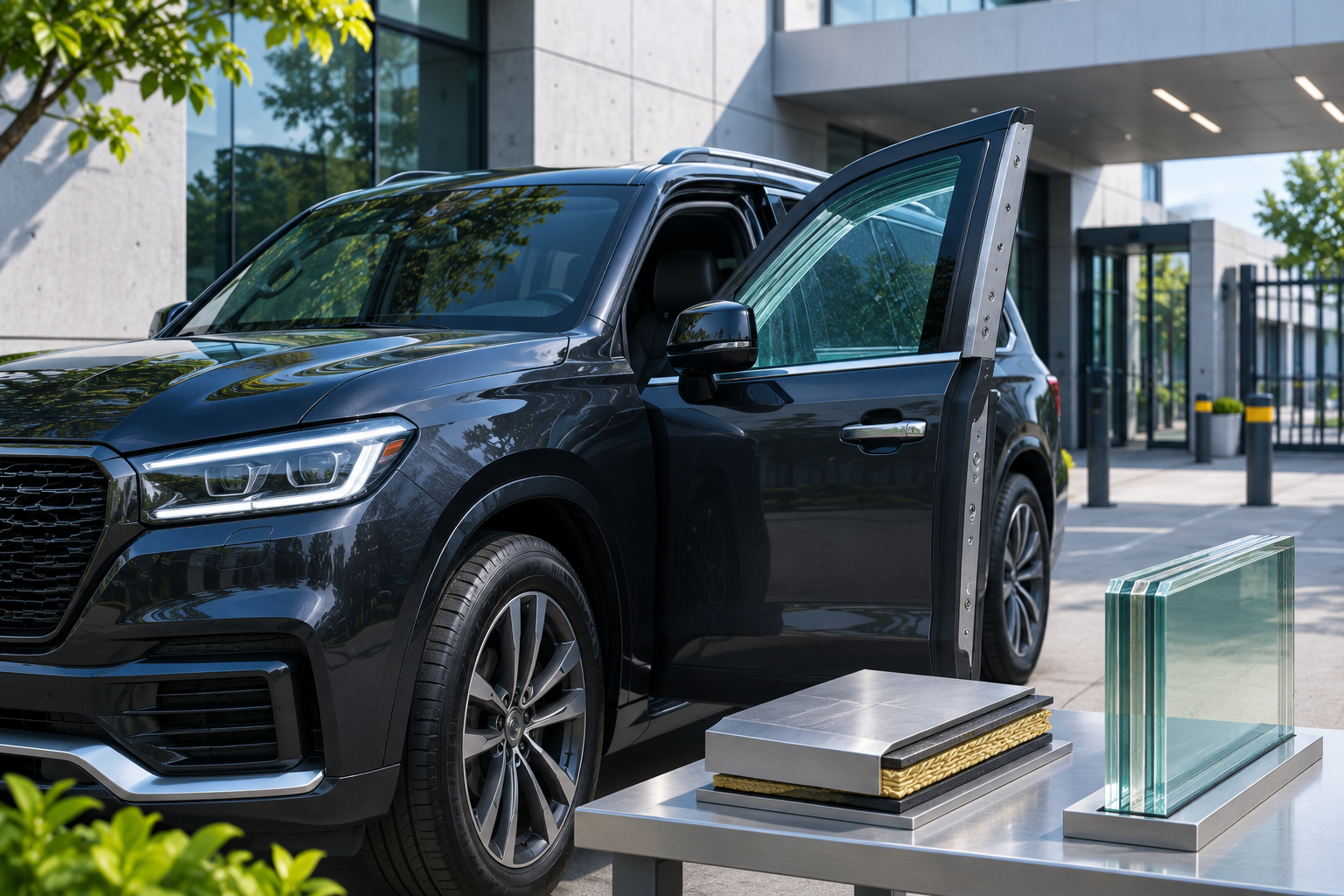
Vehicle armoring is the process of designing or converting cars, SUVs, minibuses and special-purpose vehicles to provide protection against specified ballistic attack risks. It encompasses ballistic glass, specialized armor materials, a reinforced vehicle structure and supporting security systems developed to protect occupants and, where necessary, valuable assets being transported.
Armored vehicles are used particularly for VIP protection, diplomatic transport, cash and valuables transfers, private security services, and certain high-risk transport operations.
However, vehicle armoring is not simply a matter of installing steel plates in doors or replacing standard windows with thicker glass. Added protective materials can affect a vehicle’s weight, center of gravity, braking performance, suspension loads, door mechanisms and fuel consumption.
For this reason, professional vehicle armoring should be treated as an engineering process that evaluates ballistic protection requirements and vehicle safety together.
A reliable armored vehicle is not merely one containing ballistic materials; its protection performance has been tested, its vehicle safety verified, and its compliance with relevant regulations assessed.
What Is Vehicle Armoring?
Vehicle armoring means equipping a vehicle with ballistic protection components to increase its resistance to specified threats.
This can be done during vehicle manufacture or by having an existing vehicle converted by a specialist organization.
Armoring systems generally include the following components:
Ballistically resistant vehicle glass.
Door and body protection components.
A suitable armored support structure.
Protection materials specific to the vehicle type.
Assessment of brakes and suspension for the added weight.
Suitable tire and running-gear solutions.
Emergency and communications equipment.
Special security electronics, as required.
The parts used in vehicle armoring do not all have to be made from the same material.
Ballistic steel, composite armor materials, aramid fibers, high-performance polyethylene-based structures and specialized glass compositions can be used in different product designs.
Knowing the material type alone, however, is not enough to determine a vehicle’s protection level.
How Is a Vehicle Armored?
Professional vehicle armoring begins by establishing the security and engineering requirements for the vehicle to be protected.
The general process comprises the following stages.
1. Security Risk Analysis
The first step is to assess the vehicle’s intended use and the threats against which protection is required.
Security requirements can differ for VIP transport, cash transfers and special-mission vehicles.
Therefore, it is not appropriate to assign one armoring class to every vehicle.
2. Vehicle Platform Assessment
The vehicle manufacturer’s stated limits for weight, axle load, brakes, suspension and load capacity should be reviewed before armoring.
The vehicle’s physical dimensions, body structure and existing safety systems also matter.
3. Selecting the Appropriate Protection System
Tested ballistic protection components suited to the identified security requirements are selected.
At this stage, product certificates and the target ballistic protection class for the completed vehicle should be assessed.
4. Engineering and Vehicle Adaptation
A qualified manufacturer or conversion organization designs the protection system to suit the vehicle.
Structural integrity, road safety and preservation of the vehicle’s original safety equipment are fundamental requirements.
5. Testing and Certification
The ballistic tests and safety verifications specified for the relevant product or vehicle are carried out.
6. Vehicle Safety and Handover Checks
Once the work is complete, the vehicle’s mechanical, electrical and driving-safety characteristics are checked.
Any required vehicle conformity, modification, inspection and registration procedures are assessed.
What Materials Are Used in Vehicle Armoring?
Vehicle armoring technologies draw on the protective properties of different materials.
Ballistic Steel
Ballistic steel refers to special types of steel developed to meet specified mechanical and ballistic performance requirements.
It is one of the materials that can be used in armored vehicles.
Standard structural steel or any high-strength steel cannot, however, automatically be considered certified ballistic armor material.
Aramid-Based Composites
Aramid fibers are materials that can offer high mechanical strength and, in certain applications, a weight advantage.
They can be used as a component of suitable composite structures in vehicle armoring.
But the presence of aramid alone does not prove that a part meets a particular ballistic class.
UHMWPE-Based Materials
Ultra-high-molecular-weight polyethylene, known as UHMWPE, is one of the materials used in certain ballistic composite applications.
The material’s actual protection performance depends on the structure developed by the manufacturer and on standardized test results.
Ceramic Composites
Ceramic-based composite systems can be used in certain high-performance protection applications.
Their applications and resistance characteristics vary according to product design.
Ballistically Resistant Glass
Glass used in armored vehicles has protection requirements that differ from those of standard automotive glass.
Special compositions made from multiple glass layers and suitable polymer materials may be used.
The key material-selection criterion is the product’s tested performance against the specified threat.
Ballistic Glass Applications in Vehicles
Transparent protective elements are an important component of vehicle armoring.
Special ballistic glass products can be used for the windshield, side windows and other suitable transparent sections.
The Difference Between Ballistic Vehicle Glass and Standard Automotive Glass
Standard automotive glass is designed to meet vehicle-safety and relevant breakage-behavior requirements.
Ballistic vehicle glass, in addition, consists of protective compositions tested against specified firearm threats.
Ballistic glass may be thicker or heavier.
Thickness alone, however, does not indicate a product’s ballistic class.
Optical Visibility in Ballistic Glass
When assessing armored vehicle glass, driving visibility is as important as ballistic performance.
Features to consider include:
Optical distortion.
Light transmission.
Visibility during night driving.
Reflections on the glass surface.
Preservation of the field of view.
Long-term glass durability.
Compatibility with vehicle type and glass geometry.
These are among the considerations.
Is EN 1063 Sufficient for Vehicle Glass?
EN 1063 is a testing and classification standard for ballistic-resistant glass used primarily in buildings.
Knowing that a particular ballistic glass was tested under EN 1063 can provide useful product information.
However, this does not automatically prove that the glass provides the same protection when installed in a vehicle or as part of the completed vehicle as a whole.
For vehicle-level assessment, suitable vehicle test methods such as VPAM-BRV are also important.
What Is VPAM-BRV?
VPAM-BRV is a technical testing guideline used to assess the ballistic resistance of specially protected vehicles.
VPAM is an abbreviation of the German Vereinigung der Prüfstellen für Angriffshemmende Materialien und Konstruktionen expression.
It is an association of testing organizations active in testing materials and structures that provide ballistic protection.
VPAM-BRV governs the testing and classification of vehicles against specified firearm threats.
In the official VPAM register, VPAM-BRV Edition 3 dated 15 March 2021 is listed as the current version.
VPAM-BRV VR Classes
Under VPAM-BRV, from VR1 through VR10 ballistic protection classes are defined.
Class range | General description | Technical assessment |
|---|---|---|
VR1–VR3 | Lower-numbered ballistic test levels | Verify the specific test conditions for the relevant class |
VR4–VR6 | Mid-level ballistic test classes | Review the complete vehicle certificate and test scope |
VR7–VR10 | Higher-numbered ballistic test levels | Assess higher protection requirements together with vehicle suitability |
This grouping is intended to make the classes easier to understand.
Each VR class corresponds to a separate test level defined in VPAM-APR. The table is not an official low/medium/high risk mapping or a selection recommendation for particular uses.
A vehicle tested in class VR6 is not thereby shown to provide VR10 protection.
Similarly, it should not be assumed that the highest class is necessary or suitable for every project.
What Should Be Checked in a VPAM-BRV Certificate?
The full name and edition of the standard used.
The VR class stated on the certificate.
The vehicle type and model tested.
Vehicle configuration and scope of certification.
The organization that conducted the test.
Certificate number and verifiability.
Limitations stated in the document.
The effect of subsequent modifications on the certificate’s scope.
An important distinction is that VPAM-BRV’s assessment of a completed vehicle differs from testing a single ballistic material.
A certificate for an armor plate or ballistic glass does not mean that the entire vehicle is VPAM-BRV-certified.
Are B6, B7, BR6 and VR6 the Same?
In the vehicle armoring industry, different terms such as B6, B7, BR6 and VR6 may be encountered.
These terms, however, are not direct equivalents of one another.
Term | Technical meaning | What to watch for |
|---|---|---|
B6 / B7 | Class terms used in the market | The standard they are based on should be stated |
BR6 / BR7 | EN 1063 glass resistance classes | Not a vehicle certificate on its own |
VR6 / VR7 | VPAM-BRV vehicle ballistic classes | The complete vehicle test scope should be reviewed |
VPAM-PM level | Ballistic material assessment | A material test does not replace a vehicle test |
For example, if a car is marketed as a “B6 armored vehicle,” it should be clearly stated which laboratory assessed it and under which vehicle test standard.
The right purchasing approach is to rely on the full standard and classification stated on the certificate rather than commercial class terms.
What Is VPAM-ERV? Blast-Resistant Vehicles
A vehicle’s resistance to firearm threats and its resistance to blast effects are not the same performance.
VPAM-ERV is a separate testing guideline used to assess specially protected vehicles against blast effects.
According to VPAM’s official explanation, VPAM-ERV Edition 3 was published on 1 March 2021 and may, under specified conditions, be used alongside the previous Edition 2.
Therefore, a vehicle with ballistic protection certification only under VPAM-BRV should not be assumed to be certified against blast effects as well.
Likewise, passing a particular blast test does not mean that the vehicle offers unlimited resistance to all explosive threats.
Factory-Armored Vehicles Versus Vehicles Armored After Manufacture
Vehicle armoring applications can be divided into two main groups according to the manufacturing or conversion method.
Factory-Armored Vehicles
These vehicles are developed by the manufacturer with protection requirements in mind.
The ballistic system, chassis, body, running gear and suitable vehicle equipment can be designed as an integrated whole.
Examples of factory-armored vehicles include:
BMW X5 Protection VR6.
BMW 7 Protection.
Mercedes-Benz S 680 GUARD 4MATIC.
may be cited.
BMW states that the X5 Protection VR6 offers certified vehicle protection.
Mercedes-Benz also presents the S 680 GUARD 4MATIC model VR10 as having a ballistic protection class.
These examples do not cover all standard vehicles made by these manufacturers; they are specific models developed for special protection.
Vehicles Armored After Manufacture
This involves equipping an existing vehicle with ballistic protection systems through a qualified conversion organization.
In this method, the vehicle’s original platform, structural capacity and safety features are the starting point.
In conversions performed after manufacture, particular importance attaches to:
Documentation of ballistic performance.
The vehicle’s compatibility with the added weight.
Assessment of the brake and suspension systems.
Preservation of electronic safety systems.
Approval of modifications under applicable regulations.
Maintenance and warranty conditions.
These matters are important.
Comparison of the Two Methods
Criterion | Factory-armored vehicle | Vehicle armored after manufacture |
|---|---|---|
Design approach | Integrated manufacturer design | Conversion of an existing vehicle |
Ballistic protection | Depends on the model’s certification | Depends on the conversion’s certification |
Mechanical compatibility | Can be addressed as part of a special design | Requires detailed reassessment |
Electronic systems | Manufacturer integration | Post-conversion verification is required |
Warranty | Subject to the manufacturer’s terms | Vehicle and conversion warranties may differ |
Registration/conformity | Depends on the market and vehicle approval | Modification and registration procedures may be required |
With either approach, safety performance should be based on verifiable technical documents, not marketing claims.
Vehicle Armoring Weight and Driving Safety
One of the most important considerations in vehicle armoring is the added weight.
Ballistic glass and other protective components can increase a vehicle’s total mass.
This affects not only fuel consumption but also the vehicle’s dynamic behavior.
Braking Performance
The braking system may be subjected to greater loads in a heavier vehicle.
The vehicle’s braking safety should therefore be assessed against manufacturer limits and relevant conformity requirements.
Suspension and Axle Loads
An increase in vehicle weight can change the loads borne by the front and rear axles.
Keeping total weight within the limits is not enough. The limits for each axle also matter.
Steering and Road Handling
Changes in the center of gravity and mass distribution can affect road handling, maneuverability and driving safety.
Tire and Wheel Suitability
Tire load capacity should match the vehicle’s actual operating weight.
Some specially protected vehicles may use specialized tire systems that provide limited mobility in an emergency.
These systems, however, do not guarantee safe driving over unlimited distances or at unlimited speeds with a damaged tire.
Example Weight Assessment
Suppose a vehicle has the following hypothetical values:
Parameter | Value |
|---|---|
Initial vehicle mass | 2100 kg |
Additional protection systems | 600 kg |
Mass after conversion | 2700 kg |
Assumed permitted maximum mass | 3100 kg |
Remaining theoretical load capacity | 400 kg |
In this case, 400 kg is the remaining theoretical capacity for passengers, luggage and other permitted loads.
The calculation, however, should use the actual vehicle registration and manufacturer data. It also does not by itself prove that axle limits are met or that the vehicle is technically suitable for armoring.
An increase in vehicle weight after armoring is not merely a comfort issue; it directly concerns road safety and conformity.
Electronic Security Systems in Armored Vehicles
Ballistic protection and electronic security technologies can be used together in armored vehicles.
Depending on needs and the vehicle platform, the following solutions may be considered:
Interior and perimeter camera systems.
Secure communications devices.
GPS-based vehicle tracking systems.
Emergency notification systems.
Compatible alarm systems.
In-vehicle video recording solutions.
Secure access and user authorization.
Centralized fleet monitoring for special-mission vehicles.
The presence of electronic equipment, however, does not raise the vehicle’s ballistic protection class.
These devices must be assessed alongside vehicle energy management, electromagnetic compatibility and relevant cybersecurity requirements.
ADAS and Airbag Systems in Armored Vehicles
Driver-assistance and passive-safety systems are important to safety in modern cars.
These include:
ABS and electronic stability control systems.
Airbags.
Seat-belt systems.
Automatic emergency braking.
Lane-keeping assistance.
Camera- and radar-based driving assistance.
These systems are among them.
Vehicle conversion work must not adversely affect the operation of these systems.
Changes to the original vehicle structure may in particular affect the calibration or operating conditions of some driver-assistance systems.
Consequently, after conversion, both ballistic performance and the vehicle’s original active and passive safety functions should be assessed.
In electric and hybrid vehicles, high-voltage energy systems also require specialist expertise.
Is Vehicle Armoring Legal in Türkiye?
Technical changes made to vehicles in Türkiye are assessed under the relevant road-safety and vehicle-conformity regulations.
One of the main regulations is the Regulation on the Manufacture, Modification and Assembly of Vehicles (AİTM). This is.
The regulation governs approval processes concerning the technical conformity of vehicle modifications.
Article 32 of Highway Traffic Law No. 2918 also contains provisions concerning technical changes made to vehicles and recording them in registration records.
Must Armoring Be Recorded on the Vehicle Registration?
Depending on the nature of the work and the vehicle’s existing approval status, technical modification, conformity assessment, inspection or registration procedures may be required.
It should therefore not be assumed that one document or sequence of procedures applies to every armoring job.
For vehicles armored after manufacture and intended for road use in particular, the scope of the modification should be assessed with authorized engineering and conformity organizations.
TSE Vehicle Modification Approval
The Turkish Standards Institution provides certification services for individual vehicle conformity and vehicle modifications under AİTM.
TSE service documents list vehicle modification projects, technical calculations and relevant conformity documents as important application components.
A ballistic test certificate and an AİTM conformity document, however, serve different purposes.
A ballistic certificate does not replace vehicle traffic registration or mechanical-safety conformity procedures.
The final legal assessment of vehicle armoring should be made according to the vehicle type, the scope of modification and current regulations.
How to Check an Armored Vehicle Certificate
When buying an armored vehicle or purchasing an armoring service, the manufacturer’s marketing description alone is not sufficient.
The following information should be checked in the technical documents:
Item to check | What must be verified |
|---|---|
Ballistic standard | VPAM-BRV or the other vehicle standard specified |
Protection class | VR level stated in the certificate |
Standard edition | The edition used for the test |
Testing organization | Laboratory identity and competence |
Vehicle model | Vehicle type stated in the certificate |
Vehicle configuration | Scope of the protection system tested |
Ballistic glass | Compatibility documents for the relevant product and vehicle |
Blast resistance | Separate VPAM-ERV assessment, if required |
Vehicle conformity | Technical modification, inspection and registration documents |
Warranty and service | Support terms for the protection system and vehicle |
It should also be checked whether changes made to the vehicle after certification affect the validity of the document.
Which Vehicles Can Be Armored?
VIP and Official Vehicles
Specially protected cars and SUVs can be used to transport people with specific risk profiles.
Diplomatic Vehicles
Vehicles used by diplomatic personnel and for certain official duties may have specialized protection systems based on risk analysis.
Cash-in-Transit Vehicles
Banks, cash-handling companies and organizations transporting valuables may use suitable armored transport vehicles.
In designing these vehicles, capacity, operational requirements and relevant regulations matter as much as passenger safety.
Special Security Vehicles
Vehicles developed according to protection requirements may be considered for certain high-risk security operations.
Public-Sector and Special-Purpose Vehicles
Protected vehicles with different technical requirements may be used in some public services and special-duty fields.
It should not be assumed that these vehicles are subject to the same technical and legal framework as civilian passenger vehicles.
What Determines Vehicle Armoring Costs?
The cost of vehicle armoring is determined not only by the quantity of glass or protective material used.
The main factors affecting the total cost are:
Vehicle make, model and body structure.
Target ballistic protection class.
Factory-armored or post-manufacture conversion approach.
Scope of the tested protection system.
Ballistic glass specifications.
Engineering requirements related to vehicle weight.
Conformity work for mechanical and electronic systems.
Testing and certification scope.
Conformity and registration procedures in Türkiye.
Warranty, maintenance and technical support.
A higher protection class may require different material compositions and more extensive technical verification.
There is, however, no fixed armoring price per square meter or kilogram that applies to every vehicle.
Is the Cheapest Armoring the Most Economical Solution?
Not always.
In addition to the initial investment, the vehicle’s maintenance, fuel, tire, brake, suspension, insurance and other operating costs should be considered.
A low-priced conversion without conformity documents or verified vehicle safety is not necessarily a reliable investment.
Common Mistakes in Vehicle Armoring
Relying Only on a Material Certificate
A test report for ballistic material does not replace certification of the completed vehicle.
Failing to Calculate Vehicle Weight
The added protection weight can create serious nonconformity in relation to vehicle and axle loads.
Neglecting Brake and Suspension Performance
It is wrong to focus on ballistic protection while relegating driving safety to a secondary concern.
Treating Ballistic Glass as Sufficient on Its Own
The presence of ballistic glass does not mean the entire vehicle structure belongs to the same protection class.
Confusing VR and BR Classes
Glass test classes and vehicle test classes are not direct equivalents.
Assuming Blast Protection
Ballistic protection certification does not replace separate blast-resistance certification.
Skipping Modification and Registration Procedures
The legal conformity of technical changes to a vehicle should be assessed before handover.
Technical Checklist for Vehicle Armoring Applications
- Has a security risk analysis been conducted for the vehicle?
- Has the target protection performance been defined?
- Have the standard’s name and edition been verified?
- Has the vehicle model’s suitability for armoring been assessed?
- Have the manufacturer’s weight and axle limits been reviewed?
- Have the documents for the ballistic protection materials been checked?
- Has certification of the completed vehicle been assessed?
- Have ballistic glass and other protection components been verified?
- If required, has blast resistance been assessed separately?
- Have brake, suspension and steering safety been checked?
- Has tire and wheel load suitability been reviewed?
- Have the airbags and driver-assistance systems been checked?
- Has the conformity of electrical and communications systems been verified?
- Have the vehicle modification project and technical reports been prepared?
- Have the required AİTM, inspection and registration procedures been identified?
- Have the certificate and warranty scope been confirmed in writing?
- Has a maintenance and periodic technical-inspection plan been prepared?
This checklist is for general technical assessment. The design and implementation of armoring should be carried out by qualified organizations and relevant engineering specialists.
Frequently Asked Questions About Vehicle Armoring
What is vehicle armoring?
Vehicle armoring means equipping a vehicle with specialized materials and systems to provide protection against specified ballistic threats.
Can every car be armored?
Not every vehicle platform is suitable for armoring. Weight, body structure, axle capacity, braking system and technical approval requirements must be assessed.
What is a VR6 armored vehicle?
VR6 is a vehicle class assessed under VPAM-BRV against specified ballistic test conditions. The actual protection scope should be checked in the vehicle’s certificate.
Are B6 and VR6 the same?
No. The standard underlying commercial terms such as B6 should be specified. VR6 is a VPAM-BRV vehicle test classification.
Is an armored vehicle completely bulletproof?
No. Certification applies to specified test conditions and threats. There is no guarantee of unlimited protection against every attack.
Does a car count as armored if ballistic glass is installed?
Not on that basis alone. Installing ballistic glass does not prove that the completed vehicle is certified to a particular VPAM-BRV class.
Does vehicle armoring increase fuel consumption?
Added weight and system changes can affect a vehicle’s energy or fuel consumption. The extent of the effect depends on the vehicle and the application.
Does vehicle armoring affect braking performance?
Yes. Added weight can affect the load on the braking system and the vehicle’s driving dynamics. Appropriate technical assessment is therefore required.
Is an armored vehicle also blast-resistant?
Not always. Resistance to blast effects is a separate performance requirement. Relevant test documents, such as VPAM-ERV, should be reviewed.
Can a vehicle armored after manufacture be recorded on its registration?
Depending on the scope of the modification, conformity, inspection and registration procedures may be required. The relevant process should be determined under current vehicle-modification regulations in Türkiye.
Can armored vehicles be used in normal traffic?
Use of vehicles meeting the required technical approval, safety, inspection and registration conditions is assessed under the relevant regulations. It should not be assumed that every conversion is automatically roadworthy.
Conclusion: Sound Engineering and Certification in Vehicle Armoring
Vehicle armoring applications are comprehensive engineering solutions developed to provide protection against specified security risks.
Ballistic glass, protective materials and specialized vehicle structures are important components of these systems. But a successful application depends not only on material selection, but on the performance of the completed vehicle.
Vehicle-focused test methods such as VPAM-BRV help assess ballistic protection levels on a comparable basis. Blast resistance must be verified separately.
The right armored vehicle is one that provides the target protection level as documented, preserves vehicle safety and meets relevant technical and legal requirements.
Armoring investments should therefore be planned together with security risk analysis, specialist engineering, certification, mechanical-safety verification and long-term maintenance.