
What is RTPS? Real-Time Data Communication Protocol and Operating Principle
RTPS (Real-Time Publish-Subscribe) is a communication protocol that enables real-time data exchange between devices and software in DDS-based distributed systems. We examine RTPS's operating principle, Publisher/Subscriber architecture, QoS features, UDP communication, cybersecurity requirements, and its differences from the RTSP protocol used in CCTV systems.
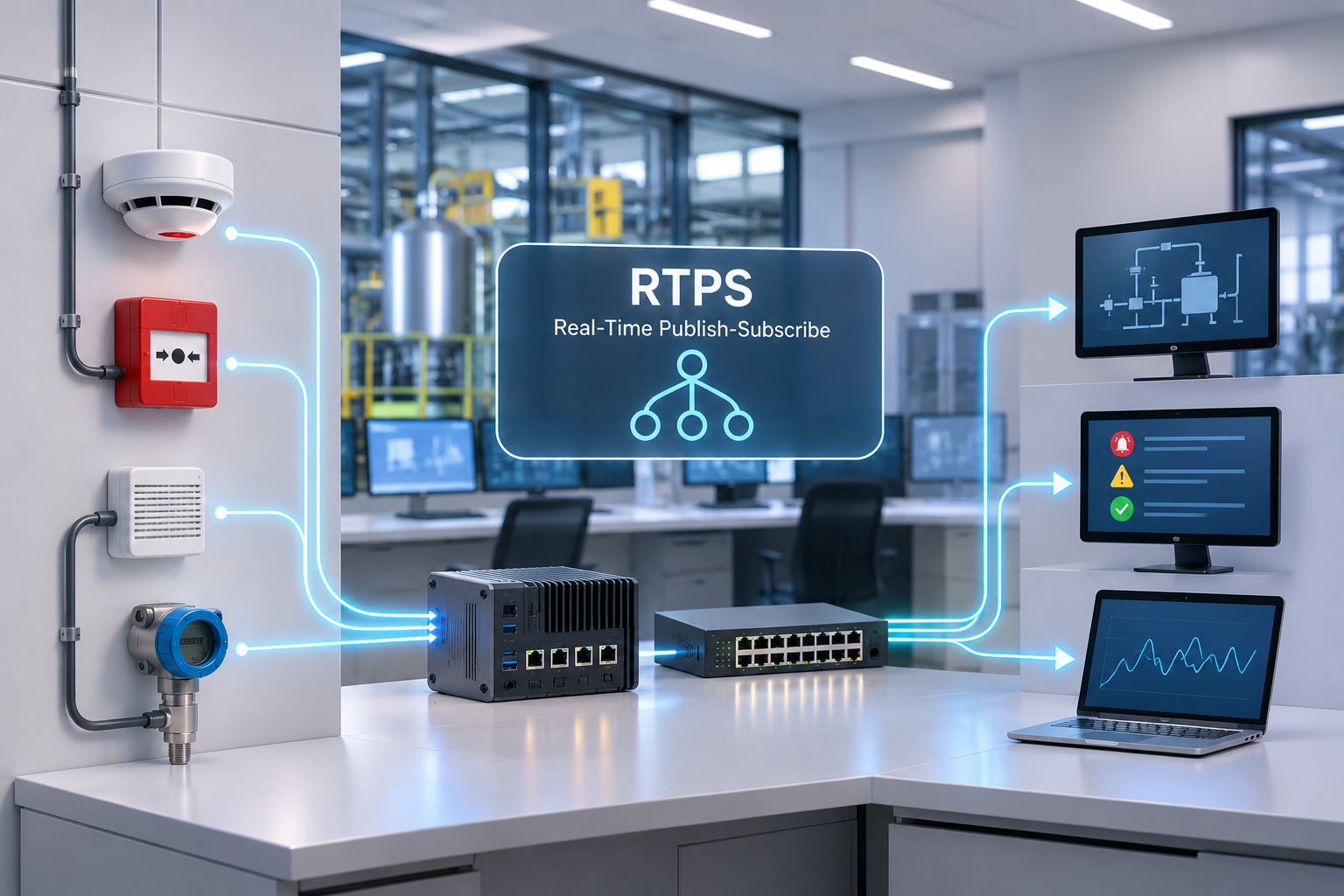
Real-time data communication is one of the important technical requirements for industrial automation, robotic systems, smart devices, and distributed control infrastructures. The low-latency sharing of data among sensors, control software, and other devices within a system is particularly crucial in time-sensitive applications.
RTPS (Real-Time Publish-Subscribe Protocol) is a standardized communication protocol used to facilitate real-time data exchange between different devices and software components. Defined by the Object Management Group (OMG), RTPS aims to enable interoperability among Data Distribution Service (DDS) system applications from various manufacturers.
RTPS stands out with its publish-subscribe communication model, automatic participant discovery, data delivery reliability, and Quality of Service (QoS) options. However, RTPS is not the same technology as the RTSP video streaming control protocol used in security cameras.
What is RTPS?
RTPS is an acronym for Real-Time Publish-Subscribe. In Turkish, it can be explained as a real-time publish-subscribe protocol.
The primary goal of RTPS is to enable applications on a network to share data with each other according to specific communication rules.
In traditional client-server communication, a client typically sends a request to a specific server and receives a response.
In the publish-subscribe model, data-producing applications publish data on specific topics. Applications that need this data subscribe to the relevant topics.
This way, data producers and consumers may not need to directly know each other's network addresses or application details.
RTPS is specifically designed for use in distributed systems where different software components need to share real-time data.
What is the Relationship Between RTPS and DDS?
To properly understand RTPS, it is necessary to explain the concept of DDS.
DDS (Data Distribution Service) is a data distribution technology standardized by the OMG to enable data exchange among distributed applications.
DDS defines which data applications will publish, which data they will subscribe to, and which Quality of Service rules will be applied in data exchange.
RTPS, on the other hand, specifies the standard communication mechanisms required for different DDS applications to exchange data over a network.
In simple terms:
DDS: Defines how an application manages data distribution.
RTPS: Defines how compatible DDS participants communicate over the network.
For example, common RTPS communication rules can be utilized for DDS-based software from different manufacturers to share data on the same network.
However, supporting the same RTPS version alone does not guarantee that all systems will operate seamlessly. Data types, QoS settings, and security configurations must also be compatible.
How Does RTPS Work?
RTPS relies on a communication architecture where components that publish data and those that subscribe to it work together.
The basic operational steps are as follows:
Applications join a DDS communication domain.
Data producers and consumers create their respective communication endpoints.
Suitable participants and communication endpoints identify each other through discovery mechanisms.
The data topic, data type, and QoS conditions are compared.
When compatibility is established, data is published and delivered to subscribers.
Necessary delivery checks are performed according to the selected reliability mechanism.
Applications use the incoming data in their own processing and decision-making mechanisms.
What are Publisher and Subscriber?
A Publisher is a DDS component used on the data publishing side of an application.
A Subscriber is a component used for receiving published data.
Actual data sending and receiving are performed via DataWriter and DataReader.
What is a Topic?
A Topic is a DDS concept that defines the subject and data type of the shared data.
For example, in an industrial automation application, the following data topics can be defined:
Machine temperature.
Motor operating status.
Ambient pressure.
Sensor health information.
Alarm event.
Control status.
These examples are hypothetical data types where RTPS could be used; they do not indicate that a specific security device has RTPS support.
What is a Domain?
A Domain defines the logical communication space for participants in a DDS system.
Applications in different domains do not directly reside in the same communication environment without additional routing or bridging mechanisms.
This separation can be used to logically organize data traffic from different systems.
However, domain separation alone is not a strong cybersecurity boundary or authentication mechanism.
RTPS Message Structure and Automatic Discovery
In RTPS communication, it is crucial for participants to find each other and for the necessary endpoints for data exchange to be identified.
The DDSI-RTPS standard defines the communication rules for data exchange and participant discovery.
Key mechanisms include:
Participant Discovery: Helps in discovering suitable DDS participants on the network.
Endpoint Discovery: Enables the identification of which applications publish or consume which data topics.
DATA messages: Used for transmitting data samples.
HEARTBEAT messages: Provide information about the sender's data status in reliable transmission.
ACKNACK messages: Can be used by the receiver to acknowledge data delivery and report missing samples.
These mechanisms help control communication, especially in applications requiring reliable data transfer.
However, automatic discovery does not mean it will work without additional configuration in all network topologies. VLAN, router, firewall, and multicast settings can affect communication.
What is RTPS QoS? How is Quality of Service Managed?
One of the important features of the RTPS/DDS architecture is that data communication can be configured according to requirements.
QoS (Quality of Service) is a set of rules that affect how data is transmitted and the communication behavior of applications.
In DDS systems, QoS policies have different functions.
QoS feature | Primary function | Importance in use |
|---|---|---|
Reliability | Data delivery reliability | Retransmission of missing data |
Durability | Access to previously published data | Subscribers joining later |
History | Scope of stored data samples | Management of current or past samples |
Deadline | Expected data update time | Detection of delayed data updates |
Liveliness | Activity status of the data source | Monitoring communication endpoints |
Latency Budget | Definition of latency expectation | Time-sensitive data processing |
The availability and actual effects of these options depend on the DDS application, selected settings, and system resources.
Difference Between Best Effort and Reliable
In RTPS communication, two fundamental reliability approaches are defined as Best Effort and Reliable.
Best Effort is a communication approach that does not necessarily require the retransmission of missing data samples.
For example, in certain applications, the rapid transmission of continuously updated temperature or location data might be more critical than retransmitting an old sample.
Reliable, on the other hand, uses reliability mechanisms that ensure the retransmission of missing data samples under selected conditions.
However, the Reliable option does not guarantee that all data will be delivered indefinitely in the event of a complete network outage or depletion of system resources.
In real-time systems, an appropriate balance must be struck between speed, reliability, and resource consumption.
Does RTPS Use UDP or TCP?
RTPS was initially strongly associated with UDP-based communication.
UDP is a connectionless transport protocol that provides packet delivery.
The ability to use RTPS over UDP can offer advantages, especially in applications requiring low latency and multicast data distribution.
Some DDS implementations also support alternative transport methods such as TCP and shared memory.
For instance, eProsima Fast DDS can utilize shared memory in suitable local applications, in addition to UDP and TCP communication options.
However, TCP or shared memory support should not be considered a mandatory feature present in all RTPS implementations.
Unicast and Multicast Communication
Unicast: Data is sent to a specific receiver.
Multicast: Data can be distributed to multiple receivers with appropriate network configuration.
The use of multicast can reduce unnecessary redundant data transmission in some scenarios.
However, multicast traffic routing requires proper configuration of network switches, IGMP, and firewall settings.
What is the Difference Between RTPS and RTSP?
Although RTPS and RTSP have similar names, they are protocols used for different purposes.
RTPS (Real-Time Publish-Subscribe) was developed for real-time data sharing in distributed systems and for interoperability between DDS applications.
RTSP (Real-Time Streaming Protocol), on the other hand, is used for session management of media streams such as video and audio.
Comparison | RTPS | RTSP |
|---|---|---|
Full Name | Real-Time Publish-Subscribe | Real-Time Streaming Protocol |
Primary Purpose | Real-time data distribution | Media stream control |
Related Standard | OMG DDSI-RTPS | IETF RFC 7826 |
Core Approach | Publish/Subscribe | Client-server session control |
Data Content | Structured application data | Audio/video streaming sessions |
Usage Examples | Industrial automation, robotics, distributed applications | IP camera, media server, video surveillance |
Key Settings | Topic, QoS, data type, discovery | Media session, streaming method, playback control |
Does RTPS Transmit IP Camera Footage?
RTPS does not directly replace the RTSP protocol, which is commonly used for obtaining camera footage in standard CCTV systems.
RTSP and related media transport methods can be used for an IP camera to transmit live footage to an NVR or VMS system.
RTPS, on the other hand, can be used for sharing data such as sensor measurements, device statuses, or event messages in appropriately developed distributed software.
For differences between RTSP and ONVIF in terms of security cameras, GüvenlikOnline's article What is ONVIF? What Does It Do in IP Camera and NVR Systems? can be reviewed.
Are RTPS and RTP the Same?
No.
RTP (Real-time Transport Protocol) is a different protocol used for transporting real-time audio and video data.
RTPS, on the other hand, is used in DDS-based data distribution.
Although RTP, RTSP, and RTPS are all related to real-time communication, they do not perform the same function.
In Which Areas is RTPS Used?
RTPS can be particularly valuable in systems where multiple software components require low-latency and configurable communication.
Industrial Automation
DDS/RTPS-based solutions can be used in manufacturing facilities for sharing measurement, machine status, or event data among different control and analysis components.
However, it should not be assumed that all PLC, SCADA, or BMS devices support RTPS.
Robotics and Autonomous Systems
In robotic applications, distributing data from various sensors to control algorithms is crucial.
DDS is among the communication technologies used in robotic software ecosystems like ROS 2.
RTPS, in turn, can play a role in the data communication of suitable DDS applications.
Industrial IoT
In Industrial Internet of Things (IIoT) systems, data from different devices may need to be processed within the same data distribution infrastructure.
RTPS/DDS can be considered for applications requiring low latency and customizable communication behavior.
However, due to power consumption, device resources, and network requirements, it may not be the most suitable option for every IoT project.
Physical Security and Alarm Integration
In security systems, sharing event data among different sensors, software, and operator applications is a critical requirement.
In a specialized security software architecture utilizing DDS/RTPS, alarm events, device health status, and environmental sensor data can be shared via a common data distribution mechanism.
However, this usage represents a possible system architecture; it does not indicate that common CCTV, NVR, or intruder alarm devices have RTPS support.
For a security device to be usable with RTPS, the manufacturer must provide protocol support or an appropriate software gateway.
Defense and Aerospace
DDS/RTPS is among the technologies that can be used in defense, aerospace, and similar systems where high performance and interoperability requirements exist for data communication.
In such applications, latency, reliability, and security requirements are evaluated separately according to the project's technical specifications.
How is RTPS Cybersecurity Ensured?
The standardization of RTPS does not mean that communication is end-to-end encrypted and secure by default.
In a system using RTPS/DDS, authentication, access control, network security, and data protection must be considered separately.
The DDS Security 1.2 standard published by OMG defines the security model and plugin interfaces for DDS applications.
In suitable systems, the following security functions can be implemented:
Participant authentication.
Access authorization to data topics.
Protection of data integrity.
Encryption of necessary data.
Restriction of communication participants according to security policies.
However, the existence of the DDS Security standard does not mean that every DDS or RTPS software used automatically enables all these functions.
Considerations for Network Security
In networks where RTPS is used, the following technical aspects should be particularly controlled:
Used UDP or TCP communication connections.
Required network access for participant discovery.
Multicast and router configuration.
Firewall and network access rules.
DDS domain and topic authorization.
Authentication and encryption support.
Software and library versions.
Monitoring of packet loss, latency, and system resources.
The fact that the protocol is designed for real-time communication alone does not guarantee a definitive latency limit or complete protection against cyberattacks.
RTPS Standard and Current Versions
RTPS has been standardized by the Object Management Group (OMG) to support interoperability among DDS applications.
The official name of the protocol is DDS Interoperability Wire Protocol (DDSI-RTPS).
In OMG's published version history:
Version | Publication Year |
|---|---|
DDSI-RTPS 2.0 | 2008 |
DDSI-RTPS 2.1 | 2010 |
DDSI-RTPS 2.2 | 2014 |
DDSI-RTPS 2.3 | 2019 |
DDSI-RTPS 2.5 | 2022 |
is included.
As of November 2026, DDSI-RTPS 2.5 is listed as the current official version in OMG's official catalog.
For DDS Security, version 1.2 has been published.
However, the RTPS version supported by the software in use does not necessarily have to be the same as the most current version of the OMG standard.
For example, different DDS implementations may have protocol support for 2.3 or 2.5.
Therefore, interoperability assessment should be performed not solely based on the standard name, but also on the product version, data models, and QoS configuration.
Technical Checklist for Systems Using RTPS
In a project where the RTPS/DDS architecture will be used, the following checks should be performed:
Has the use case where RTPS is truly necessary been identified?
Have the DDS and RTPS versions of the applications to be used been verified?
Have data publishers and subscribers been defined?
Have topic names and data types been standardized?
Have Reliability and other QoS requirements been determined?
Have expected latency and update frequency been measurably defined?
Has UDP, TCP, and multicast support been verified?
Has participant discovery been tested across different network segments?
Have packet loss and network outage scenarios been evaluated?
Have security policies and access permissions been configured?
Has DDS Security support and application scope been checked?
Has interoperability with applications from different manufacturers been tested?
Has the application's network and processor resource consumption been measured?
Have system monitoring, fault diagnosis, and maintenance processes been established?
This checklist is for preliminary technical evaluation. In time-critical or life-safety related systems, additional functional safety and system engineering requirements must also be applied.
Frequently Asked Questions About RTPS
What does RTPS stand for?
RTPS stands for Real-Time Publish-Subscribe. It is a standardized communication protocol used for real-time data exchange in DDS-based distributed applications.
Are RTPS and RTSP the same?
No. RTPS is a protocol for DDS data distribution. RTSP is used to control video/audio streaming sessions in IP cameras and other media applications.
Which port does RTPS use?
RTPS network connections depend on the transport method, domain, and participant configuration of the DDS application used. Although there are standard port calculation rules for UDP-based communication, a single, immutable port should not be assumed for all applications.
Does RTPS use UDP?
Yes. UDP is one of the common transport methods for RTPS. Some DDS implementations also support TCP and other transport mechanisms.
Is RTPS secure?
RTPS alone does not automatically meet all security requirements. Appropriate DDS Security functions, access control, encryption, and secure network configuration are necessary.
What is the difference between RTPS and MQTT?
Both are associated with the publish-subscribe data approach. MQTT, in its common use, is a broker-centric lightweight messaging protocol, while DDS/RTPS stands out with data-centric distributed communication and detailed QoS options. Both technologies may have different architectural and application options.
Is RTPS used in IP camera systems?
In standard IP camera live footage transmission, media streaming protocols like RTSP are more common. RTPS can be used for data communication in specially developed DDS-based integrations.
Why is RTPS Important for Real-Time Systems?
RTPS is an important communication protocol that enables data to be shared in a standardized manner among different applications in distributed systems.
When used with the DDS architecture, it offers features such as a publish-subscribe model, participant discovery, QoS options, and reliable data transmission.
It can be particularly valuable in industrial automation, robotics, distributed control, and time-sensitive data processing systems.
However, RTPS's support for real-time data distribution does not mean it guarantees definitive latency in every application or that it can replace RTSP in CCTV systems.
The correct protocol selection should be made by jointly evaluating the type of data to be transferred, system architecture, latency requirements, security, application compatibility, and operating conditions.