
What is CAT Cable? Differences Between Cat5e, Cat6, Cat6A, Cat7, and Cat8
What is a CAT cable, what is its purpose, and which type should be preferred? We compare Cat5e, Cat6, Cat6A, Cat7, and Cat8 Ethernet cables based on speed, frequency, distance, and application areas. We examine UTP, FTP, SFTP, RJ45, PoE, IP camera cabling, copper conductor quality, and technical criteria for correct cable selection.
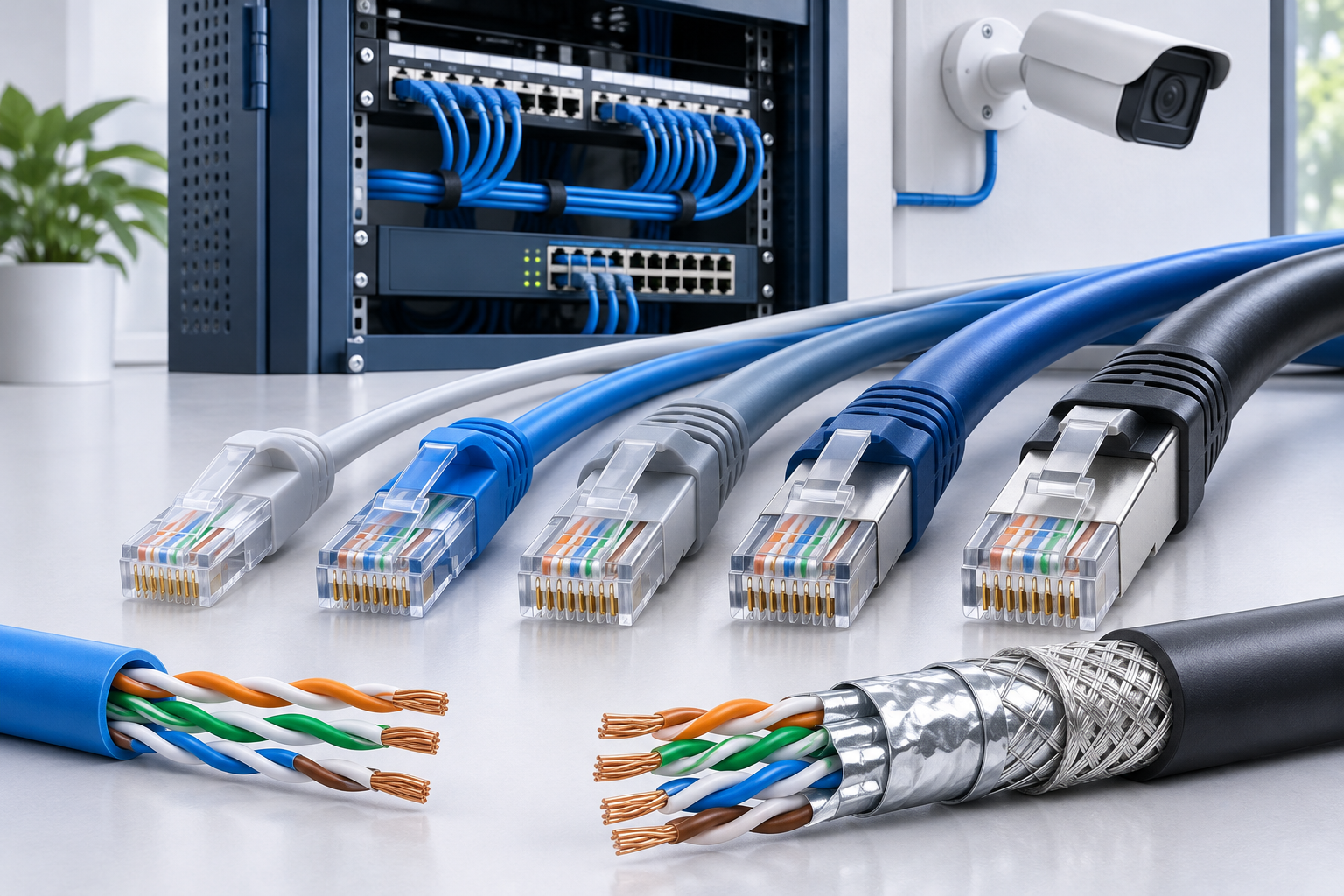
A CAT cable is a communication cable consisting of twisted copper conductor pairs, used to provide data communication between computers, security cameras, network switches, IP phones, and other network devices. Today, it is widely used in home and office networks, as well as in CCTV, access control, building automation, and industrial Ethernet infrastructures.
The term CAT is an abbreviation for the English word Category. Classifications such as Cat5e, Cat6, Cat6A, Cat7, and Cat8 define the specific electrical transmission characteristics and performance levels of cables.
The main differences between CAT cables are evaluated based on transmission frequency, signal loss, interference immunity, supported Ethernet applications, and usable connection distance.
However, it should not be assumed that a cable with a higher category number will always yield faster or better results in every application. The correct cable selection should be made according to the technical specifications of the network devices to be used and the project's needs.
What is a CAT Cable?
A CAT cable is the general name for the family of balanced twisted-pair cables used specifically in Ethernet networks.
Standard four-pair Ethernet cables contain a total of eight copper conductors. These conductors are twisted together in groups of two, forming four separate twisted pairs.
The twisted-pair structure helps reduce electromagnetic interference and unwanted signal interactions that can occur between pairs within the cable.
A typical four-pair CAT cable includes the following color groups:
Blue / white-blue.
Orange / white-orange.
Green / white-green.
Brown / white-brown.
These pairs are used in Ethernet communication with appropriate termination methods.
The application areas of CAT cables are not limited to internet connectivity. Data and electrical power can also be transmitted over the same cable with suitable devices.
This feature provides significant advantages, especially for PoE-enabled IP security cameras and other electronic security devices.
How Does a CAT Cable Work?
In Ethernet communication, data is transmitted using electrical signals over copper conductors.
Twisted-pair cabling helps reduce the effect of certain external interference thanks to differential signal transmission.
The main electrical parameters that determine the performance of a CAT cable are:
Frequency: Refers to the signal frequency range at which the cable is tested under standards.
Insertion Loss: Describes the attenuation of the signal along the cable.
NEXT (Near-End Crosstalk): Refers to unwanted signal interaction occurring at the near end between pairs in the cable.
Return Loss: Is related to signal reflections caused by impedance mismatches.
Alien Crosstalk: Refers to the effect of signals in one cable on neighboring cables. It is especially important in high-speed and dense cable bundles.
The conformity of a cable to the relevant category is determined not only by the CAT value written on its outer jacket but also by the verification of these and other necessary parameters according to standards.
What are the Types of CAT Cables?
The main cable categories used in Ethernet networks can be listed as Cat5e, Cat6, Cat6A, Cat7, and Cat8.
These categories have been developed for different bandwidth and usage requirements.
What is Cat5e Cable?
Cat5e is an abbreviation for Category 5 Enhanced.
Cat5e cables have electrical performance characteristics defined up to 100 MHz frequency.
With appropriate four-pair cabling and network devices, they can support 1000BASE-T Gigabit Ethernet communication up to 100 meters.
Primary application areas:
Home and small office networks.
IP security cameras.
IP phone systems.
Basic data communication infrastructures.
PoE-enabled devices with low to medium power requirements.
Cat5e infrastructures can also support higher Ethernet speeds like 2.5GBASE-T under suitable cable quality and connection conditions.
However, it should not be assumed that every existing Cat5e connection will work flawlessly in all multi-gigabit applications.
What is Cat6 Cable?
Cat6 is one of the widely used Ethernet cable categories in structured cabling and electronic security systems today.
Cat6 cables have defined transmission performance up to 250 MHz frequency.
Properly installed Cat6 systems can be used for Gigabit Ethernet connections up to 100 meters.
Under certain conditions, they can also support 10GBASE-T, i.e., 10 Gigabit Ethernet applications.
However, the usable distance for 10 Gbps transmission over Cat6 depends on the cable's shielding structure and especially on interference from neighboring cables. While approximately 37–55 meters is a common design reference, the actual upper limit must be verified with installation test results.
Common application areas for Cat6 cables:
IP CCTV camera systems.
Office and enterprise networks.
NVR and network switch connections.
IP phone infrastructures.
Access control systems.
Wireless access points.
Smart building and automation networks.
Cat6 cable selection can be considered especially in projects requiring Gigabit Ethernet and standard PoE.
What is Cat6A Cable?
Cat6A is an abbreviation for Category 6 Augmented.
Cat6A cables have transmission characteristics defined up to 500 MHz frequency.
10GBASE-T communication up to 100 meters can be supported in a Cat6A/Class EA channel created with appropriate cable, connectors, and connection equipment.
This feature is one of the most important technical differences between Cat6 and Cat6A.
The Cat6A product family offers shielded or unshielded cable options, depending on the model.
Prominent application areas:
10 Gigabit Ethernet infrastructures.
High-performance enterprise networks.
High-speed wireless access points.
Infrastructures with powerful PoE devices.
Buildings where network capacity is planned to be increased in the future.
Technical areas requiring high data traffic.
However, Cat6A cable may be thicker, less flexible, or more costly than Cat6. This varies depending on the product's structure.
Therefore, using Cat6A is not mandatory for all small office or camera applications.
What is Cat7 Cable?
Cat7 is a cable category defined under ISO/IEC cabling standards and associated with 600 MHz frequency performance.
It is linked to Class F connectivity infrastructures.
Cat7 solutions typically feature individually shielded twisted pairs and an overall outer shield.
There is an important standard distinction here:
Cat7 is not a category adopted by TIA in the same way as Cat5e, Cat6, Cat6A, and Cat8.
Additionally, special connection solutions like GG45 or TERA may be used in systems compliant with full Class F performance.
It should not be assumed that every Cat7 cable sold with RJ45 connectors automatically provides end-to-end Class F performance.
Therefore, when evaluating Cat7 products, the compatibility of the cable, as well as the connectors, patch panels, and all channel components, should be checked.
It should not be concluded that Cat7 is a better investment than Cat6A simply because its category number is higher.
What is Cat8 Cable?
Cat8 is a cable category developed for high-speed and short-distance Ethernet connections.
Cat8 cabling has defined performance characteristics up to 2,000 MHz, or 2 GHz, frequency.
It supports channel designs up to 30 meters with suitable systems for Ethernet applications such as 25GBASE-T and 40GBASE-T.
Primary application areas for Cat8:
Data center rack connections.
Short-distance connections between servers and network switches.
Special network applications requiring high bandwidth.
While TIA Cat8 systems can use the standard eight-position modular connection structure, connection components in ISO/IEC Class I and Class II architectures may differ.
Cat8 cable is not a cable that carries 40 Gbps data over 100 meters in all conditions.
The 30-meter channel limit used for 25/40 Gigabit Ethernet is an important design criterion for this category.
Using Cat8 in a standard IP camera connection generally does not provide additional performance advantages.
Differences Between Cat5e, Cat6, Cat6A, Cat7, and Cat8
Category | Specified frequency | Typical Ethernet application | Distance |
|---|---|---|---|
Cat5e | 100 MHz | 1 Gbps; multi-gigabit under suitable conditions | 100 m for 1 Gbps |
Cat6 | 250 MHz | 1 Gbps; 10 Gbps depending on conditions | 100 m for 1 Gbps; shorter for 10 Gbps |
Cat6A | 500 MHz | 10 Gbps | 100 m |
Cat7 | 600 MHz | 10 Gbps in a suitable Class F system | 100 m |
Cat8 | 2,000 MHz | 25/40 Gbps | 30 m |
The values specified in the table summarize standardized usage scenarios. Lower or different speeds may also be supported in specific Ethernet applications.
Important: The MHz value is not directly the data transfer speed. For example, the connection speed of a Cat6A cable with a 500 MHz frequency class will not be 10 Gbps if the network switch and connected devices do not support it.
For a more detailed comparison of two categories, GüvenlikOnline's article What is the difference between Cat6 and Cat6a? can be reviewed.
What is the Difference Between UTP, FTP, and SFTP CAT Cables?
CAT cables are classified not only by data transmission categories but also by their shielding structures used against electromagnetic interference.
Terms such as UTP, FTP, and SFTP are used in the market. More precise definitions should be preferred in technical documentation.
U/UTP — Unshielded Twisted Pair Cable
U/UTP cable does not have metallic shielding around the twisted pairs.
Signal integrity is ensured through the cable's balanced transmission structure and the twisting characteristics of the pairs.
It is commonly used in home and office environments with suitable electromagnetic conditions.
F/UTP — Overall Foil Shielded Cable
F/UTP cable has a common foil shield around all four twisted pairs.
This shield can help reduce external electromagnetic effects in properly designed and installed systems.
S/FTP — Braid and Pair-Based Foil Shielding
S/FTP cables have an outer braid shield and individual foil shielding around each twisted pair.
This structure can contribute to reducing external interference and unwanted interaction between pairs under suitable conditions.
Is Shielded Cable Always Better?
No.
To benefit from the technical advantages of a shielded cable, the connection equipment and shielding integrity must be properly designed.
A system with incorrectly terminated or incompatible shielding components may not provide the expected performance.
Therefore, when choosing a cable, one should look not only at the UTP or SFTP designation but also at the project's electromagnetic conditions, appropriate grounding and equipotential bonding design, cable category, and application standard.
What is RJ45 in CAT Cables?
RJ45 is the practical name used for the eight-position modular connection interface commonly used in Ethernet cables.
Technically, this connection structure is usually defined as 8P8C.
The modular plugs used at the cable ends and wall outlets must be compatible with the appropriate CAT standard and cable type.
For example, for a line created using Cat6A cable to provide the required performance, it must be terminated with appropriate Cat6A connection components.
Simply upgrading the cable to a higher category does not automatically upgrade the entire connection channel to the same category.
What are T568A and T568B?
T568A and T568B are two termination schemes that define the color order in which the eight conductors in Ethernet cables are placed onto the connector pins.
The main difference between them is the pin positions of the orange and green pairs.
Both schemes can be used in accordance with relevant standards.
When preparing a new standard straight-through Ethernet connection, the same termination scheme must be applied at both ends of the connection.
Using T568A at one end and T568B at the other creates a different connection and can cause an error in cable testing if applied incorrectly.
More importantly, conductors going to the same pins at both ends does not necessarily mean that the twisted pairs are correctly preserved. Split pair errors created by incorrect pairing can cause communication problems at high frequencies, even if the electrical continuity test passes.
What is the Maximum Usable Length for CAT Cable?
The most common design limit for standard copper Ethernet cabling is a 100-meter channel.
In categories such as Cat5e, Cat6, and Cat6A, the general structured cabling design is created as follows:
Standard Ethernet channel length
90 m
Permanent Link10 m
Total patch cables100 m
Total channel limitFor example, when designing a permanent cable run from a network cabinet to an IP camera, the total channel length, including patch panel, patch cable, outlet, and camera connections, must be considered.
Can CAT Cable Be Used Beyond 100 Meters?
Some specialized Ethernet and long-distance PoE products can offer connections beyond standard distance limits.
However, in these applications, data speed may decrease, or special network equipment may be required.
For example, GüvenlikOnline's Excel Xtend with 250 Meter PoE review explains that longer distances can be achieved with certain products, but with speed limitations such as 10 Mbps at 250 meters.
Therefore, it should not be assumed that a standard Cat6 cable will work flawlessly in every Ethernet application over 200–250 meters.
For longer distances, suitable PoE extenders, intermediate network switches, or fiber optic connections can be considered.
Which CAT Cable Should Be Used in IP Camera Systems?
IP security cameras are one of the most common application areas for CAT cables.
Most modern IP cameras establish network connections over Ethernet. PoE-enabled models can also receive power over the same cable.
However, not all IP cameras have the same bandwidth or power requirements.
Standard IP Camera Applications
For many IP camera projects with basic network communication and standard PoE requirements, good quality Cat5e or Cat6 cable can be used.
In new installations, Cat6 is one of the common and technically viable options.
High Power Consumption PTZ Cameras
Motorized PTZ cameras may consume higher power due to features like IR illumination, heaters, or other functionalities.
For these devices, not only Ethernet speed but also the following parameters are important in cable selection:
The actual copper structure of the conductor.
Cable length.
Conductor resistance.
PoE standard.
Camera power consumption.
Temperature rise in the cable bundle.
Network switch's total PoE power budget.
In infrastructures with high-power and numerous PoE devices, suitable Cat6A options can be considered. However, using Cat6A alone does not eliminate all power issues.
Outdoor IP Camera Cabling
The jacket material of CAT cables used outdoors must be suitable for environmental conditions.
Especially in areas with a risk of exposure to UV radiation, humidity, and water, appropriate outdoor products should be selected.
It should not be assumed that a cable inside a conduit or duct is completely protected from water and moisture effects under all conditions.
In outdoor applications, lightning-induced overvoltages, grounding, and appropriate protection equipment should also be considered.
For more technical information, GüvenlikOnline's article How to Cable When Migrating from Analog to IP? What to Consider? can be reviewed.
What is PoE? How is Electricity Transmitted Over CAT Cable?
PoE (Power over Ethernet) is a technology that enables the transmission of electrical power along with data communication over a suitable Ethernet connection.
Thanks to PoE, IP cameras, IP phones, wireless access points, and certain electronic security devices can operate without a separate power adapter.
There are two main components in PoE systems:
PSE (Power Sourcing Equipment): A device that provides power, such as a PoE network switch or injector.
PD (Powered Device): A device that receives power, such as an IP camera or IP phone.
PoE Standards Comparison
PoE type | IEEE standard | Maximum power at source |
|---|---|---|
PoE / Type 1 | IEEE 802.3af | 15.4 W |
PoE+ / Type 2 | IEEE 802.3at | 30 W |
PoE++ / Type 3 | IEEE 802.3bt | 60 W |
PoE++ / Type 4 | IEEE 802.3bt | 90 W |
These values represent the standard maximum power classes at the power source side.
Due to losses in the cable, the usable power at the device side is lower. For example, for IEEE 802.3bt Type 4, the maximum power at the device side is defined as 71.3 W under suitable standard conditions.
PoE compatibility does not depend solely on the CAT cable category. The network switch, camera, connection components, and cable infrastructure must be evaluated together.
In cable bundles carrying high power, temperature rise and conductor resistance are important design criteria.
What is the Difference Between Full Copper CAT Cable and CCA Cable?
One of the most important considerations when purchasing CAT cable is the conductor material.
Full Copper Cable
Standard-compliant copper conductor CAT cables are designed for use in appropriate structured cabling and PoE applications.
The conductor cross-section, resistance, and other electrical properties must meet the requirements of the relevant cable category.
CCA Cable
CCA stands for Copper Clad Aluminum.
In CCA cables, the inner part of the conductor is aluminum, and the outer surface is a thin copper layer.
This structure can create higher electrical resistance compared to cables with actual copper conductors.
Potential risks:
Greater voltage drop.
More heating in PoE applications.
Mechanical fragility.
Termination problems.
Non-compliance with standards.
According to technical explanations from Fluke Networks and Belden, CCA cables should not be used in place of structured cabling products that meet the copper conductor requirements of relevant standards.
Especially in long-distance IP camera and high-power PoE projects, actual copper conductor cable compliant with the relevant standard should be preferred over CCA.
What is the Difference Between CAT Cable and Fiber Optic Cable?
CAT cables use electrical signals, while fiber optic cables transmit data with light signals.
Criterion | CAT copper cable | Fiber optic cable |
|---|---|---|
Transmission method | Electrical signal | Optical signal |
Typical standard distance | 100 m in most Ethernet channels | Longer depending on fiber type and optics |
Electromagnetic interference | Can be affected by design and shielding | Fiber itself is not affected by EMI |
PoE power transmission | Supported | PoE is not provided over standard optical fiber |
Termination | Appropriate copper connection equipment | Fiber connector and optical equipment |
Usage | End device connections | Building backbones and long distance |
Especially in shopping malls, factories, campuses, and large perimeter security projects, copper CAT and fiber optic cabling can be used together.
For example, fiber optic backbones can be laid to points where remote security cameras are located, and CAT cable connections can be made from suitable field network switches to the cameras.
This approach offers an alternative to trying to cover the entire distance with a single long copper Ethernet line.
PVC, LSZH, and Outdoor Jackets in CAT Cables
The outer jacket of a CAT cable must be suitable for its application area, as much as its electrical performance.
PVC: One of the common cable jacket materials used in various indoor applications.
LSZH / LSOH: Refers to low smoke and halogen-free material properties. It can be considered in specific indoor applications where fire behavior is important.
PE and suitable outdoor jackets: Can be used for cables in areas exposed to environmental effects such as moisture and UV.
There is an important distinction here: A cable being defined as LSZH does not automatically mean it has a specific fire reaction class.
When selecting indoor cables, the product's required fire reaction properties, relevant test documents, and applicable local regulations must also be checked.
What are the CAT Cable Standards?
International standards are used to evaluate cable categories and connection performances in structured cabling projects.
ANSI/TIA-568.2-E:2024
Published by the Telecommunications Industry Association (TIA), ANSI/TIA-568.2-E defines the performance requirements for balanced twisted-pair copper communication cables and associated connecting hardware.
The 2024 edition replaces the ANSI/TIA-568.2-D version.
ISO/IEC 11801-1:2017 + AMD1:2025
The ISO/IEC 11801 standard family addresses general-purpose structured cabling infrastructures in buildings.
ISO/IEC 11801-1:2017 has been updated with Amendment 1 dated 2025 and a corrigendum document.
In these standards, not only the cable's category but also the performance of the entire connection system is important.
For example, in ISO/IEC terminology:
Cat5e components are associated with Class D.
Cat6 components are associated with Class E.
Cat6A components are associated with Class EA.
Cat7 components are associated with Class F.
Cat8 solutions are associated with Class I or Class II.
The CAT cable category and the performance class of the installed connection channel are not the same concept.
The cable, patch panel, connectors, and patch cables must collectively provide the required performance.
How is CAT Cable Testing and Certification Performed?
In professional structured cabling projects, it is not enough for connections to merely appear to be working.
For example, an IP camera connecting to the network does not prove that the cable fully meets Cat6 or Cat6A standards.
Cable tests can be performed at different levels.
Simple Continuity Test
Helps determine if conductors are connected to the correct pins, breaks, or some short-circuit faults.
However, this test does not verify all transmission characteristics of the cable at high frequencies.
Network Connectivity Test
Link speed, network connection establishment, and specific communication conditions can be checked.
However, establishing a 1 Gbps connection does not mean the line is certified according to the relevant CAT category.
Cable Certification Test
The necessary parameters of the relevant standard are measured with appropriate field certification devices.
These include:
Wiremap.
Cable length.
Insertion Loss.
NEXT and PSNEXT.
Return Loss.
ACR-F and related combined parameters.
Alien Crosstalk in required systems.
DC resistance and resistance unbalance, which can be important for PoE.
The scope of the test should be determined according to the cable category and the selected Permanent Link or Channel test limits.
As explained in Fluke Networks' technical guides, the purpose of cable certification is not just to see that the connection works, but to measure whether the installed infrastructure provides the targeted standard performance.
Most Common Mistakes in CAT Cable Installation
Incorrect cable selection or faulty installation can cause even a high-quality cable to fail to provide the expected performance.
The main mistakes are:
Using non-standard CCA cable.
Cable length exceeding the required Ethernet limits.
Twisted pairs being untwisted too much during termination.
Using keystone, patch panel, or plugs incompatible with the cable category.
Not adhering to the allowed bend radius.
Pulling the cable with excessive tension or compression.
Creating an improper route too close to power cables.
Incorrect termination of shielded cable.
Failure to calculate PoE power consumption and temperature effects.
Not performing standard-compliant tests after installation.
Especially in CCTV projects, a connection working flawlessly during initial installation does not guarantee that errors will not occur in the long term.
Incorrect terminations, temperature changes, and mechanical effects can cause connection problems over time.
Which CAT Cable Should Be Preferred?
There is no single correct category for all projects when selecting CAT cables.
The table below provides a general preliminary assessment based on usage scenarios.
Application area | Cable to consider |
|---|---|
Home and basic office network | Cat5e or Cat6 |
Standard IP security camera | Suitable Cat5e or Cat6 |
Newly installed Gigabit office network | Cat6 |
10 Gbps enterprise network | Cat6A |
Areas with high density of high-power PoE devices | Suitable Cat6 or Cat6A; with power and heat calculation |
Short-distance 25/40 Gbps copper data center connection | Cat8 |
Long-distance CCTV backbone | Suitable fiber optic solution |
These recommendations do not replace definitive engineering design.
Especially in long-distance IP camera applications, cable selection, PoE power requirements, and network device capacity must be calculated together.
Technical Checklist for CAT Cable Selection
Before purchasing CAT cable and completing installation, the following criteria should be evaluated:
- Required Ethernet speed and cable distance determined?
- Cat5e, Cat6, Cat6A, or other category requirement verified?
- Cable checked for genuine copper conductors and standard compliance?
- U/UTP, F/UTP, or S/FTP shielding need determined?
- Indoor, outdoor, and required fire jacket properties suitable?
- Cable, patch panel, and connection equipment compatible?
- PoE device power budget calculated?
- T568A or T568B termination correctly applied?
- Cable lengths and routes checked?
- Appropriate cable testing and certification performed after installation?
- Test reports and cable labeling records prepared?
This checklist can be used for pre-project selection and field acceptance processes.
Frequently Asked Questions About CAT Cable
What does CAT cable mean?
CAT is an abbreviation for Category. It refers to the performance category of twisted-pair cables used in Ethernet and other suitable communication applications.
What is the difference between Cat5e and Cat6?
Cat5e has defined performance up to 100 MHz, while Cat6 has performance up to 250 MHz. Both can support Gigabit Ethernet up to 100 meters with suitable connections. Cat6 offers additional performance capacity for higher frequency applications.
Is Cat6 or Cat6A better?
Cat6A supports the performance class designed for 10 Gigabit Ethernet up to 100 meters in a suitable system. However, for a project requiring only Gigabit Ethernet, Cat6 may be sufficient.
Is Cat7 cable faster than Cat6A?
A higher category number does not automatically make the connection faster. Network speed is determined by all connection components and active network devices.
Is Cat8 cable used in IP camera systems?
Technically, it can be used under suitable connection conditions. However, the 25/40 Gbps capacity of Cat8 is generally not necessary for standard IP camera applications.
What is the maximum length of a CAT cable?
The common limit for standard Cat5e, Cat6, and Cat6A Ethernet channels is 100 meters. For 25/40 Gbps applications with Cat8, a 30-meter channel limit is used. Special long-distance systems may have different conditions.
Can electricity be transmitted over CAT cable?
Yes. When suitable cable, network switch, and device are used, data and electrical power can be transmitted over the same Ethernet connection using PoE technology.
Is Cat6 sufficient for IP cameras?
For many standard IP camera applications, a good quality and correctly installed Cat6 cable may be sufficient. However, in projects with high power, long distance, or special network requirements, further technical evaluation should be made.
Should UTP or SFTP be preferred?
The choice depends on electromagnetic interference conditions and the shielding design of the connection system. Shielded cable is not mandatory in every environment.
What should be considered when buying CAT cable?
Cable category, genuine copper conductor structure, manufacturer compliance documents, usage environment, PoE requirement, connection distance, and testability are key selection criteria.
Conclusion: The Right CAT Cable is the Foundation of a Reliable Network Infrastructure
CAT cables form the data communication infrastructure for many technologies, from computer networks to IP camera systems, access control devices to building automation.
Cat5e, Cat6, Cat6A, Cat7, and Cat8 categories have different electrical performance and application requirements.
While Cat6 can be considered for many standard Gigabit Ethernet projects, Cat6A stands out in suitable infrastructures requiring 10 Gigabit Ethernet up to 100 meters. Cat8 is developed for short-distance high-speed data center connections.
However, the correct CAT cable selection should not be made solely based on the category number.
Cable distance, targeted data speed, PoE power requirements, conductor quality, shielding needs, fire, and environmental conditions must be evaluated together.
True success in a professional structured cabling infrastructure is achieved through correct material selection, standard-compliant installation, proper termination, and documented certification tests.