
Visitor Identity Security in Critical Infrastructures: Document Verification and Biometric Integration
HID's ATOM document scanner and U.ARE.U face verification module are integrated on the Soloinsight CloudGate platform with CTS kiosk hardware, creating a self-service architecture that automates identity verification in critical facilities.
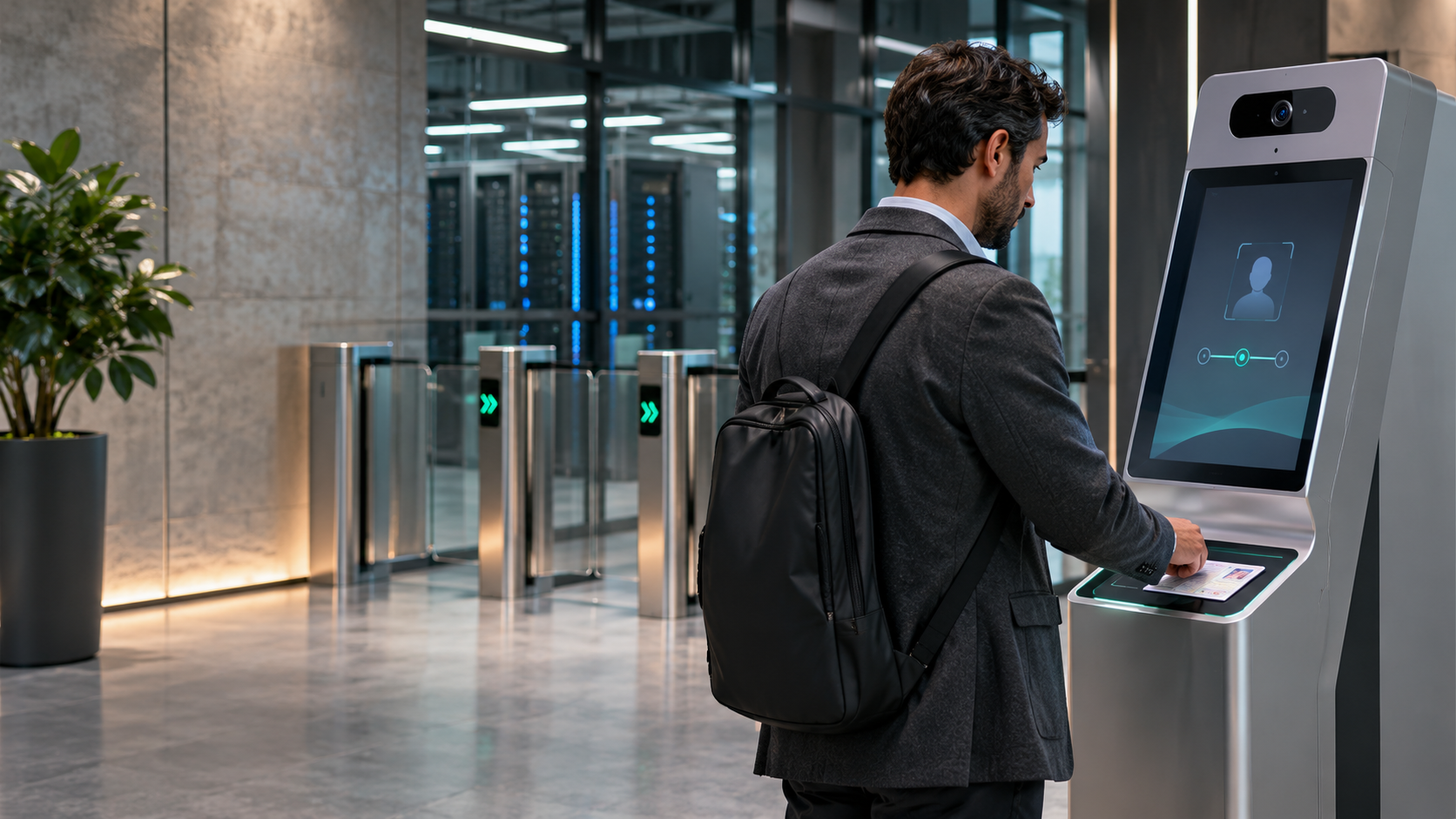
HID's ATOM document scanner and U.ARE.U face verification module are integrated on the Soloinsight CloudGate platform with CTS kiosk hardware, creating a self-service architecture that automates identity verification in critical facilities. [1]
Risks Posed by Declaration-Based Processes in Access Security
In high-security areas such as data centers, hospitals, and logistics hubs, a large number of contractors, suppliers, and visitors pass through daily. In traditional check-in procedures, the inability of reception staff to technically verify the authenticity of identity documents, or visitors gaining entry merely by declaring their names, leads to unauthorized individuals obtaining access cards and creates retrospective audit vulnerabilities.
Physical access granted with fake or unverifiable identities in regulated facilities can make retrospective tracing impossible in the event of a security breach. To ensure compliance with regulatory rules, verifying visitor identities with reliable hardware before physical access cards are even issued constitutes an operational imperative. [1]
Self-Service Kiosk Architecture and Identity Verification Layers
In the process developed as part of the integration, the host pre-registers the visitor on the Soloinsight CloudGate platform, and the system sends an invitation email containing a QR code to the visitor. Upon arrival at the self-service CTS kiosk, the visitor scans this code; subsequently, document verification is performed using the hardware-based HID ATOM reader, which can read passports, driver's licenses, or mobile ID formats.
Immediately after document presentation, the HID U.ARE.U Face Module activates to perform live facial verification. The biometric module instantly rejects the transaction if the image captured by the camera is not a live face or does not match the photo on the presented identity document. Upon successful verification, the system prints the visitor card and sends a notification to the host. [1]
Optical and Chip Security: Hardware Features Differentiating from Standard Cameras
Unlike mobile phone cameras, which are dependent on ambient light and may be insufficient in reading embedded security elements, the specialized document scanner architecture aims to minimize forgery risks. The HID ATOM unit directly reads encrypted data strips, barcodes, and RFID/NFC chips on IDs and analyzes the structural integrity elements of the document.
From a user experience perspective, visitors can process different types of documents such as passports, barcodes, or mobile IDs from a single scanning surface without needing to be directed to separate readers. [1]
PIAM, PACS, and Enterprise Audit Integration
Every verified transaction is centrally recorded by the Soloinsight CloudGate system, enabling the generation of audit evidence compliant with over 40 regulatory frameworks such as HIPAA, GDPR, SOC 2 Type II, and ISO 27001. This allows security units to access detailed historical data during incident investigations.
The architecture supports HID Signo readers and mobile identity infrastructures, while offering over 150 integration options across IT, HR, IAM, and SIEM layers with approximately 30 Physical Access Control System (PACS) connectors. The kiosk hardware produced by CTS is presented in an ADA-compliant structure. [1]
Resources
Source: HID