
ASSA ABLOY Access Control Systems: Aperio, SMARTair, and CLIQ Solutions
ASSA ABLOY access control systems offer wireless electronic locks, card and mobile access, digital keys, and centralized management solutions. We compare Aperio, SMARTair, CLIQ, Incedo, and ABLOY PULSE technologies in terms of integration, security, application areas, and correct system selection.
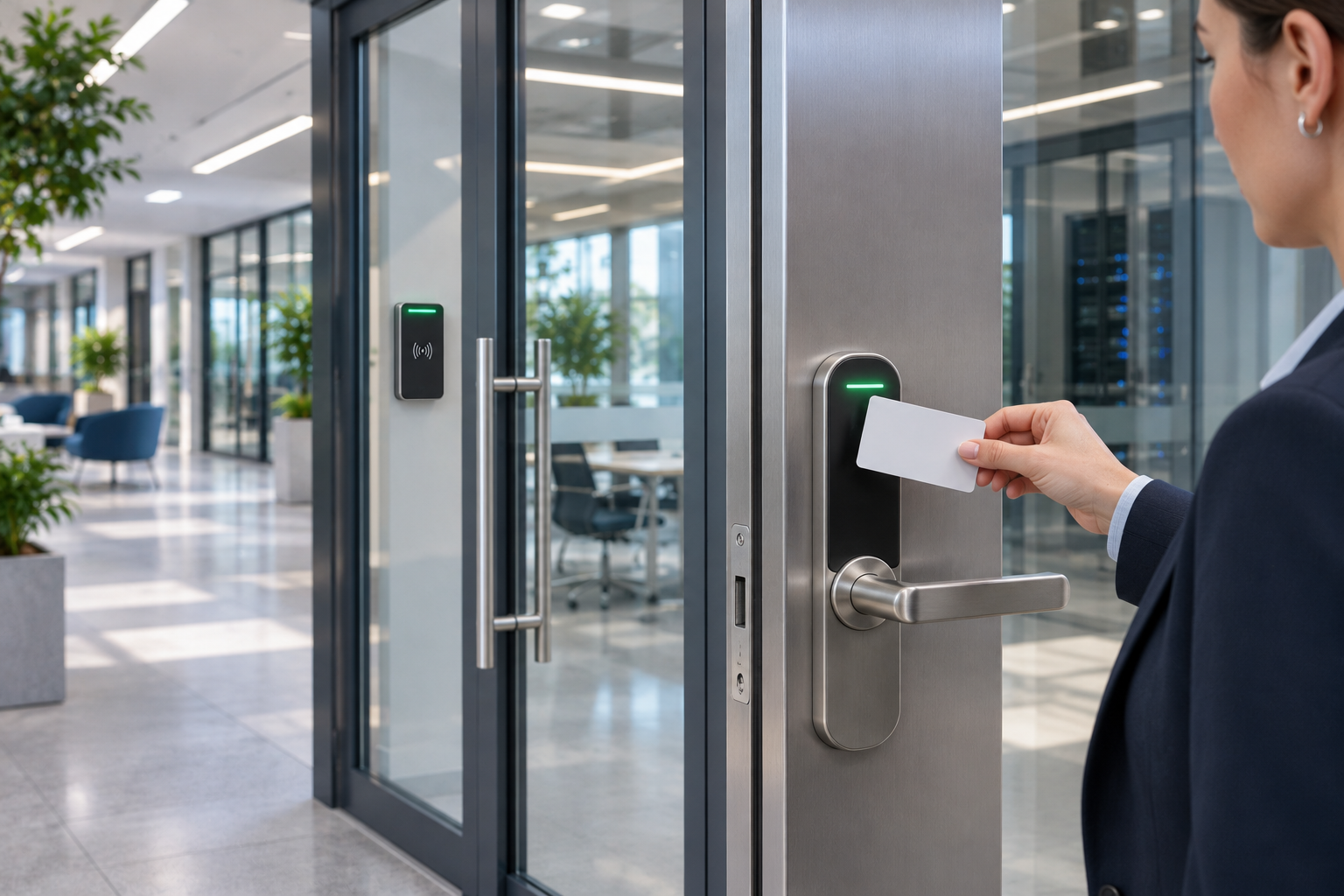
ASSA ABLOY access control systems offer a broad portfolio of solutions for managing physical access in buildings and facilities, comprising electronic locks, card readers, digital keys, mobile credentials, and centralized management software. They can be used for diverse security needs, from digitizing traditional mechanical key systems to multi-site enterprise access control infrastructures.
ASSA ABLOY's product family includes Aperio wireless electronic locks, SMARTair access control systems, CLIQ programmable key solutions, ABLOY PULSE, and the Primo access management platform. Although these technologies serve the same purpose, they differ in terms of connection architecture, authentication methods, management features, and installation requirements.
When determining the correct system, not only card or mobile access support should be considered, but also door type, existing lock infrastructure, the need for online control, fire safety, communication security, and future expansion requirements.
What is ASSA ABLOY?
ASSA ABLOY is an international group that develops mechanical and electronic locking systems, door hardware, digital access management, and building security solutions.
The group's access control portfolio combines physical door security with electronic authorization technologies.
While access in traditional mechanical locks is managed by physically duplicating or replacing a key, in digital systems, user-defined permissions can be modified within specific rules.
For example, maintenance personnel in a factory might only be granted access to specific technical rooms. If the personnel's role changes, their access permissions can be reconfigured via supported digital systems.
ASSA ABLOY's product variety makes it possible to convert existing doors to electronic access control or to install integrated systems in new constructions.
What are ASSA ABLOY Access Control Systems?
1. Aperio Wireless Access Control Systems
Aperio is an ASSA ABLOY technology developed to extend the scope of existing electronic access control systems with wireless locking devices.
The Aperio product family includes electronic cylinders, door handles, electronic escutcheons, and locking devices for specific special applications.
One of the system's significant advantages is that electronic access control can be added to suitable existing doors without running long electrical and data cables.
Key technical features of Aperio include:
Battery-powered wireless electronic lock options.
Supported RFID card and mobile credential technologies.
Online and offline operation alternatives.
Integration with compatible third-party access control systems.
Centralized management of user permissions.
Event logs and remote control in supported configurations.
A significant technical feature of the Aperio system is its use of IEEE 802.15.4-based wireless communication for lock-hub communication, rather than direct Wi-Fi.
This communication is carried out over an encrypted wireless connection. However, radio coverage and system stability can be affected by building materials, metal surfaces, hub location, and the electromagnetic environment.
Differences Between Aperio Online and Offline
Aperio Online: The lock connects to the electronic access control system via a suitable communication hub. Access decisions can be managed by the central system, and events can be transmitted in real-time in supported scenarios.
Aperio Offline: Access decisions are evaluated based on the authorization data held by the lock and the user credential. User updates are performed using methods different from the online architecture.
According to the manufacturer's stated capacities, the AH40 IP hub can communicate with up to 64 Aperio locks in a suitable configuration. However, this number does not mean that a single hub will reliably manage 64 doors in every building.
Actual capacity should be evaluated based on wireless coverage, door placement, integration, and traffic conditions.
2. SMARTair Electronic Access Control Systems
SMARTair is an electronic lock and access management system developed for businesses looking to transition from mechanical key usage to digital access control.
The SMARTair product family offers electronic door hardware with card and mobile authentication options.
The system can be utilized in offices, educational institutions, healthcare facilities, hospitality establishments, and commercial buildings.
Its main components include:
Electronic door handles and escutcheons.
Electronic cylinders.
Wall readers.
RFID cards and key fobs.
PIN verification in supported models.
Mobile access applications.
Centralized access management software.
SMARTair features multiple system architectures for businesses of varying sizes.
SMARTair Standalone
This is a standalone access control option for applications with a small number of doors and users.
It can operate without requiring a central management server for certain operations.
This approach can be considered for small offices or areas with a limited number of controlled doors.
SMARTair Offline
This architecture allows electronic locks to operate without being continuously connected to a central system.
Authorization and update processes can be carried out according to the product and management method used.
SMARTair Update on Card
In this architecture, specific authorization information can be transferred to locks via the user's card.
This means not all doors may need to be continuously online.
However, the process between the revocation of an access right and its propagation to all relevant locks should be evaluated according to the system design.
SMARTair Wireless Online
The wireless online architecture allows electronic locks to communicate with the management system via suitable communication hubs.
The manufacturer states that in certain SMARTair Wireless Online configurations, a hub can manage 30 doors within a range of up to 30 meters.
These values are architectural limits declared by the manufacturer and should not be considered as definitive on-site coverage performance.
The fundamental difference between SMARTair and Aperio: While SMARTair offers an integrated solution with its own access management options, Aperio particularly stands out with its approach of adding wireless locks to existing third-party electronic access control infrastructures.
3. CLIQ Electronic Key and Digital Locking Systems
CLIQ is an ASSA ABLOY solution family that combines traditional key usage with electronic authorization and management features.
The system utilizes programmable electronic keys, compatible lock cylinders, and access management software together.
A particularly noteworthy feature of CLIQ is its ability to digitally manage access permissions while preserving the familiar method of opening doors with a key.
In CLIQ solutions:
Access permissions can be defined for specific doors for users.
Access durations for keys can be limited.
Permissions for lost or stolen keys can be managed.
Event logs can be reviewed in supported systems.
Key permissions can be updated via programming devices.
eCLIQ within the CLIQ family is a digital access control option that operates via electronic keys and lock cylinders.
The system's energy architecture may vary depending on the product family used. Therefore, not all CLIQ devices should be assumed to have the same battery, programming, and connectivity features.
CLIQ Web Manager
CLIQ Web Manager is software developed for web-based management of supported CLIQ systems.
Authorized administrators can manage users, keys, access rights, and specific event logs.
This approach can particularly help centralize key management in organizations with multiple facilities.
However, the time it takes for access revocations to be applied to physical locks is related to the key update method used.
4. ABLOY PULSE Digital Locking Systems
ABLOY PULSE is a digital locking solution that implements electronic access control with a different energy generation approach.
A significant feature of the system is that suitable lock cylinders do not require a separate battery or electrical cable to operate.
The energy required for the locking operation is generated when the key is inserted into the cylinder.
This design can eliminate battery maintenance on the lock in certain applications.
The PULSE product family includes alternatives for door cylinders, padlocks, and other suitable locking points.
Access rights can be managed via the ASSA ABLOY Access platform in supported configurations.
However, the lock's battery-free operation does not mean the entire system is completely independent of power or communication infrastructure. The requirements for software, update devices, and other components should be examined separately.
5. Incedo and Primo Access Control Management Systems
ASSA ABLOY's Incedo ecosystem includes solutions aimed at unifying different hardware and credential components of an electronic access control system within a common management structure.
The Incedo hardware family includes access control panels, door reader modules, cards, mobile credentials, and compatible electronic locking components.
Primo is one of ASSA ABLOY's current software solutions designed to unify online and offline access points within a single management platform.
The manufacturer states the following scalability values for Primo:
Up to 10,000 doors.
1 million credentials.
Up to 250 sites or locations.
These figures represent the capacity limits declared by the manufacturer for the product. Actual project capacity must be verified in conjunction with server architecture, version, licensing, network performance, and other technical requirements.
Primo offers options for using compatible Aperio locks, readers, and certain third-party hardware within the same solution.
However, the functions supported by each integration are not identical. Software and firmware compatibility of the devices to be used should be checked before the project.
6. ASSA ABLOY Access Cloud-Based Access Management
ASSA ABLOY Access is a platform designed to unify key, card, tag, and supported mobile access technologies within a cloud-based management environment.
The system aims for centralized management of access permissions for suitable digital locking devices.
Such solutions can be considered for residential managements with multiple buildings, commercial enterprises, and facilities requiring centralized key management.
In a cloud-based access control architecture, particular attention should be paid to data hosting location, protection of access logs, behavior during internet outages, authentication, and service continuity.
ASSA ABLOY Access Control Systems Comparison
Since ASSA ABLOY product families do not focus on identical security requirements, the most suitable system should be chosen based on the application architecture rather than directly from the product name.
System | Core Technology | Management Approach | Key Application |
|---|---|---|---|
Aperio | Wireless electronic lock | Online/offline with compatible central EAC | Expanding existing access system |
SMARTair | Wireless electronic access | Standalone, offline or online | In-building door management |
CLIQ / eCLIQ | Programmable electronic key | Key and cylinder authorization | Key-based digital transformation |
ABLOY PULSE | Energy-generating digital key/cylinder | Digital authorization management | Battery-free cylinder applications |
Incedo / Primo | Access control hardware and software | Centralized multi-door system | Integrated enterprise access control |
ASSA ABLOY Access | Cloud-based platform | Centralized digital access management | Multi-site key and access management |
The information in the table compares the general architecture of the product families. It should not be assumed that all models support all features.
Technologies Used in ASSA ABLOY Access Control Systems
RFID Card and Contactless Authentication
ASSA ABLOY's suitable electronic locks and readers can support various RFID identification technologies.
These include MIFARE DESFire, Seos, and other supported technologies, depending on the product and configuration.
However, merely supporting RFID does not mean a system has an adequate level of security.
The encryption used in card authentication, key management, and the protection of credentials are important.
For example, making an access decision based solely on a card's fixed UID number is not equivalent to more secure cryptographic authentication methods.
Mobile Access Control Systems
Certain ASSA ABLOY solutions support Bluetooth Low Energy (BLE) and NFC-based mobile authentication methods.
On the SMARTair side, mobile access options like Openow are available.
Mobile access can reduce the need to carry physical cards and facilitate the distribution of digital credentials within a suitable management infrastructure.
However, when choosing mobile access, the following points should be checked:
Supported phone and operating system.
BLE or NFC communication method.
Secure storage of mobile credentials on the device.
Operating conditions without an internet connection.
Revocation of authorization if the phone is lost.
Lifecycle management of user credentials.
A device supporting Bluetooth does not mean it is compatible with all mobile access applications.
Wired and Wireless Access Control Architecture
Wired systems can offer advantages at specific access points requiring continuous connection and centralized event management.
Wireless electronic locks, on the other hand, can reduce cabling costs and installation disruption in existing structures.
However, in wireless systems, battery management, radio frequency coverage, connection latency, and behavior in case of central connection loss should be evaluated separately.
Especially at critical access points, scenarios involving connection loss and power outages should be included in commissioning tests.
Can ASSA ABLOY Systems Be Integrated with CCTV, Alarm, and T&A?
Certain ASSA ABLOY electronic access control solutions can work with compatible third-party security and building management systems.
Through these integrations, scenarios such as associating an access control event with camera footage or generating an alarm upon an unauthorized access attempt can be realized.
In supported architectures, connectivity with the following systems can be considered:
CCTV and video management software.
Intruder alarm systems.
Video intercom solutions.
Turnstile and barrier systems.
Building management systems.
Personnel Time & Attendance (T&A) systems.
However, access control and T&A are not the same function.
While an access control system manages authorization to a specific door, T&A focuses on calculating working hours and attendance information according to company rules.
The acceptance of a user's card is not definitive proof that the person physically passed through the door or started their shift.
For more details on T&A, GüvenlikOnline's article What is T&A? Personnel Tracking and Timekeeping System Guide can be reviewed.
What to Consider When Choosing an ASSA ABLOY Access Control System?
1. Door and Lock Compatibility
When selecting an electronic lock, the door's material, opening direction, existing lock case, cylinder size, and fire resistance properties should be examined.
Installation requirements may differ, especially for glass doors, fire doors, and high-traffic access points.
2. Online or Offline Operation
Not every access point may require a continuous connection to the central system.
However, in high-security areas, the speed at which access revocations are applied and when events are transmitted to the central system are crucial.
3. User and Door Capacity
The total number of users, number of doors, different authorization groups, time schedules, and future expansion needs should be evaluated.
The maximum capacity stated by the software does not guarantee that the existing server or network infrastructure will provide the same capacity.
4. Authentication Security
When using cards, mobile credentials, or electronic keys, secure authentication and authorization revocation methods should be evaluated.
In areas requiring high security, the mere presence of a physical key or credential may not be considered sufficient.
5. Fire Safety and Emergency Evacuation
Electronic lock systems must not impede safe evacuation requirements.
EN 179, EN 1125, and other applicable door hardware standards should be evaluated according to the relevant use case scenario.
Important technical distinction: A lock remaining locked from the outside when power is cut does not mean that safe exit from the inside cannot be provided. The internal exit function, mechanical panic hardware, and fire alarm integration (if any) should be evaluated together.
For fire-rated doors, the compatibility of any lock change with the door's tested and certified configuration must also be verified.
6. Software, Integration, and Maintenance
Operating the system is as important as installing it.
Specifically, the following requirements should be determined:
Remote user addition and authorization revocation.
Access to event logs.
Monitoring battery and device health status.
Software updates.
API or third-party integration support.
Backup and post-failure operation.
Technical support and spare parts processes in Turkey.
Standards and Data Security in ASSA ABLOY Access Control Systems
International standards can be utilized in the technical evaluation of electronic access control systems.
IEC 60839-11-1:2013 defines the requirements for minimum functions, performance, and test methods for electronic access control systems and components.
IEC 60839-11-2:2014 is the application guide for the planning, installation, commissioning, operation, maintenance, and documentation of these systems.
The specified versions of both standards are included in the official IEC catalog. For projects in Turkey, relevant TSE equivalents and applicable national regulations should also be checked.
KVKK and Access Logs
Electronic access control systems may process personal data such as user identity, access point, date, and time.
Therefore, the purpose for which access logs will be kept, who can view them, how long they will be stored, and how they will be protected must be determined.
If biometric access control is used, biometric data for fingerprint and authentication may fall under the scope of special categories of personal data.
For such an application, the relevant processing conditions, necessity, proportionality, and data security obligations of Law No. 6698 on the Protection of Personal Data must be evaluated separately.
In Which Areas Can ASSA ABLOY Access Control Systems Be Used?
Offices and plazas: Card or mobile access management in workspaces, meeting rooms, executive floors, and controlled office sections.
Factories and industrial facilities: Production areas, maintenance rooms, technical volumes, warehouse entrances, and areas with different security levels.
Hospitals: Controlled entry to medicine storage, laboratories, staff areas, and sections requiring special access.
Educational institutions: Classrooms, laboratories, administrative offices, staff areas, and common use points.
Hotels and hospitality establishments: Room access, staff areas, and applications requiring centralized authorization management.
Data centers: Electronic access control as a component of a suitable security architecture in critical technical rooms, server areas, and controlled entry points.
Residential complexes and residences: Building entrances, common areas, and digital key or mobile access applications within facility management.
The features of the system to be used in these areas should be determined in line with the project's security risks and operational needs.
Technical Checklist for ASSA ABLOY Systems
Have the doors to be controlled and their security levels been determined?
Have existing mechanical locks and door hardware been examined?
Has the suitability of Aperio, SMARTair, CLIQ, or other architectures been evaluated?
Have online and offline access points been differentiated?
Has the security of card and mobile credential technologies been verified?
Has a coverage test been performed for wireless systems?
Has user and door capacity been calculated?
Has battery replacement and periodic maintenance been planned?
Have lost card or key scenarios been tested?
Has behavior during power and communication outages been verified?
Have fire alarm and emergency evacuation requirements been evaluated?
Have necessary CCTV, alarm, and T&A integrations been checked?
Has personal data and access log management been defined?
Has technical support and product compatibility in Turkey been verified?
This list is for technical preliminary evaluation. Project-specific engineering assessment should be conducted for door hardware selection, fire safety, and necessary compliance procedures.
Frequently Asked Questions About ASSA ABLOY Access Control Systems
Do ASSA ABLOY access control systems work without internet?
Some standalone and offline systems can operate without an internet connection. However, different connectivity requirements may exist for remote management, cloud services, and real-time event transmission.
What is the difference between Aperio and SMARTair?
Aperio specifically focuses on adding wireless locks to existing electronic access control systems. SMARTair, on the other hand, is a solution family offering various standalone, offline, and online access management options.
Do ASSA ABLOY electronic locks run on batteries?
Aperio and SMARTair product families include battery-powered locks. ABLOY PULSE, however, uses a different energy generation technology in suitable cylinders that does not require a separate battery or cable.
Can ASSA ABLOY access control systems open doors with a mobile phone?
This is possible with supported models and suitable mobile credential solutions. However, not every electronic lock supports mobile access.
Do ASSA ABLOY systems work with other brands' access control software?
Certain product families, such as Aperio, are developed for integration with third-party systems. However, compatibility of the brand, control panel, software version, and integration method used is required.
Are ASSA ABLOY access control systems suitable for large facilities?
Enterprise management solutions like Primo support system architectures covering numerous doors and locations. Final suitability must be determined based on project capacity, licensing, security, and continuity requirements.
How Should ASSA ABLOY Access Control Systems Be Evaluated?
ASSA ABLOY offers various technologies ranging from mechanical locking infrastructure to digital access management.
Aperio can be considered for expanding existing electronic access control systems with wireless locks; SMARTair for electronic door management in facilities of different sizes; and CLIQ and ABLOY PULSE for key-based digital authorization needs.
Management platforms like Primo and ASSA ABLOY Access offer options for centralized management of access rights in various use cases.
The basis for correct system selection should not be the number of doors, but rather access security, existing infrastructure, authorization requirements, emergency evacuation safety, and operational continuity.
Whether ASSA ABLOY solutions meet project requirements must be verified through model-specific technical documents, manufacturer compatibility information, and tests conducted under actual installation conditions.