
People Counting Systems in Airports: Passenger Flow and Density Analysis
We examine 3D people counting sensors, AI-powered passenger flow analytics, check-in and security queues, real-time occupancy, KPIs, accuracy measurement, and KVKK (Personal Data Protection Law) requirements.
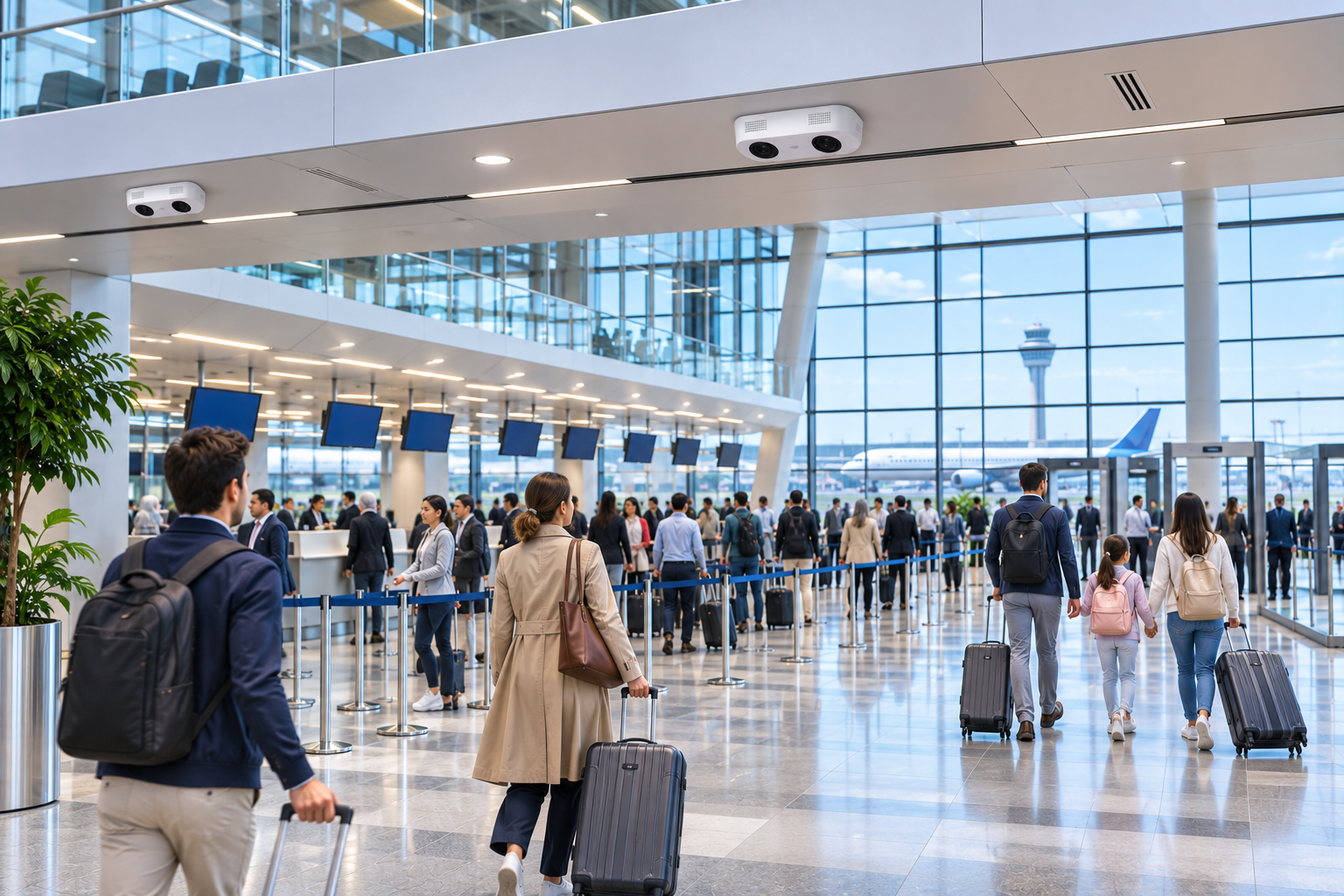
Airports are complex transportation hubs where thousands of passengers, greeters, farewell-givers, and employees move at different times of the day. Accurately measuring human traffic at terminal entrances, check-in counters, security checkpoints, passport control, waiting lounges, and boarding gates is crucial for the efficient management of airport operations.
People counting systems in airports are technological solutions that automatically detect human movements within the terminal, measure passenger transits, and analyze density in specific areas, converting them into operational reports.
Thanks to 3D people counting sensors, AI-powered video analytics, and specialized passenger flow management software, airport operators can monitor densities, queue lengths, waiting times, and area utilization to a certain extent.
These systems are primarily used to manage passenger flow, assess terminal capacity, plan service points, and support decisions aimed at reducing waiting times.
However, the total number of people in the airport, the number of passengers on flights, and the transit movements within the terminal are different data points. A reliable passenger analytics system must first clearly define the purpose for which these indicators are measured.
What is a People Counting System in Airports?
An airport people counting system is a hardware and software infrastructure that automatically detects people passing through specific terminal entrances or processing points, determines entry-exit directions, and measures area density using appropriate technologies.
Internationally, these systems can be defined by the following concepts:
Airport People Counting
Passenger Flow Monitoring
Passenger Flow Management System (PFMS)
Airport Queue Management
Passenger Tracking Analytics
Airport Occupancy Analytics
These concepts do not necessarily refer to the same technical functions.
For example, a basic people counting system can measure how many people passed through a specific gate. A Passenger Flow Management System (PFMS), with appropriate setup, can combine transit, density, waiting, and service data from multiple processing points on a common platform.
Airport people counting systems can provide the following information:
Terminal entry and exit movements.
Hourly and daily human traffic.
Number of passengers passing through specific checkpoints.
Check-in queue density.
Security control waiting time.
Density in the passport control area.
Occupancy of the boarding gate waiting area.
Utilization density of baggage claim areas.
Estimated occupancy of specific areas within the terminal.
Peak hours and bottlenecks in passenger flow.
Historical and near-term density forecasts with appropriate software infrastructure.
However, it should not be assumed that a standard people counting sensor can generate all these indicators on its own. Queue times, multi-zone passenger flow, and capacity forecasts may require additional analytical functions or data integrations.
Why is Passenger Counting Important in Airports?
One of the main challenges of airport operations is the constantly changing passenger demand at different processing points throughout the day.
Scheduling many flights within an hour can create high passenger demand in specific terminal areas in a short period.
Conversely, flight delays or changes in passenger arrival behavior can lead to unexpected densities.
People counting and passenger flow analytics enable the measurement of actual physical mobility.
Improving Passenger Experience
The time spent at the airport is not just about boarding the plane.
Passengers may go through different stages such as check-in, baggage drop, security, passport control, and boarding.
Long waits at these stages can negatively impact the passenger experience.
ACI's Airport Service Quality approach emphasizes that the airport experience requires a holistic evaluation of different stages of the passenger journey.
People counting systems can contribute to evaluating the operational aspect of the passenger experience, especially by measuring density and waiting times.
However, reduced waiting time alone is not a definitive indicator of passenger satisfaction. It should be examined together with data such as passenger surveys, complaint records, accessibility, and service quality.
Planning Terminal Operations
Airport operators can use actual density data when evaluating how many checkpoints or service counters should be active at specific times.
Evaluating Area Utilization
By measuring densities in waiting lounges, corridors, and common areas, terminal layout and wayfinding decisions can be supported.
Identifying Bottlenecks
If queues form at specific processing points with increased demand, it can be examined when and under what conditions this occurs.
However, measuring queue density does not automatically determine the cause of the bottleneck. Factors such as service time, equipment malfunction, staff planning, and flight schedules should also be evaluated.
Where are People Counting Systems Used in Airports?
People counting and passenger flow analytics can be applied to different processing points in airports.
1. Terminal Entrances and Exits
Human movements can be measured at the landside entrances of the terminal.
People passing through these areas may include:
Passengers flying.
People coming to meet passengers.
People coming to see off passengers.
Airport employees.
Supplier and service personnel.
Therefore, the number of people at the terminal entrance is not equivalent to the number of passengers flying in the same period.
A passenger may re-enter through different gates. Also, not everyone who comes to the terminal necessarily takes a flight.
2. Check-in Counters
Passengers forming queues and heading to different counters in check-in areas can affect operational planning.
Appropriate analytical systems can:
Measure the number of people waiting in the queue.
Measure the density in front of the counter.
Measure the waiting time.
Measure the flow of people passing through the service point.
Measure queue changes over time.
or estimate them.
This data can help airline and ground handling operators with counter planning.
3. Baggage Drop Points
Baggage drop areas can be a separate service point for passengers who have completed their check-in online.
In these areas, operational capacity can be assessed by measuring passenger traffic, processing time, and queue density.
However, the number of passengers processing baggage is not the same as the number of bags delivered.
4. Security Checkpoints
Security control is one of the important processing stages of passenger flow in airports.
People counting systems and appropriate queue analytics solutions can help assess density in control areas.
Measurable indicators include:
Number of people in the security queue.
Waiting time in the queue.
Number of people passing through the control area.
Service capacity.
Density change.
Exceeding specific waiting time thresholds.
However, a people counting system does not replace security control procedures and does not determine how security screening will be performed.
5. Passport Control Areas
In international terminals, passport control points can have high passenger density at different times.
Appropriate systems can generate aggregated data on queue and processing flow in these areas.
However, passport control is a process within the jurisdiction of authorized public institutions.
A people counting system is not a border control or identity verification system. Integrations and data processing activities in such an area are subject to the permission and security requirements of the relevant authorized institutions.
6. Boarding Gates
Waiting areas at boarding gates can become crowded depending on the number of passengers for different flights and operational status.
Sensors can measure people present or transit movements in appropriate areas.
However, the number of people near the boarding gate is not the same as the number of passengers actually boarding the aircraft.
Airline and boarding control system records should be used to verify aircraft boarding.
7. Transfer Passenger Areas
Transfer passengers may undergo re-screening or transit between specific areas of the terminal.
In these areas, people counting, density, and walking path analysis can be evaluated.
However, determining that movements in different areas belong to the same passenger requires a different data processing and matching capability than standard anonymous entry counting.
8. Baggage Claim Halls
Estimated occupancy and density changes can be measured in areas where arriving passengers wait for their baggage.
This data can assist with area management and passenger service planning.
However, the number of people in front of baggage carousels does not mean that baggage processing is complete.
9. Airport Shops and Commercial Areas
Visitor traffic can be measured in duty-free shops, restaurants, cafes, and other commercial areas.
Appropriate systems can help compare store entry numbers and sales data.
For these applications, the article What is a Store Customer Counter?, which explains the general store analytics approach, is a complementary technical resource.
What is an Airport Passenger Flow Management System (PFMS)?
A Passenger Flow Management System (PFMS) is a system architecture that enables the centralized evaluation of passenger movement, density, and waiting data obtained from different processing points in the airport.
PFMS is not just a collective list of people counting sensors.
In an appropriate solution, sensors, analytical software, event management, and reporting components work together.
For example, an airport operator can monitor the following on the same management platform:
Terminal entrance density.
Check-in area queues.
Security control waiting times.
Occupancy of different waiting lounges.
Mobility around the boarding gate.
Xovis' AERO Passenger Flow Management System solution is one of the commercial applications where KPIs related to waiting time, processing time, and passenger flow can be centrally evaluated using data from 3D sensors.
However, PFMS functions vary by manufacturer and project. It should not be assumed that all systems include flight data integration, person-based route tracking, or automatic density forecasting.
People Counting Technologies Used in Airports
Different sensing technologies can be used in airport environments.
To make the right choice, it must be determined whether the measurement will be performed at an entrance, in a queue, in a large hall, or in multiple areas.
3D People Counting Sensors
3D people counting sensors can utilize stereo imaging or different depth measurement methods, depending on the technology used.
Appropriate ceiling-mounted devices can detect people in specific transit areas and measure their entry and exit directions.
Advantages include:
Bi-directional transit counting.
Separating people using depth information.
Analyzing crowded transits with appropriate devices.
Centralized reporting.
Queue and occupancy analytics in specific systems.
However, not all 3D sensors have the same coverage width or high-density performance.
AI-Powered Video Analytics
AI video analytics systems can perform people detection and movement analysis from suitable camera images.
These systems can be particularly useful for evaluating specific densities in large areas, virtual counting lines, and regional usage analysis.
However, a standard security camera's ability to detect humans does not directly mean it provides reliable passenger flow management.
Camera angle, crowd occlusion, lighting, luggage, and moving objects can affect measurement results.
ToF and Other Depth Sensing Technologies
Time of Flight (ToF) sensors can generate depth information using measurements related to the movement of optical signals.
They can be evaluated for analyzing specific transit areas in appropriate devices.
However, the performance of ToF, stereo imaging, and other depth technologies depends on the device's design and installation conditions.
Thermal People Counting
Thermal sensors can detect human movement by utilizing differences in temperature and infrared energy.
In some environments, they can provide a people counting option without generating a visible light image.
However, factors such as human density, ambient temperature, and sensor resolution can affect performance.
mmWave Radar Sensors
mmWave technology can be used in certain movement and presence detection applications.
However, a radar sensor detecting human presence does not automatically mean it can reliably count every person in a dense airport queue separately.
Technology Comparison
Technology | Prominent use | Technical limitation |
|---|---|---|
3D people counting | Terminal gates and transits | Mounting height, crowd occlusion |
AI video analytics | Large area and queue analysis | Perspective, lighting, privacy |
ToF depth sensor | Suitable enclosed area transits | Range and surface conditions |
Thermal sensor | Specific movement and people counting | Thermal contrast and resolution |
mmWave radar | Specific presence and movement analyses | Multi-person separation and resolution |
Boarding/control records | Process and passenger verification | Does not directly measure physical queue density |
The most suitable technology should be evaluated based on the actual operational conditions of the area to be measured, rather than solely on the accuracy rate stated in the device's catalog.
How Does Queue Analytics Work in Airports?
Queue analytics is used to evaluate the time passengers wait before reaching a processing point and the density status of that area.
It is particularly important at check-in, baggage drop, security, and passport control points.
A queue analytics system, depending on the technology used, can evaluate the following events:
Passenger joining the defined queue.
Moving within the queue.
Reaching the service point.
Service starting.
Service completing.
However, not all solutions have to track these events individually.
Some systems can measure actual waiting time, while others can generate estimated times based on queue length and service capacity.
Difference Between Waiting Time and Processing Time
Waiting Time: The period between a passenger joining the queue and starting to receive service.
Processing Time: The period from the start of service to its completion.
Total Process Time: The period from entering the queue to the completion of the process.
These three times should not be used interchangeably.
How is Waiting Time Calculated in Airports?
Waiting time can be calculated based on actual event times using an appropriate monitoring system.
For example, if a passenger joined the security queue at 10:05 and started the control process at 10:17:
a waiting time of 12 minutes is obtained.
However, it should be stated in the report whether this duration is an actual measurement or an estimate generated via sensors and software.
Average Waiting Time
Obtained by dividing the sum of all eligible waiting records in a specific period by the number of records.
P90 and P95 Waiting Times
Refer to waiting times below which a certain percentage of passengers fall.
For example, if the P90 value is 14 minutes, approximately 90% of the evaluated records waited 14 minutes or less.
Such indicators can help understand long queue experiences that the average might conceal.
Waiting Time Thresholds
For example, an airport operator might define an operational alert if waiting at a specific checkpoint exceeds 15 minutes.
However, 15 minutes here is merely an illustrative example.
It should not be assumed that there is a single international mandatory waiting time threshold applicable to all airports.
Service targets should be determined according to the operator's requirements, the responsibilities of relevant institutions, and existing standards or service agreements.
Capacity Planning and Passenger Flow Analysis in Airports
One of the primary factors in the formation of queues at an airport is the relationship between incoming passenger demand and service capacity within a specific time interval.
For example, in a hypothetical security control area:
Hourly arrival demand: 800 passengers.
Average service capacity of one control lane: 150 passengers/hour.
Number of open control lanes: 6.
Then:
Example capacity assessment
800
Passengers/hour demand900
Passengers/hour theoretical capacity%88,9
Demand/capacity ratioTotal theoretical capacity:
Demand/capacity ratio:
is calculated.
In this scenario, the average service capacity appears higher than the average demand.
However, this result does not guarantee that no queues will form.
Short-term passenger clustering, variability in service times, temporary closure of certain lanes, or delays in control procedures can create queues.
Therefore, as in IATA's Airport Development Reference Manual approach, peak hours, passenger demand, and capacity should be evaluated together.
How is Airport Terminal Occupancy Calculated?
The estimated real-time occupancy of the terminal or a specific section can be calculated using appropriate entry and exit data.
For example:
Initial number of people: 500.
Entries during the measurement period: 1,200.
Exits: 850.
Then:
is calculated.
The reliability of this value depends on the monitoring of all relevant boundary crossings.
Challenges in Measuring Terminal Occupancy
In airports:
There can be multiple entrances and exits.
Transitions can occur between terminal sections.
Employees may use different gates.
Passengers may re-enter some areas.
Transfer passenger movements may follow different routes.
Therefore, the initial occupancy and area boundaries must be correctly defined.
Under or overcounting by sensors can accumulate over time, leading to deviations in occupancy calculations.
Estimated occupancy data does not replace the terminal's approved fire safety capacity or official evacuation plan.
For systems used for life safety, relevant reliability, redundancy, and regulatory conditions must also be evaluated.
Heatmaps in Airport Passenger Flow Analytics
Heatmaps can visually show areas where human movement or presence is concentrated in specific areas.
In an airport environment, this technology can be evaluated for:
Terminal corridors.
Waiting lounges.
Check-in areas.
Around boarding gates.
Commercial areas.
Specific transfer routes.
However, a heatmap represents the data measured by the system used.
Some systems show the density of people in a specific area, while others may report transit movements or presence data collected over a certain period.
Therefore, heatmaps from different manufacturers do not automatically show the same data type.
Difference Between Passenger Flow Map and Individual Tracking
Measuring the total number of people passing through specific corridors does not mean that every passenger is tracked throughout the entire terminal.
Correlating a person across different sensor observations may require additional technical methods and personal data protection assessment.
Therefore, anonymous aggregated traffic analysis and individual passenger tracking should be designed separately.
Is Airport Passenger Count the Same as People Counting Data?
No. Different data sources used in airports do not measure the same concepts.
Data source | Key information | Limitation |
|---|---|---|
People counting sensor | Human movements passing through a specific point | The same person can be counted again |
Queue analytics | Waiting area and process density | Depends on measurement or estimation method |
Check-in system | Relevant process and passenger records | Does not directly show physical queue length |
Boarding control system | Aircraft boarding processes | Does not show all human traffic in the terminal |
Flight information system (FIDS) | Flight statuses and schedule information | Does not perform physical people counting |
AODB / operational data | Flight and operational records | May not determine real-time area density without sensors |
PFMS | Combined flow and density KPIs | Depends on the scope of integrated data |
For example, 180 passengers might have completed boarding for a flight. However, it is possible that 230 people were present in the waiting area at the boarding gate a while ago.
These people may include passengers for different flights, employees, or people passing through again.
Therefore, the difference between data sources alone does not prove that any system is malfunctioning.
Accurate passenger analytics evaluates the definition of each data point and the physical boundary where it is measured together.
Integration of Flight Data with People Counting in Airports
In advanced airport projects, data obtained from people counting systems can be evaluated together with operational flight information, with appropriate authorizations.
For example, planned departures within specific time intervals can be compared with security control entry density.
This approach can be useful for:
Assessing expected passenger demand.
Pre-determining upcoming peak hours.
Planning existing capacity.
Examining bottlenecks at different terminal points.
Analyzing differences between past flight schedules and actual traffic.
However, when creating estimated passenger density from flight schedules, it is not sufficient to look only at the number of flights.
Factors such as aircraft capacity, occupancy, passenger arrival times at the airport, domestic/international distribution, and transfer relationships are also important.
Furthermore, the sharing of passenger and flight data is subject to data access rules between the airport operator, airlines, and authorized institutions.
Important KPIs for People Counting Systems in Airports
KPI | Data measured | Purpose of use |
|---|---|---|
Passenger Throughput | People/hour passing through a specific point | Processing capacity |
Queue Length | Number of people waiting in queue | Density tracking |
Average Waiting Time | Average waiting time | Passenger experience |
P90 / P95 Waiting Time | Distribution of long waits | Service level |
Processing Time | Service process duration | Operational efficiency |
Area Occupancy | Estimated number of people in the area | Area utilization |
Peak Hour Traffic | Traffic during the busiest hour | Capacity planning |
Flow Direction | Entry and exit directions | Movement analysis |
Dwell Time | Time spent in a defined area | Evaluating area utilization |
Sensor Availability | Time sensor can produce data | System continuity |
Counting Error | Error relative to reference count | Data reliability |
Not all of these KPIs must be present in a single system.
Specifically, reports for waiting time, in-area movement, and processing time may require specific software and sensor capabilities.
Installation of People Counting Sensors in Airports
Airport terminals can present technical challenges for the placement of people counting sensors.
High Ceilings
Ceiling heights in airport terminal entrances and common areas can be greater than in standard stores.
Sensors must operate within the mounting height and coverage limits specified by the manufacturer.
Wide Transit Areas
Terminal entrances and corridors can be very wide.
Areas not covered by a single sensor can lead to incomplete people counting.
In such points, multiple sensors or different wide-area detection methods can be considered.
However, overlapping sensor fields of view should not lead to the same person being accidentally counted twice.
Suitcases and Baggage Carts
Suitcases, backpacks, and baggage carts carried by passengers can affect the performance of the detection system.
Especially when people obscure each other or baggage carts obscure people in the image, tracking errors can occur.
Therefore, it should be evaluated not only that the product can count people, but how reliably it can separate people from objects under real airport conditions.
Group Movements
Families, tour groups, and clusters of passengers trying to catch the same flight can create dense transits.
These conditions should be included in the accuracy tests of people counting sensors.
Passengers Waiting at the Entrance
Passengers standing around a queue, turning back, or moving several times over the same boundary can cause incorrect counts.
Therefore, counting lines should be configured to represent actual transits.
Airport Installation Permits
Mounting cameras or sensors on the ceiling, preparing cable routes, and connecting to the network must be carried out in accordance with the airport operator's technical and security procedures.
Especially in restricted access areas, work permits, maintenance access, and coordination with relevant operational units are important.
How is People Counting Accuracy Measured in Airports?
If people counting data in airports is to be used for operational decisions, it must be validated under real field conditions.
The accuracy percentage stated by the manufacturer in the catalog alone should not be considered sufficient.
Manual Reference Count
Actual entry and exit movements are independently counted at specific time intervals.
Then, they are compared with the results of the automatic sensor.
For example:
Manual reference entries: 1,000 people.
Automatic system entries: 970 people.
Absolute total difference: 30 people.
Then:
In this example, the accuracy calculated over the total count is 97%.
However, the system missing 40 people and overcounting 10 people could also result in the same net difference.
Therefore, not only the total count difference but also missed and overcounted events should be evaluated.
Queue Waiting Time Validation
Waiting time analytics should also be tested.
For example:
Manually measured waiting time: 12 minutes.
System measurement: 13 minutes.
Absolute error: 1 minute.
This measurement applies to the relevant passenger or test scenario.
For evaluating overall performance, average absolute error, error in long waits, and P90/P95 comparisons can be used across a large number of samples.
Which Conditions Should Be Tested?
Normal and peak hours.
Simultaneous entries and exits.
Crowded group transits.
Suitcases and baggage carts.
Children and families.
Wheelchair users.
Passengers changing queues.
People waiting at the terminal entrance.
Temporary operational changes.
Sensor or network connection interruptions.
AXIS' official People Counter technical guide recommends validating appropriate systems with manual counts after installation and comparing at least 100 transits.
This number belongs to a specific manufacturer's validation procedure. It should not be interpreted as a universal field acceptance standard applicable to all airports.
Data Integrity in Airport Passenger Flow Analytics
In large airports, hundreds of sensors may be distributed across different terminal areas.
Therefore, data reliability does not depend solely on sensor accuracy.
The central system must also be monitored.
Main control areas:
Sensor IDs and physical locations.
Terminal, floor, gate, and zone mappings.
Synchronization of system clocks.
Correct definition of entry and exit directions.
Network connectivity and device online status.
Data transmission delays.
Offline recording buffer.
Reporting flags in case of data loss.
Sensor firmware versions.
Calibration and validation history.
Especially when a part of the system is not working, presenting the entire terminal report as complete should be avoided.
Measurement Scope in Centralized Reporting
For example, if only five of the six entrances in Terminal A are measured, the scope of the report should be clearly stated.
Directly assuming zero data for the missing gate can lead to an incorrect total entry count.
Therefore, in operational reports, data availability and measurement scope are quality indicators as important as visitor traffic.
Are People Counting and Biometric Recognition the Same in Airports?
No.
A people counting system is used to measure the number of people or density in defined areas.
Biometric identification systems, on the other hand, perform the function of identifying or verifying a person's identity using appropriate technologies.
IATA's One ID approach aims for passengers to pass through different processing points with fewer repeated document presentations using digital identity and biometric verification.
However, the presence of a 3D people counting sensor in an airport does not mean that the airport has biometric passenger recognition or One ID infrastructure.
Furthermore, One ID is not a feature provided solely by installing a facial recognition device; it also encompasses identity information, interoperability, and data protection processes.
Difference Between RE-ID and Passenger Flow Analytics
RE-ID (Re-Identification) is a matching method used to evaluate whether different observations belong to the same person.
Not all airport passenger flow analytics systems use RE-ID.
In many basic applications, operational reports can be generated with entry, exit, and density measurements without the need for long-term person-based matching.
Therefore, to avoid unnecessary personal data processing risks, less intrusive technologies suitable for the measurement purpose should be considered.
Do People Counting Systems in Airports Fall Under KVKK Scope?
The evaluation of airport people counting systems under KVKK (Personal Data Protection Law) depends on what data the technology processes.
Some devices can process depth or image data locally and only transmit aggregated counting results.
Other systems, however, can:
Record recognizable images.
Track individuals for a certain period.
Correlate movements between different cameras.
Perform data matching with passenger records.
Process biometric or other identifiers.
Therefore, a product being advertised as anonymous people counting does not alone prove that no personal data is involved at every stage of the data processing activity.
The Personal Data Protection Authority's statements regarding the use of security cameras draw attention to purpose limitation, proportionality, access control, and retention period.
In airport projects, it should also be considered that the powers and responsibilities of the airport operator, airline, ground handling company, and relevant public institutions may differ.
Key Control Criteria from a KVKK Perspective
The purpose of data processing must be clearly defined.
The minimum necessary data should be used.
If personal data is processed, the legal basis should be evaluated.
Appropriate disclosure obligations must be fulfilled.
Retention periods for image recordings and other data must be determined.
User access permissions must be restricted.
If cloud usage and international data transfer are involved, the relevant conditions must be examined.
Unnecessary individual passenger tracking should be avoided.
If biometric data processing is involved, special category personal data provisions must be evaluated separately.
Aggregated measurement of airport passenger flow and tracking passengers' flight journeys via their identities are different data processing activities.
What to Consider When Choosing a People Counting System for Airports?
1. Defining Measurement Points
The needs of areas such as terminal gates, security control, baggage areas, and boarding gates should be defined separately.
2. Detection Technology
3D people counting, AI-powered video analytics, or other technologies should be compared based on real-world use cases.
3. High-Density Performance
Actual accuracy should be measured under crowded group transits and passengers moving close to each other.
4. Passenger and Object Separation
How suitcases, baggage carts, and other moving objects affect counting results should be verified.
5. Queue Analytics
Actual waiting time measurement and estimated queue time features should be distinguished.
6. Centralized Management
The ability to monitor numerous sensors on a common platform based on terminal, gate, and zone should be evaluated.
7. Operational Integration
Integration with flight information and other operational data should be evaluated where necessary.
8. Data Continuity
Data loss, local buffering, and re-synchronization behaviors during network or power outages should be tested.
9. Cybersecurity
Network segmentation, access permissions, software updates, and remote maintenance policies for devices should be defined.
10. Field Validation
It should be measured whether the performance values stated by the manufacturer are achieved under real airport conditions.
Airport People Counting System Technical Checklist
The following checks should be performed during the project planning, installation, and acceptance phases:
- Has the map of the terminal and measurement points been prepared?
- Have landside, airside, and relevant processing areas been separated?
- Has the difference between physical people count and flight passenger statistics been defined?
- Has it been determined where entries-exits will be measured and where queues will be measured?
- Have sensor mounting heights and coverage areas been verified?
- Has a multi-sensor plan been made for wide transit points?
- Has the effect of suitcases and baggage carts been tested?
- Has accuracy been measured during crowded passenger movements?
- Are waiting time and processing time definitions clear?
- Has the area covered by the real-time occupancy calculation been determined?
- Has the reporting scope for employee and passenger movements been determined?
- Are sensor clocks and central software synchronized?
- Have network outage and data buffering processes been tested?
- Can data loss and device malfunctions be reported?
- Have necessary operational data integrations been verified?
- Have KVKK and system access permissions been evaluated?
- Have airport technical work permits been completed?
- Has field validation been performed with manual reference counts?
- Have acceptance tests and corrective actions been documented?
- Has a periodic maintenance and re-validation plan been prepared?
Frequently Asked Questions About People Counting Systems in Airports
What is a people counting system in airports?
It is a sensor and software infrastructure that measures people passing through specific transit points in an airport terminal, and in appropriate systems, measures area density and waiting times.
Where are people counting systems used in airports?
They can be used at terminal entrances, check-in counters, security checkpoints, passport control areas, boarding gates, waiting lounges, and commercial areas.
Does an airport people counting system recognize individual passengers?
This is not necessary for standard people counting systems. Person recognition or matching between different areas may require additional technologies and should be evaluated separately from a personal data protection perspective.
How are waiting times measured in airports?
Appropriate queue analytics systems can measure the time between a passenger joining the queue and starting to receive service. Some solutions generate estimates based on queue density.
Can 3D people counting sensors be used in airports?
Yes. Suitable devices can be used in terminal entrances, specific checkpoints, and density analytics applications. Actual performance depends on installation conditions.
Is people counting data in airports the same as flight statistics?
No. Physical transit counts may include re-entries, employees, and non-passengers. Flight statistics use different data sources and definitions.
Can real-time occupancy be measured in airports?
If all relevant entries and exits are measured appropriately, estimated occupancy can be calculated for specific areas. Periodic validation is required due to the accumulation of counting errors.
Can passenger density be predicted in advance?
In appropriate analytical systems, forecasts can be generated by evaluating historical traffic, flight schedules, and current density data together. However, forecasts are not a definitive guarantee of actual density.
Is an airport people counting system the same as CCTV?
No. CCTV is primarily for video surveillance and recording. A people counting system generates transit and density measurements. Some suitable cameras can offer both functions together.
Is an airport people counting system compliant with KVKK?
Compliance depends on the data processing method, legal basis, and technical/administrative measures of the system used. Aggregated anonymous statistics and the processing of identity or image data have different conditions.
How is people counting accuracy checked in airports?
Actual transits are compared with manual reference measurements. Peak hours, luggage, group movements, and different entry-exit scenarios should be tested.
Conclusion: Data-Driven Management of Passenger Flow in Airports
People counting systems in airports are important analytical solutions that help evaluate terminal operations based on physical human mobility.
Data obtained from terminal entrances, check-in and baggage drop areas, security and passport control points, boarding gates, and waiting lounges can support the examination of densities, waiting times, and service capacity.
However, a successful system does not consist solely of sensors with high counting accuracy.
Physical people counting, flight passenger statistics, waiting times, terminal occupancy, and individual passenger identity information are different types of data.
Therefore, in a professional airport passenger analytics project, it is necessary to define measurement definitions, correctly position sensors, securely manage multiple data sources, and validate the system under real field conditions.
The fundamental value of airport people counting systems is not just to record passenger movements; it is to transform reliable and accurately interpretable data into operational information usable for terminal management.