
Paradox Alarm Systems: Spectra, Magellan, EVO and M Series
Paradox alarm systems address diverse security needs, from homes to commercial facilities, with Spectra SP, Magellan, EVO and next-generation M-series control panels. We examine the technical specifications of Paradox alarm models, the differences between wired and wireless systems, the BlueEye mobile app, communication options, and the criteria to consider when choosing the right alarm system.
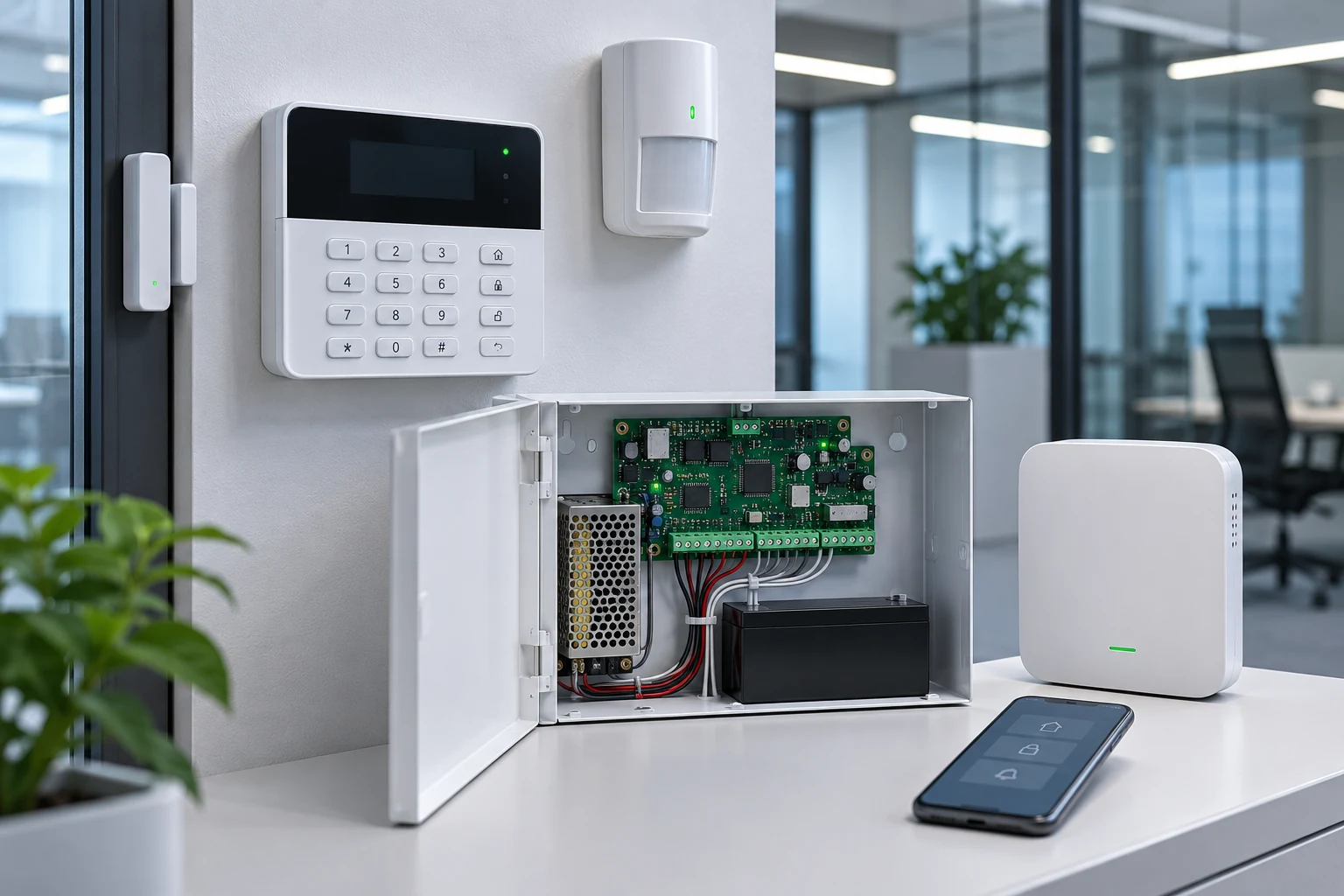
Paradox alarm systems are electronic security solutions designed to protect homes, workplaces, shops, offices and commercial facilities against unauthorized entry. Offering wired, wireless and hybrid system architectures, Paradox systems are used in projects of different sizes and comprise alarm control panels, motion detectors, magnetic contacts, keypads, sirens, communication modules and mobile security apps.
Within Paradox’s product portfolio, the Spectra SP, Magellan and EVO series have long been among the alarm platforms in use, while next-generation control units such as M25, X45 and X46 stand out for their more advanced communication, security management and integration options.
Choosing the right Paradox alarm system depends on the size of the area to be protected, detector capacity, existing cabling infrastructure, independent alarm partitions, communication reliability and future expansion needs.
About Paradox Security Systems
Paradox Security Systems is a Canadian-origin manufacturer that has been developing electronic security technologies since 1989. Its products include intrusion alarm control panels, motion detectors, wireless security devices, alarm communication modules, access-control components and security management software.
Paradox alarm systems comprise product families designed to meet different application needs:
Spectra SP: Alarm panels based on wired infrastructure that can be expanded wirelessly using compatible modules.
Magellan MG: Alarm control panels and security accessories distinguished by their wireless communication capabilities.
EVO: Alarm platforms offering high zone capacity, independent security partitions and access-control features.
M Series: A next-generation platform combining wireless and hybrid system architecture with IP communications, automation and video alarm verification on supported devices.
Esprit and legacy systems: Legacy product families that may be found in installed systems and whose hardware and software compatibility must be assessed separately.
These product groups do not all use the same peripherals. Model compatibility must therefore be verified when installing a new system, modernizing an existing one or expanding it.
How Do Paradox Alarm Systems Work?
Paradox alarm systems work by assessing information from detectors placed in protected areas at a central alarm control panel.
When a door or window is opened, movement is detected or an attempt is made to tamper with a protected device, the relevant detector sends a signal to the control panel.
Depending on the programmed zone settings and the system’s armed state, the control panel performs alarm, alert or fault actions.
The system’s main components are:
Alarm control panel: Manages zone inputs, events, alarm conditions and programmed outputs.
PIR motion detectors: Assess changes in infrared energy within the detection area.
Dual-technology detectors: Can use different detection methods, such as PIR and microwave, together.
Magnetic contacts: Monitor the status of opening points such as doors and windows.
Keypads: Enable the system to be armed and disarmed and display status information.
Sirens: Provide an audible or visual alert when an alarm occurs.
Communication modules: In supported systems, enable events to be sent to the user or an alarm monitoring center.
Triggering an alarm and delivering it to the user are separate processes. For example, a panel without an internet connection may activate a local siren but may be unable to send a mobile notification without suitable communication infrastructure.
For more information on the general operating principles of intrusion alarm technologies and the differences between wired and wireless systems, see GüvenlikOnline’s Intrusion Alarm System guide.
Paradox Spectra SP Alarm Systems
Spectra SP is Paradox’s family of expandable alarm control panels. Designed around wired detector inputs, these panels can also be used in hybrid systems with compatible wireless receivers and expansion modules.
The product family includes various models, such as SP4000, SP5500+, SP6000+, SP7000+ and SP65.
Paradox SP4000 Alarm Panel
SP4000 is a control panel designed for small-scale security applications.
According to the manufacturer’s technical information, it has 4 physical zone inputs. The board’s inputs can provide 8 zones using the ATZ zone-doubling method; with suitable expansion hardware, total capacity can reach 32 zones.
Key features:
System capacity of up to 32 zones.
2 independent alarm partitions.
32 user codes.
Support for wired detectors and wireless detectors via a compatible receiver.
StayD arming feature.
Supported IP and cellular communication modules.
SP4000 may suit residential or small-business projects that start with a small number of detectors but may require expansion.
Paradox SP5500+ Alarm Panel
SP5500+ is an alarm panel with 5 zone inputs on the board, expandable to up to 32 zones using suitable expansion hardware.
According to the manufacturer, it supports 2 independent alarm partitions and 32 user codes.
This model can use a compatible RTX3 wireless expansion module, additional zone modules and communication accessories.
It may be suitable for small homes, offices and businesses with a limited number of security zones.
Paradox SP6000+ Alarm Panel
SP6000+ has 8 physical zone inputs and allows 16 zones on the board using the ATZ method. With supported expansion methods, total system capacity can reach 32 zones.
Standout technical features:
8 physical inputs, 16 zones with ATZ.
Total expansion to up to 32 zones.
2 independent alarm partitions.
32 user codes.
Programmable outputs.
Compatible wireless expansion options.
BabyWare programming support.
Supported IP and cellular communication modules.
SP6000+ may be considered for residential, office and commercial projects requiring more wired detectors.
Paradox SP7000+ Alarm Panel
SP7000+ is one of the Spectra SP family models offering more physical inputs.
The panel has 16 zone inputs and can be expanded to a total system capacity of 32 zones.
This feature may reduce the need for additional expansion modules in applications where multiple detectors will connect directly to the panel.
However, the fact that the panel has 16 physical inputs does not mean SP7000+ will provide greater security in every application. The required system capacity and cabling topology should guide the choice.
Paradox Magellan Wireless Alarm Systems
Magellan is Paradox’s alarm system family distinguished by its support for wireless detectors and accessories.
Wireless alarm systems may be considered particularly in applications where running new cables through an existing building infrastructure is difficult.
The Magellan family includes products of different generations and architectures, such as MG5000, MG5050, MG5050+ and MG6250.
Paradox MG5050+ Alarm Panel
MG5050+ is a control panel that combines wired zone inputs with a built-in wireless transceiver.
The manufacturer’s stated technical specifications include:
Total capacity of up to 32 zones.
8 physical zone inputs, 16 zones with ATZ.
2 independent alarm partitions.
Support for 32 users and 32 remote controls.
433 MHz or 868 MHz radio variants.
Connection of up to 15 bus modules.
IP and cellular communication with compatible modules.
RF supervision that enables monitoring of wireless signal jamming.
Important technical distinction: The built-in wireless communication feature does not mean MG5050+ is completely wireless. The panel has a hybrid architecture that allows wired and wireless detectors to be used together.
Paradox MG6250 Alarm Console
MG6250 is a wireless alarm system with an integrated console architecture.
The manufacturer’s product information specifies capacity for up to 64 wireless zones, 2 independent partitions, a built-in siren and multiple alarm communication options.
MG6250 is among the models that may be encountered particularly in existing installed systems. For new projects, however, the product’s current sales status, operator support for its cellular communication technology and availability of service parts should be assessed.
Older GPRS/GSM communication capabilities should not be assumed to be equivalent to those of newer LTE-based products.
Paradox EVO Alarm Systems
EVO is Paradox’s alarm platform for applications requiring higher detector capacity and independent security-area management.
The EVO series differs from Spectra SP and Magellan not only in its higher zone count, but also in its expandable bus architecture and supported access-control functions.
Paradox EVO192 Alarm Panel
EVO192 is a control panel expandable to up to 192 alarm zones.
Key features stated by the manufacturer:
Capacity of up to 192 zones.
8 independent security partitions.
999 user codes.
Expansion modules via the bus.
Access-control support with compatible hardware.
Monitoring of alarm and tamper events.
Remote communication via supported communication modules.
Independent alarm partitions can offer operational advantages in buildings with multiple shops, warehouses or usage areas.
For example, if a commercial building’s warehouse, technical room, office and sales area need to open at different times, the alarm partitions can be configured accordingly.
Paradox EVOHD+ Alarm Panel
EVOHD+ is a control panel in the EVO family offering more advanced hardware and power-management features.
Features stated by the manufacturer include 192 zones, 8 independent partitions, 999 user codes, up to 254 expansion modules and digital bus communication.
It also offers dual serial communication connections, an enhanced power infrastructure and battery-discharge protection functions.
EVOHD+ may be considered for projects requiring higher device density and detailed security management.
However, a system’s total detector capacity differs from the electrical load that its power supply can support. Auxiliary power capacity must be calculated separately when increasing the number of modules and detectors.
Paradox M Series: Next-Generation Hybrid Alarm Systems
The M25, X45 and X46 control units stand out in Paradox’s 2026 product portfolio.
In addition to traditional intrusion alarm functions, these products aim to combine security management, access control, automation and video verification features with supported peripherals.
Paradox M25 and M25 LTE
M25 is a compact hybrid control unit that can use wired and wireless components together.
The manufacturer’s official technical information states the following capacities:
Technical specification | M25 / M25 LTE |
|---|---|
Total system zones | Up to 200 |
Independent security partition | 10 |
User | 128 |
Remote control | Up to 128 |
Wireless network node | Up to 75 |
Wireless repeater | Up to 4 |
Built-in communication | Ethernet and Wi-Fi |
Cellular connection | On the LTE model |
M25 uses GFSK-based wireless communication and frequency-hopping technologies. The manufacturer specifies 868 MHz and 914 MHz frequency variants.
A capacity of 200 zones does not mean that 200 independent wireless devices can be connected. The wireless network node limit, input capacity and expansion methods to be used should be assessed separately.
According to the manufacturer, M25 also offers a communication architecture that supports direct event transmission to an alarm monitoring center without reliance on the cloud. This feature may be considered in communication design, but it does not eliminate network and power continuity requirements.
Paradox X45 and X46
X45 and X46 are hybrid control units developed by Paradox for higher capacity and multi-system integration.
The manufacturer specifies 200 system zones, 40 independent security areas and a capacity of 1,000 users for both models.
The main distinction is physical input capacity:
X45: 8 physical inputs; capacity for 16 inputs with ATZ.
X46: 16 physical inputs; capacity for 32 inputs with ATZ.
With supported hardware and software features, these platforms can use RS-485, Ethernet, Wi-Fi and M wireless connectivity methods.
Access control, programmable outputs and automation scenarios can also be incorporated into the system design.
However, it should not be assumed that all product functions can be used simultaneously with every hardware and firmware version. Access-control functions and certification status in particular should be verified in the technical documentation.
Comparison of Paradox Alarm Panel Models
Zone capacity alone is not enough to choose the right model. Independent alarm partitions, the number of wireless devices, physical inputs, communication methods and expansion needs should all be considered together.
Model | Maximum zones | Independent partitions | System approach |
|---|---|---|---|
SP5500+ | 32 | 2 | Wired, expandable |
SP6000+ | 32 | 2 | Wired, expandable |
SP7000+ | 32 | 2 | More physical inputs |
MG5050+ | 32 | 2 | Hybrid with wireless support |
EVO192 | 192 | 8 | Expandable bus system |
EVOHD+ | 192 | 8 | Advanced EVO platform |
M25 | 200 | 10 | Next-generation compact hybrid |
X45 / X46 | 200 | 40 | High-capacity hybrid |
The values in the table are the maximum system capacities stated by the manufacturer. A panel’s total zone capacity alone does not determine the number of detectors that can be connected directly, the wireless device limit or the system’s security grade.
Module compatibility between legacy and new product families cannot be assessed from this table alone.
BlueEye Mobile App for Paradox Alarm Systems
BlueEye is Paradox’s mobile security app for iOS and Android devices.
On supported systems, users can remotely view the alarm status, arm or disarm the system and receive notifications.
The app’s key features include:
Remote arming and disarming.
Notifications about alarm events.
Assigning different access permissions to multiple users.
Controlling programmable outputs on supported systems.
Managing access-control and video functions in compatible integrations.
Using BlueEye requires a supported control panel, communication module and software version.
Difference Between BlueEye and Insite GOLD
Insite GOLD is one of Paradox’s previous-generation mobile security apps. BlueEye is the mobile app platform currently offered by the manufacturer.
The presence of the name Insite GOLD in older product documentation does not mean that the relevant panel is incompatible with BlueEye—or that it is directly compatible.
For systems with older IP150 units and cellular communication modules in particular, check the firmware version, communication service in use and mobile app requirements.
Paradox BabyWare Programming Software
BabyWare is software developed by Paradox to program and manage compatible alarm control panels.
The following operations can be performed on supported control panels:
Programming zone properties.
Defining users and security partitions.
Setting entry and exit delays.
Configuring programmable outputs.
Managing supported modules.
Backing up system configurations.
Firmware operations and system tests on compatible hardware.
When programming with BabyWare, the panel’s exact model, hardware version and supported communication method must be checked.
The M series’ new software and hardware architecture may not use the same programming methods as classic Paradox control panels.
Choosing Detectors for Paradox Alarm Systems
The characteristics of the detectors used are as important as the alarm panel’s technical capacity.
Paradox offers motion detectors and security sensors for a range of indoor and outdoor applications.
PIR Motion Detectors
PIR detectors are used to detect movement by assessing changes in infrared energy within the detection area.
Their detection performance is affected by mounting height, lens design, temperature conditions, direction of movement and environmental factors.
Dual-Technology Motion Detectors
Detectors combining PIR and microwave technology may help reduce the likelihood of false alarms under certain conditions.
However, it should not be assumed that a dual-technology detector will perform better than a single-technology detector in every environment.
Outdoor Detectors
Outdoor applications require consideration of weather conditions, moving vegetation, sunlight, temperature changes and animal movement.
Paradox’s NV series and other suitable outdoor detectors may be considered for these needs.
For perimeter security in particular, the detector’s detection geometry, mounting location and false-alarm scenarios should be verified through field tests.
EN 50131 Standard for Paradox Alarm Systems
The EN 50131 standards series is an important reference when assessing intrusion and hold-up alarm systems.
This standards series provides a technical framework covering alarm system security grades, component requirements and system characteristics.
For example, the manufacturer states that EVO192 complies with EN 50131 Grade 3. Certification information relating to the relevant EN standards and security grade has also been published for the M25 product family.
However, a panel’s certification does not show that the entire installed alarm system automatically meets the same security grade.
The detectors, sirens, communication components, power supplies, tamper protection and installation conditions used in the system must be assessed together.
For new products such as X45 and X46, the manufacturer has stated that certain EN 50131 certifications are pending. Such documentation should not be treated as a completed certificate.
What Should You Consider When Choosing a Paradox Alarm System?
1. Risk Assessment of the Area to Be Protected
First, identify the entrances, windows, rooms and critical assets that need protection.
Choose panel capacity according to the detector and security-zone plan developed from the risk assessment.
2. Wired, Wireless or Hybrid Architecture
It may be possible to plan wired infrastructure in new projects, whereas installing new cabling in an operating business can be costly.
For wireless systems, battery management, radio coverage, signal interference and compliance of the frequency used with national regulations are important.
3. Alarm Zone and Partition Capacity
The number of zones should be determined by the number of points to be protected.
Independent alarm partitions allow different users or business areas to manage the alarm separately.
4. Communication Continuity
If communication over the internet is planned, determine how the system will behave if the connection is lost.
Depending on the project’s risk level, assess the need for backup communication channels, connection supervision and an alarm monitoring center.
5. Power Redundancy
Calculate how long the system will operate if mains power is lost.
This calculation should account not only for the alarm panel, but also for detectors, expansion modules, keypads and other connected loads.
6. Product and Software Compatibility
When adding a new device to an existing Paradox system in particular, check the following:
Exact panel model and hardware revision.
Current firmware version.
Wireless device frequency and protocol.
Communication module compatibility.
Mobile app support.
Programming software and service availability.
Do not assume that components in older Paradox Esprit, Spectra or Magellan systems can be transferred directly to the new M series.
Technical Checklist for Installing a Paradox Alarm System
Check the following points during installation and commissioning:
- Has a risk assessment of the area to be protected been carried out?
- Have the alarm zones and independent partitions been planned correctly?
- Has the technical compatibility of the detectors with the panel been verified?
- Have wired zone connections and line terminations been checked?
- Have tamper circuits been tested?
- Has the signal level of wireless devices been measured at their actual installation locations?
- Have the detection areas of motion detectors been verified by a walk test?
- Have the sirens and programmable outputs been tested?
- Have battery capacity and power-outage scenarios been checked?
- Have communication failures and backup-channel behavior been tested?
- Have user permissions and remote-access security been configured?
- If there is a connection to an alarm monitoring center, has it been tested end to end?
- Have the installation configuration and maintenance information been recorded?
This list is intended for preliminary technical checks. The final installation and commissioning procedure should be determined according to the manufacturer’s model-specific documentation and the standards applicable to the project.
Where Can Paradox Alarm Systems Be Used?
Homes and Villas
Residential projects commonly require door and window protection, indoor motion detection and mobile alarm management.
Shops and Retail Businesses
Shop entrances, checkout areas, warehouses and management offices can be assigned to different alarm zones.
Offices and Commercial Buildings
In buildings with independent-use areas, system management can be planned around different alarm partitions and user permissions.
Warehouses and Industrial Facilities
In large areas, cable distances, detector coverage, electromagnetic effects and communication continuity should be assessed.
Multi-Section Commercial Facilities
EVO and suitable M-series control units may be considered for facilities requiring numerous independent security partitions.
However, the type of premises alone is not enough to determine the model. The actual number of detectors, security risks and integration requirements should be the main considerations.
Frequently Asked Questions About Paradox Alarm Systems
Can Paradox alarm systems be controlled by phone?
Yes. Compatible Paradox alarm panels can be controlled remotely using suitable communication infrastructure and the BlueEye app. Model and firmware compatibility should be checked.
What is the difference between Paradox SP6000 and SP7000?
SP6000+ has 8 physical zone inputs, while SP7000+ has 16 inputs. Both models can support up to 32 zones using suitable expansion methods.
Is Paradox MG5050 wireless?
The MG5050 family has a hybrid alarm architecture that combines support for wireless detectors with wired inputs.
How many zones does Paradox EVO192 support?
According to the manufacturer’s data, EVO192 supports 192 alarm zones and 8 independent security partitions.
What is the main difference between Paradox M25 and EVO192?
EVO192 is an alarm platform offering bus-based expansion and access-control functions. M25 is a control unit focused on wireless and hybrid communication, IP connectivity and next-generation system integration. They cannot be ranked by superiority based on zone capacity alone.
Can BlueEye be added to older Paradox alarm systems?
Some existing systems can be managed through BlueEye with a compatible communication module and software version. However, it should not be assumed that all older Paradox panels are supported.
How to Choose the Right Paradox Alarm System
Paradox’s alarm product range offers different system architectures, from small residential projects to commercial buildings with independent security partitions.
Spectra SP and Magellan systems may suit traditional wired and wireless alarm needs; the EVO series may suit expandable, multi-partition applications; and M25 and the X series may be considered for next-generation hybrid security management.
The right alarm system is not the panel with the highest zone capacity, but the one suited to the protected area’s risk level, existing infrastructure, communication requirements and sustainable maintenance conditions.
Paradox alarm system selection should therefore be undertaken alongside a technical site survey, detector placement plan, device compatibility checks and commissioning tests.