
Hikvision Unifies Pedestrian and Vehicle Access on a Single Platform with Quick Pass
Hikvision's new Quick Pass solution unifies pedestrian and vehicle access control within a centralized infrastructure. Offering MinMoe facial recognition terminals, ANPR cameras, and AI-powered management features, the system provides integration advantages but also requires careful consideration regarding biometric data regulations in Turkey.
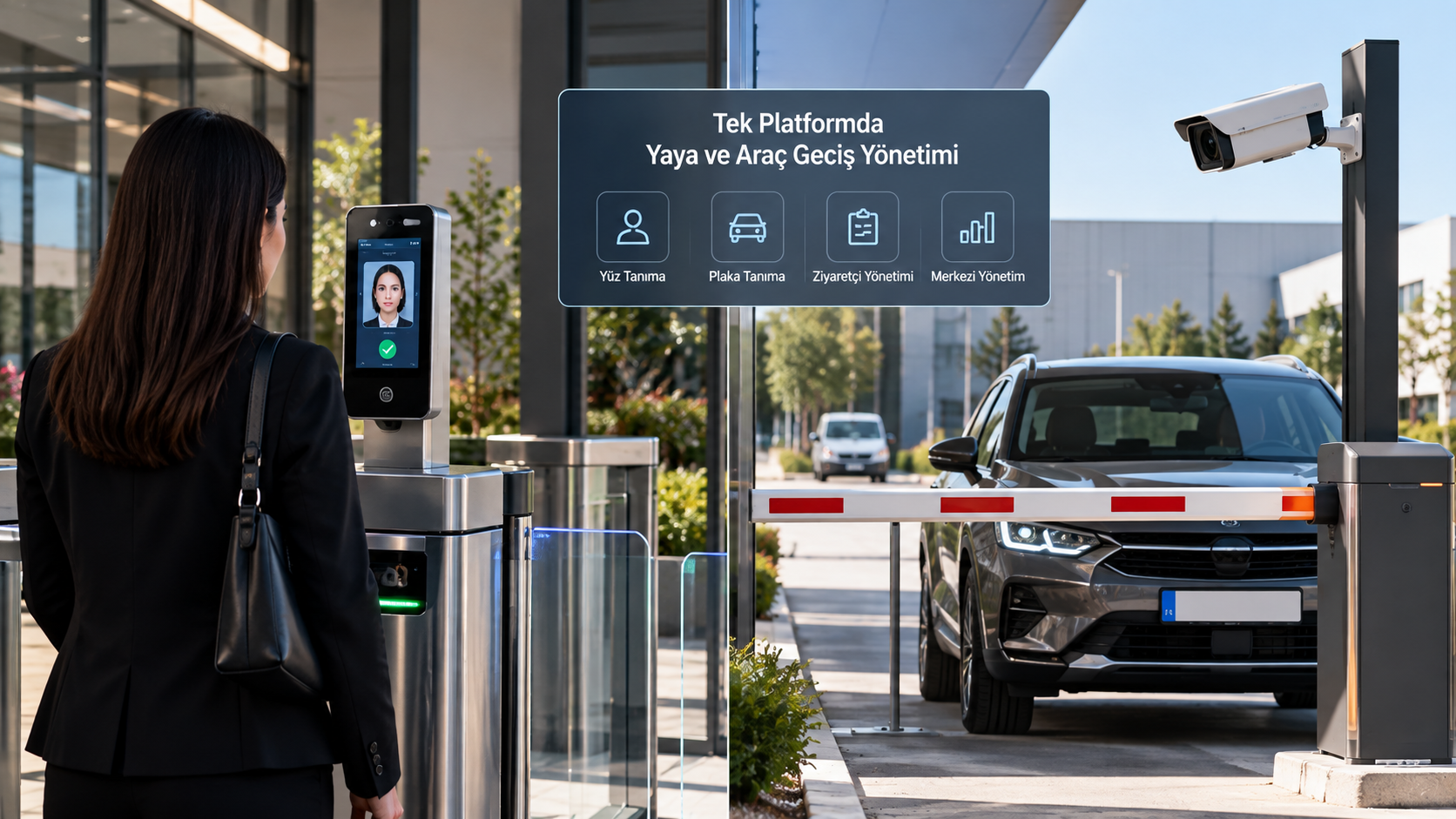
Hikvision announced its Quick Pass solution on October 22, 2026, aiming to manage pedestrian and vehicle access in residential projects, business centers, and industrial facilities through a common infrastructure.
Bringing together MinMoe facial recognition terminals, automatic number plate recognition (ANPR) cameras, barriers, and central management software, the solution aims for a more integrated management of records and access permissions generated at different access points.
The striking aspect of Quick Pass is not just its ability to speed up entry processes. Unifying human and vehicle authentication within a common management structure can provide operational advantages, especially in facilities with multiple entrances. However, this approach also raises new questions regarding system integration, access permissions, and the protection of biometric data.
What Problem Does Quick Pass Aim to Solve?
In traditional access control projects, staff entries, parking barriers, and visitor management can operate through different devices or software.
For instance, in a factory, employee card access records might be kept in a separate system, vehicle license plate permissions in another software, and visitor entry information in manual logs.
This structure can increase the management burden, especially during permission changes and the investigation of security incidents.
Quick Pass aims to reduce this complexity by unifying different access methods within a common management infrastructure.
According to Hikvision's statement, the solution supports both cloud-based and on-premises deployment options.
However, it should not be assumed that both deployment models offer the same features, data storage options, and integration capacity. These details must be verified within the scope of the project.
Facial Recognition and License Plate Reading Performance
On the human access side of the Quick Pass solution are Hikvision's MinMoe terminals, while ANPR cameras are used for vehicle access.
According to technical data released by Hikvision, MinMoe terminals boast a facial recognition time of under 0.2 seconds and a 99% accuracy rate. For ANPR cameras, a license plate recognition accuracy of 98.5% and above is stated.
These values are performance data announced by the manufacturer; they should not be considered as results of independent field tests conducted under different environmental conditions.
In real-world applications, facial recognition performance can be affected by lighting, camera position, user movement, and device configuration. For license plate recognition systems, vehicle speed, camera angle, plate condition, and night illumination are important.
Therefore, in access control projects, before considering catalog accuracy rates, how the system performs under real installation conditions should be evaluated.
What Does Dual Authentication for Vehicle and Driver Provide?
One of the notable features of Quick Pass is the ability to use both the vehicle's license plate and the driver's identity as two separate authentication elements in appropriate configurations.
License plate recognition systems can automate the passage of pre-authorized vehicles through barriers. However, the identification of the license plate alone does not prove that the person driving the vehicle is also authorized.
Hikvision offers a dual authentication approach, combining ANPR with facial recognition, as one of the options to address this need.
For example, at a controlled facility entrance, the system can be designed to require not only the vehicle's license plate to be on the authorized list but also the driver's identity to be verified.
Such an application can provide an additional layer of control beyond access permissions granted solely via license plates.
However, the combined use of two authentication methods does not completely eliminate the possibility of unauthorized access. Erroneous recognition, credential management, network outages, and how the barrier will operate in emergency situations should also be evaluated.
What Does AI-Powered Management Provide to Operators?
In addition to authentication functions, Quick Pass also includes AI features aimed at simplifying management operations through natural language.
According to Hikvision's statement, some operations related to user registration, visitor access, permission management, and attendance tracking can be performed with commands given in everyday language.
This approach can help streamline routine management operations, especially in facilities with a large number of users and entry points.
However, before implementation, it must be verified which languages AI-powered commands support, with what permissions they operate, and how approvals are obtained for critical operations.
For example, changing a user's access permission as a result of a natural language command given by an administrator is not merely a matter of interface convenience.
In such operations, user permissions must be restricted, transaction logs maintained, and critical changes auditable.
Critical Distinction in Biometric Access Control and KVKK in Turkey
One of the most important issues to be evaluated for Quick Pass applications in Turkey is the processing of biometric data.
Technical processes that enable the unique identification or authentication of a person through facial recognition may constitute a special category personal data processing activity under Law No. 6698 on the Protection of Personal Data (KVKK).
Here, there is a significant legal distinction between physical access security and employee attendance tracking.
The Personal Data Protection Board's Principle Decision No. 2026/921 dated April 29, 2026, on Processing Biometric Data for Attendance Tracking Purposes, introduces significant limitations on the use of biometric methods for employee attendance tracking.
The Board states that when evaluating the processing of biometric data solely for attendance tracking purposes, the existence of explicit consent alone is not sufficient; the principles of necessity and proportionality must also be met. The availability of less intrusive alternative methods is important in this assessment.
Conversely, biometric systems used for authentication and authorization in critical areas requiring high security should be evaluated separately based on the specific security need and relevant data processing conditions.
This situation does not mean that Quick Pass cannot be used in Turkey. However, the presence of a facial recognition feature does not imply that this feature is lawful for every purpose of use.
Especially in workplaces, the presence of biometric access verification and automatic timekeeping functions within the same system requires that the two operations be evaluated separately from a legal perspective.
It is important for project owners to determine the processing purpose, legal basis, alternative access methods, data retention period, and access permissions during the design phase.
What Should System Integrators Check in a Quick Pass Project?
The true value of a unified access control approach depends on more than just displaying different devices in a single software.
When evaluating Quick Pass in a new or existing facility, the following points stand out:
Existing system compatibility: To what extent are existing barriers, turnstiles, readers, and other access control equipment supported?
Behavior during connection loss: How are local access permissions enforced when the connection to the internet or the central management system is lost?
Emergency scenarios: How is the behavior of doors and turnstiles determined in situations such as fire alarms, evacuations, or power outages?
Permission management: How are changes reflected across all relevant systems when personnel leave, visitor periods expire, or vehicle permissions are revoked?
Logging and privacy: Where are facial recognition, vehicle license plate, and visitor information stored, who can access it, and when is it deleted?
AI management permissions: What operations can be performed with natural language commands, and how are the logs of these operations audited?
These are not verified missing functionalities in Quick Pass; rather, they are technical evaluation questions that need to be answered by the manufacturer or integrator in a real project.
In Which Facilities Can Quick Pass Be More Meaningful?
Quick Pass can become more operationally meaningful in facilities where multiple access methods are managed together.
Examples of these scenarios include managing building entrances, visitor access, and parking permissions together in residential complexes; defining separate permissions for different employee groups in office campuses; and monitoring personnel and vehicle access under a common management in factories.
However, in small-scale facilities with a limited number of entry points, simpler access control architectures may also meet the needs.
Therefore, when selecting a solution, not only the presence of new technologies but also the size of the enterprise, security requirements, and total management cost should be evaluated.
GüvenlikOnline's Access Control Systems catalog can be used to examine different hardware classes that can be considered in such projects.
Evaluation: Unified Access Management Also Brings New Responsibilities
Quick Pass presents an example of a more integrated management approach for human and vehicle access control, which have long been treated separately in physical security systems.
The operational benefit of this approach could be the ability to manage permissions and access information from a common structure.
However, centralizing access data also requires more careful design of permission control, data security, and system continuity.
Particularly in Turkey, the use of facial recognition systems cannot be considered merely a technical product choice. The purpose of data processing and compliance with regulations must be fundamental parts of project design.
The factor that will determine Quick Pass's true field success, beyond the stated recognition speeds, will be the extent to which hardware, software, operational security, and personal data protection requirements are met together.
Resources
Source: asmag / Hikvision