
Hanwha Vision NVR Models: Wisenet Recorders and Technical Specifications
We compare Hanwha Vision NVR models. Wisenet QRN, XRN and PRN series offer 4, 8, 16, 32 and 64-channel options, recording bandwidth, HDD capacity, PoE, RAID, AI search and technical selection criteria.
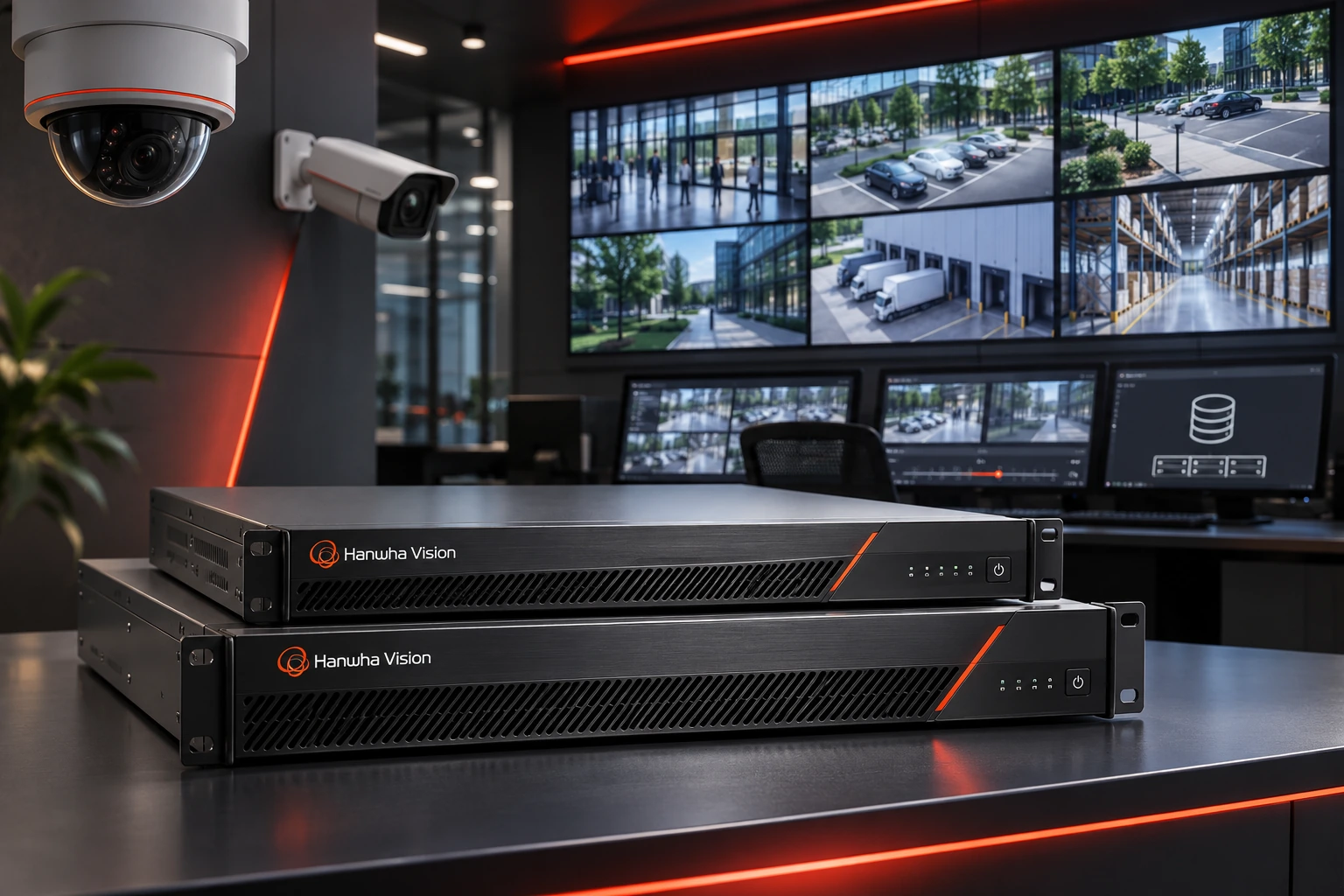
Hanwha Vision NVR recorders are professional network video recording systems designed to record, view, search and securely manage video footage from IP security cameras. Part of the Wisenet product ecosystem, these devices are used in projects of varying scale, from small businesses to enterprise security deployments with multiple cameras.
Hanwha Vision's NVR portfolio includes 4, 8, 16, 32 and 64-channel recorders. Depending on the product family and model, features may include integrated PoE ports, H.265 compression, multiple HDD bays, RAID support, advanced event search with Wisenet AI cameras and centralized video management.
However, the right NVR model should not be selected solely on the basis of the number of cameras to be connected. The cameras' combined bit rate, resolutions, recording duration, HDD capacity, live-view decoding performance and compatibility with third-party cameras should all be assessed together.
The primary aim of a professional Hanwha Vision NVR project is not merely to add cameras to the system, but to record footage at the required quality, without interruption, and in a form that can be played back reliably when needed.
What Is a Hanwha Vision NVR?
NVR (Network Video Recorder), is a recording device that stores and manages video streams sent over a network by IP cameras.
Hanwha Vision NVRs can work with compatible Wisenet IP cameras and may also support certain ONVIF-compliant third-party cameras.
The core functions of an NVR system are:
IP camera connection and management.
Continuous or event-based recording.
Recording H.264 and H.265 video streams.
HDD storage management.
Live viewing.
Playback of recorded footage.
Video search and export.
Alarm and event management.
Authorized remote access.
AI metadata search on compatible models.
The camera channels, maximum resolution and recording bandwidth supported by an NVR vary by product model.
What Are the Hanwha Vision NVR Series?
Hanwha Vision recorders are offered under different product families.
QRN Series
The QRN family includes cost-effective recording options primarily intended for small and medium-sized IP camera installations.
Selected QRN models offer:
4, 8 and 16 channels.
Integrated PoE.
H.265/H.264 recording.
HDMI monitor output.
One or two HDD bays.
Local and remote viewing.
These are among the available features.
XRN Series
The XRN family offers a wider range of models for professional recording and management requirements across projects of different scales.
Alongside compact 4- and 8-channel devices, the range includes enterprise recording systems with 16, 32 and 64 channels.
Selected XRN models offer:
Higher recording bandwidth.
Multiple HDD bays.
RAID options.
Advanced user and event management.
Search using AI camera metadata.
Dual-monitor support.
Redundancy on compatible models.
These features may be available.
PRN Series
The PRN family comprises Hanwha Vision's enterprise recording solutions with AI capabilities.
This series particularly emphasizes processing AI camera metadata, advanced search and certain analytics applications.
However, it should not be assumed that every recorder designated PRN performs all AI analytics on the device itself.
The model's analytics processing capacity and supported camera types should be examined separately.
Hanwha Vision NVR Models Comparison Table
The models below are examples listed in Hanwha Vision's official product and technical support resources.
Model | Channels | Key features | HDD configuration |
|---|---|---|---|
QRN-430S | 4 | 8 MP camera support, compact PoE NVR | 1 SATA |
XRN-420S | 4 | 8 MP, 4 PoE ports, compatible with AI camera search | 1 SATA |
QRN-830S | 8 | 4K-class PoE recording | 1 SATA |
XRN-815S | 8 | 12 MP camera support, 8 PoE | 2 SATA |
XRN-820S | 8 | 8 PoE, AI search support | 2 SATA |
QRN-1630S | 16 | 8 MP, 128 Mbps recording, 16 PoE+ | 2 SATA |
XRN-1620SB1 | 16 | 16 PoE, compatible with AI search | 4 SATA |
XRN-1620B2 | 16 | Expanded disk capacity | 8 SATA |
XRN-3210B4 | 32 | 32 MP, 400 Mbps-class recording | 16 SATA |
XRN-3220B4 | 32 | 12th-generation processor, 520 Mbps recording | According to the model datasheet |
XRN-6410B4 | 64 | 32 MP, AI search, RAID | 16 SATA |
XRN-6420B4 | 64 | 12th-generation processor, 520 Mbps recording | According to the model datasheet |
PRN-3200B2 | 32 | AI NVR, advanced analytics integration | 8 SATA |
PRN-6400B4 | 64 | AI NVR, 32 MP camera support | 16 SATA |
The table is intended as a product-selection overview. Each model's maximum HDD capacity, RAID options, software version and regional availability should be verified against the manufacturer's datasheet. Suffixes within the same family B2, B4, DB4 and S suffixes may indicate different hardware configurations.
4-Channel Hanwha Vision NVR Models
QRN-430S
QRN-430S is a 4-channel NVR model developed for small-scale IP camera projects.
Key features:
4 IP camera channels.
Camera resolution supported up to 8 MP.
Integrated PoE connections.
H.265 and H.264 recording.
One HDD bay.
HDMI video output.
Compatible software and mobile viewing.
It may be considered for small shops, offices and sites with a limited number of cameras.
XRN-420S
XRN-420S is a 4-channel X-series recorder.
According to the manufacturer's documentation, it supports 8 MP cameras, four PoE connections and searches based on object attributes with Wisenet AI cameras.
However, the advanced AI search feature depends on receiving the required metadata from a compatible camera.
8-Channel Hanwha Vision NVR Models
QRN-830S
QRN-830S is one of the PoE-enabled models offered for eight-channel IP camera recording applications.
It can be used particularly in small and medium-sized security system projects.
Camera resolution, total recording load and disk capacity should be checked against the product documentation.
XRN-815S
Key features of the XRN-815S model:
8 IP camera channels.
Camera support up to 12 MP.
8 PoE ports.
Two HDD bays.
AI search using compatible camera metadata.
Local viewing via HDMI.
Hanwha Vision's HDD capacity table lists two 10 TB disks and a nominal total capacity of 20 TB for the model.
XRN-820S
XRN-820S is an X-series NVR with eight PoE ports, offering a plug-and-play installation approach.
Search based on object attributes and recording management are possible with compatible Hanwha AI cameras.
When assessing disk capacity and recording performance for this model, it should not be assumed to have the same specifications as XRN-815S.
16-Channel Hanwha Vision NVR Models
QRN-1630S
Key technical specifications of QRN-1630S:
16 IP camera channels.
Camera support up to 8 MP.
H.265, H.264 and MJPEG recording.
Maximum recording bandwidth of 128 Mbps.
2 SATA HDD bays.
Nominal total disk capacity of 20 TB under the conditions specified for the model.
16 PoE+ connections.
Total PoE power budget of 130 W.
Two HDMI video outputs.
ONVIF and SUNAPI support.
The presence of 16 PoE ports on this model does not mean that the total power consumption of all connected cameras can exceed 130 W.
The power requirement per camera and the total PoE budget should be calculated together.
XRN-1620SB1
XRN-1620SB1 is a 16-channel X-series recorder with PoE support.
Key features:
16 IP camera channels.
16 PoE ports.
Four HDD bays.
Advanced search with compatible AI cameras.
H.265/H.264 video recording.
Remote access and local video management.
Hanwha Vision's capacity guide specifies nominal storage of 24 TB for this model using four 6 TB disks.
XRN-1620B2
XRN-1620B2 may be considered for projects requiring greater disk capacity with 16 channels.
Key features of the model:
16 IP camera channels.
Eight SATA HDD bays.
Nominal storage of up to 80 TB with compatible disks.
Search using Wisenet AI camera metadata.
Enterprise recording management.
Models of this type may be considered for CCTV projects requiring long retention periods.
32-Channel Hanwha Vision NVR Models
XRN-3210B2
XRN-3210B2 is a professional 32-channel NVR model.
32 IP camera channels.
AI camera search integration.
8 SATA HDD bays.
Nominal storage of 80 TB according to the relevant capacity table.
Compatible RAID and recording management options.
For this model, it is important to assess the storage configuration separately to achieve high recording bandwidth.
XRN-3210B4
XRN-3210B4 is a 32-channel X-series recorder with greater disk capacity.
Key features:
32 IP camera channels.
Camera resolution support up to 32 MP.
Recording capacity in the 400 Mbps class.
16 SATA disk bays.
Nominal storage of up to 160 TB in the manufacturer-specified configuration.
Compatibility with Wisenet AI cameras.
Advanced event and recording search.
Important: To use the 400 Mbps performance of the XRN-3210B4 model, the RAID or Distributed Recording conditions defined by the manufacturer must be taken into account.
XRN-3220B4
XRN-3220B4 is one of the newer-generation 32-channel NVR models introduced with 12th-generation Intel processor architecture.
The manufacturer's description highlights:
32 channels.
520 Mbps recording bandwidth.
Advanced recording and processing infrastructure.
Compatibility with AI camera search.
These features stand out.
This model may be considered for enterprise recording projects with heavy video-stream traffic.
However, the conditions under which the 520 Mbps figure applies should be checked against the relevant technical datasheet.
64-Channel Hanwha Vision NVR Models
XRN-6410B4
XRN-6410B4 is a high-capacity 64-channel recorder.
Key features:
64 IP camera channels.
Camera resolution up to 32 MP.
Search using AI camera metadata.
16 SATA HDD bays.
Nominal storage of up to 160 TB in the applicable capacity table.
RAID 5/6 support.
A recording infrastructure suitable for centralized security monitoring applications.
XRN-6420B4
XRN-6420B4 is one of the 64-channel recording system options featuring a newer processor architecture.
On the manufacturer's product page, the following are listed:
64-channel.
generation processor.
520 Mbps recording bandwidth.
AI camera search support.
Enterprise video recording and management.
These features are listed.
PRN-6400B4
PRN-6400B4 is one of the members of the 64-channel AI NVR product family.
According to the manufacturer's documentation:
64-channel.
Camera support up to 32 MP.
AI video search and analytics functions.
16 SATA HDD bays.
Nominal capacity of up to 160 TB in specific disk configurations.
are available.
However, it should not be assumed that the model can perform all analytics applications independently on the NVR.
What Is Hanwha Vision NVR Recording Bandwidth?
Recording bandwidth refers to the NVR's capacity to store video data received from cameras.
It is generally stated in Mbps.
For example, assume that each of 32 IP cameras produces an average of 8 Mbps of video.
In this case, the total average recording load is 256 Mbps.
The NVR must be able to handle this value.
However, recording bandwidth is not the same as the device's capacity for decoding live video, playing back recordings or exporting footage at the same time.
The Difference Between 150 Mbps and 400 Mbps
According to Hanwha Vision's technical statement dated May 13, 2026, recording bandwidth is limited to 150 Mbps under the default storage configuration on certain XRN and PRN AI NVR models.
With a suitable RAID or Distributed Recording configuration, this value can be increased to 400 Mbps on certain models.
The same statement specifies that the relevant value for PRN-1605B2 is 250 Mbps.
This is explained in the manufacturer's list, which also includes the following models:
XRN-3210B4.
XRN-6410B4.
XRN-6410DB4.
PRN-3205B2.
PRN-3205B4.
PRN-6405B4.
PRN-6405DB4.
Therefore, it is not enough for the technical specification to state only “supports 400 Mbps recording.” It must be verified that the required performance can be achieved with the actual disk and recording configuration.
The Difference Between RAID and Distributed Recording
What Is RAID?
RAID is a storage approach that allows multiple disks to be used together to meet specific performance or data-continuity objectives.
Hanwha Vision NVR models that support it may offer options such as RAID 5 or RAID 6.
However, RAID:
Does not necessarily protect recordings that are accidentally deleted.
Does not, on its own, provide protection against cyberattacks.
Does not prevent data loss in every type of disk failure.
Is not a substitute for an independent backup.
What Is Distributed Recording?
Distributed Recording is a recording approach that distributes the recording load among specific groups of cameras and disks.
Hanwha Vision states that, on certain models, this method can be used to increase recording bandwidth without configuring RAID.
However, using Distributed Recording does not mean that the same data redundancy as RAID is achieved.
High write performance and protection against disk failure are distinct design objectives.
How to Choose HDD Capacity for Hanwha Vision NVR
NVR storage capacity should be calculated based on the following variables:
Number of cameras.
Average video bit rate.
Recording duration.
Continuous or event-based recording.
H.264 or H.265 codec.
Audio and metadata.
RAID use.
Disk capacity.
System reserve.
Example: 16 Cameras, 30 Days of Recording
Assume that each of the 16 cameras produces an average of 4 Mbps of video.
Total bit rate:
For 30 days of continuous recording:
This calculation represents only the theoretical raw video data.
In actual projects, usable disk capacity, RAID, audio, indexes and capacity reserves must also be evaluated.
Why Is HDD Compatibility Important?
Hanwha Vision publishes HDD compatibility lists for its NVR models.
Two hard disks with the same capacity may not offer the same performance or support on an NVR.
Therefore:
Disk make and model.
Firmware.
Supported capacity.
Recording workload.
CMR/SMR technology.
RAID compatibility.
Temperature and power consumption.
must be checked.
Hanwha Vision NVR PoE Support
PoE (Power over Ethernet), the technology that delivers electrical power to IP cameras over a network cable.
Certain compact Hanwha Vision NVR models have built-in PoE connections.
For example, the QRN-1630S model has 16 PoE+ ports.
However, the number of PoE ports alone is not enough.
The total PoE power budget must also be calculated.
PoE Power Budget Example
Assume that each of eight cameras consumes a maximum of 12 W.
In this system, the total power budget of the NVR or PoE switch should be selected to meet at least the required load, taking the relevant standard and connection losses into account.
Cameras with IR illumination, motorized lenses, heaters or other accessories may consume more power.
AI Search on Hanwha Vision NVRs
One important feature of Wisenet AI camera systems is their ability to generate metadata for specific object attributes.
Compatible NVR models can use this data to support searches through past recordings.
What Does AI Search Do?
With a supported camera and software combination, searches can be made by:
Object categories such as people or vehicles.
Specific object attributes.
Events generated by the camera.
Specific time periods.
These criteria can be used to search.
Difference Between AI Search and AI Analytics
An AI camera can analyze the video stream and generate metadata.
Where appropriate, an NVR can record this metadata and display it in the search interface.
Although some specialized AI NVR models may offer more analytics functions, it should not be assumed that all NVRs supporting AI Search can perform the same AI analytics independently of the camera.
ONVIF and Third-Party Camera Support on Hanwha Vision NVRs
Hanwha Vision NVRs support ONVIF-compliant third-party IP cameras on compatible models.
However, the ability to record via ONVIF does not mean that every camera feature is supported.
What to Check When Integrating Third-Party Cameras
Supported ONVIF profile.
Camera firmware version.
Video codec.
H.264/H.265 profiles.
Resolution.
Main and substream configuration.
Audio support.
PTZ control.
Event notifications.
AI metadata compatibility.
Live video and recording playback.
Especially in projects that use cameras from different manufacturers, the fact that recording works does not guarantee that live video on an HDMI monitor or AI events will work without issues.
The “Recording Works, but There Is No Live Video” Issue
This issue can occur in some NVR systems due to:
An unsupported video profile.
An incompatible H.265/H.264 setting.
A main- or substream issue.
Exceeding the local video-decoding capacity.
An ONVIF integration limitation.
Camera firmware incompatibility.
among other causes.
For a definitive diagnosis, the camera stream, the decoding capabilities supported by the NVR, and the model's compatibility documentation should be assessed.
Hanwha Vision NVR and Wisenet Viewer
Wisenet Viewer is software that helps users monitor and manage compatible Hanwha Vision recording devices from a computer.
With compatible NVR models, users can:
View live video.
Play back recordings.
Group cameras and devices.
Review events.
Perform certain user and system operations.
These functions are available.
Hanwha Vision's official support portal publishes a list of recording devices compatible with Wisenet Viewer.
However, Wisenet Viewer support does not mean that every function can be used in the same way on every model.
Hanwha Vision NVR Cybersecurity
NVR devices are important components of security systems connected to IP networks.
Therefore, cybersecurity features should be evaluated alongside video recording performance.
Compatible Hanwha Vision NVR models may offer:
User authorization.
IP address filtering.
User access logs.
802.1X network authentication.
HTTPS/TLS support.
Signed firmware.
Certificate management.
TPM support on compatible models.
may be available.
However, the scope of these features varies by model and firmware version.
Why Are Firmware Updates Important?
Hanwha Vision publishes security advisories and firmware updates for its NVR products.
Therefore, after installation:
Check the supported firmware version.
Follow the manufacturer's security advisories.
Do not use default credentials.
Restrict remote access.
Segment camera and NVR networks appropriately.
Back up the configuration before updating.
Hanwha Vision NVR Technical Selection Checklist
Criterion | What to check |
|---|---|
Number of cameras | 4, 8, 16, 32 or 64 channels |
Camera resolution | Maximum resolution supported by the model |
Recording bandwidth | Total Mbps and value depending on configuration |
Video codec | H.264, H.265 and relevant profiles |
Live video | Local HDMI decoding capacity |
PoE | Number of ports and total power budget |
HDD | Number of bays and compatible disks |
Total storage | Required retention period |
RAID | Support and usable capacity |
Distributed Recording | Performance and disk distribution |
AI search | Camera metadata compatibility |
Third-party cameras | ONVIF and actual feature support |
Remote access | Wisenet Viewer and secure connection |
Cybersecurity | Firmware, TLS and access control |
Redundancy | ARB, failover and independent backup |
Service | Updates and technical support |
Acceptance tests | Recording, playback, alarm and fault tests |
Common Mistakes When Choosing a Hanwha Vision NVR
1. Choosing Based Only on Channel Count
16-channel devices may not have the same recording bandwidth.
2. Accepting the Maximum Mbps Value in the Catalog Without Qualification
Some models require RAID or Distributed Recording to achieve their maximum bandwidth.
3. Miscalculating HDD Capacity
Nominal capacity and usable storage capacity after RAID are not the same.
4. Overlooking the PoE Power Budget
The total power budget may be insufficient even if there are enough ports.
5. Mistaking AI Search for Independent AI Analytics
The NVR's search capability may depend on metadata supported by the camera.
6. Failing to Test Third-Party Camera Compatibility
An ONVIF connection does not guarantee that all functions will work smoothly.
7. Failing to Calculate Local Live-View Capacity
Even if recording capacity is sufficient, the number of high-resolution streams that can be decoded simultaneously via HDMI may be limited.
8. Failing to Check Redundancy and Recording Continuity
RAID and disk protection do not replace independent backup.
Frequently Asked Questions About Hanwha Vision NVRs
What is a Hanwha Vision NVR?
A network video recorder that enables recording and management of footage from Hanwha Vision IP cameras and compatible third-party cameras.
Are Wisenet NVRs and Hanwha Vision NVRs the same?
Wisenet is a brand and technology name associated with Hanwha Vision's video surveillance products. Hanwha Vision recorders are offered under various Wisenet product families.
How many channels do Hanwha Vision NVRs support?
The product portfolio includes various NVR models with 4, 8, 16, 32 and 64 channels.
What is the difference between QRN, XRN and PRN?
QRN covers more affordable, compact solutions; XRN offers a broad range of professional recording options; and PRN encompasses certain enterprise recording products focused on AI. Exact performance differences should be determined on a model-by-model basis.
Do Hanwha Vision NVRs support H.265?
Many current models support H.265. However, codec and profile compatibility depends on the model and firmware version.
Do Hanwha NVRs have RAID?
Certain XRN and PRN models support RAID. Do not assume that all compact NVRs have RAID.
Can a Dahua or Hikvision camera be connected to a Hanwha Vision NVR?
Certain functions may be available if compatible ONVIF or other supported connection methods are used. Live view, recording, PTZ and event support should be tested separately.
Can a Hanwha Vision NVR record at 400 Mbps?
Certain models may support recording bandwidth of 400 Mbps. However, some models specified by the manufacturer require a suitable RAID or Distributed Recording configuration.
What is a Hanwha Vision AI NVR?
A recorder that offers search using AI camera metadata or, depending on the model, additional AI analytics functions.
How many TB of hard disk storage can be used in Hanwha Vision NVRs?
The supported number of disks and total capacity depend on the model. For example, certain models have nominal total capacities of 20 TB, 80 TB or 160 TB.
Is Wisenet Viewer free?
Wisenet Viewer is viewing software provided by the manufacturer for its compatible video security devices. Check the manufacturer's official website for the latest terms of use and distribution.
Conclusion
Hanwha Vision NVRs offer a broad product range, from small-scale IP camera installations to high-capacity enterprise CCTV projects.
The QRN series targets compact, cost-effective recording needs; the XRN family addresses professional, high-capacity recording requirements; and the PRN series is intended for certain AI-focused video management applications.
Models such as XRN-3210B4, XRN-6410B4, XRN-3220B4 and XRN-6420B4 offer different bandwidth and storage options, while smaller devices with integrated PoE may be considered for facilities with a limited number of cameras.
However, the right Hanwha Vision NVR should be selected based not only on the number of camera channels, but also on actual recording bandwidth, HDD compatibility, RAID configuration, PoE budget, AI integration and live-view decoding capacity.
Especially in projects involving cameras from different brands, ONVIF compatibility and recording/playback functions should be tested before installation.
In professional CCTV projects, the right NVR is not merely a device that records video; it is a key component of long-term recording reliability, data integrity and sustainable security management.