
Dahua Alarm Systems: AirShield Wireless and Smart Security Solutions
Dahua alarm systems offer solutions for residential and commercial properties with AirShield wireless security technology, ARC3000H and ARC3800H control panels, motion detectors, video alarm verification, and DMSS mobile management features. We examine Dahua's wired and wireless alarm products, CCTV integration, communication security, and technical criteria for correct system selection.
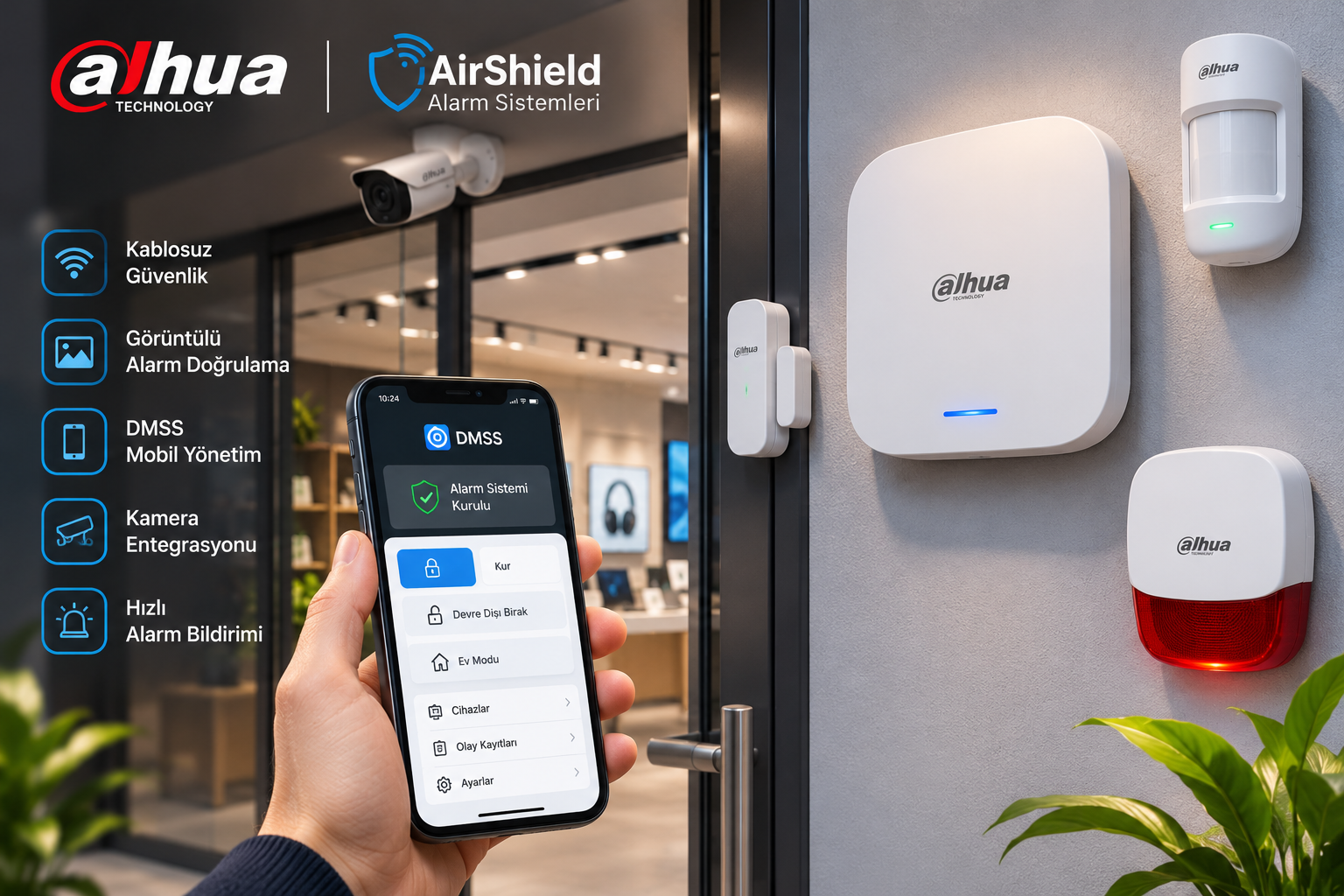
Dahua alarm systems are electronic security solutions developed for the detection of intrusion attempts, notification of security events, and management of alarm systems in conjunction with camera infrastructure. Dahua Technology's product portfolio includes wireless alarm control panels, motion detectors, door and window sensors, sirens, remote controls, wired alarm panels, and video alarm verification technologies.
Among the brand's prominent solutions, Dahua AirShield provides security management in residential and commercial properties by connecting wireless sensors to a central alarm panel. Notable features of AirShield systems include two-way radio communication, frequency hopping, encrypted communication, mobile application management, and the association of alarm events with compatible Dahua security cameras.
However, the correct Dahua alarm system selection should not be based solely on wireless connectivity or mobile application support. The risk level of the area to be protected, the detection capacity of the detectors, the communication options of the control panel, backup power duration, camera integration, and security standards must be evaluated together.
What Are Dahua Alarm Systems?
Dahua Technology is a manufacturer that develops electronic alarm and security management solutions, in addition to camera systems and video recording technologies.
Dahua's alarm products can be categorized into three main solution groups:
Wireless alarm systems: Consist of hubs, detectors, sirens, and control devices from the AirShield family.
Wired alarm systems: Operate with detectors connected to the control panel via physical cables.
Emergency alarm systems: Include solutions for emergency calls, communication, and notification of security events in specific applications.
A significant approach in Dahua's alarm systems is the ability to use the intrusion detection system in conjunction with CCTV and video intercom infrastructure.
For example, when a burglar alarm sensor is triggered in a store, the relevant footage from a compatible Dahua IP camera can be associated with the alarm event. This allows for visual assessment of the event instead of just receiving an alarm notification.
The availability of these functions depends on the control panel, camera, firmware version, and system configuration.
What is Dahua AirShield Wireless Alarm System?
Dahua AirShield is a family of security systems that enables the management of wireless alarm detectors via a central control panel.
The AirShield architecture offers installation flexibility, especially in existing structures where running new alarm cables is difficult.
The main components of the system are:
Alarm control panel (Hub).
PIR motion detectors.
Door and window magnetic contacts.
Dual-technology motion detectors.
Photo alarm verification sensors.
Indoor and outdoor sirens.
Wireless keypads and remote controls.
Signal repeaters.
Mobile application and professional management software.
In AirShield systems, sensors communicate with the compatible control panel via dedicated radio communication.
Therefore, the term wireless alarm system does not mean that all detectors connect directly to a Wi-Fi network.
While Wi-Fi or Ethernet is typically used for the hub's external network connection, sensor communication is carried out over a separate radio infrastructure.
How Does the AirShield Alarm System Work?
When the alarm system is armed, if a detector senses an event in the defined security area, it transmits information to the hub.
The control panel can perform different actions based on the nature of this event and predefined rules.
For example:
The motion detector detects unauthorized movement.
The detector sends the alarm event to the hub.
The hub checks the status of the relevant security zone.
The system activates the siren under appropriate conditions.
An alarm notification is sent to the user's mobile application.
If there is a compatible camera connection, footage related to the event can be provided.
If suitable integration is available, a notification is transmitted to the alarm monitoring center.
Actual operation time and notification behavior depend on the communication features of the selected devices and network connectivity.
Dahua AirShield Control Panels and Models
The main control panel families in AirShield systems include the ARC3000H and ARC3800H series.
These panels offer different regional frequency, Wi-Fi, and cellular connectivity options.
Dahua ARC3000H-W2 Alarm Hub
The ARC3000H-W2 is one of the AirShield control panels that enables centralized management of wireless alarm detectors.
Key features announced by the manufacturer include:
Support for up to 150 compatible wireless peripherals.
Network connectivity via Ethernet and Wi-Fi.
Two-way radio communication.
Frequency hopping technology.
Low battery and detector connection status monitoring.
Arming and disarming the alarm via mobile application.
Alarm association with camera footage in supported scenarios.
Built-in backup battery.
are included.
However, the 150-device capacity does not mean that all detector types can be used simultaneously without limits. There are separate sub-limits for sirens, keypads, camera detectors, and other device types.
Dahua ARC3000H-FW2 Alarm Hub
The ARC3000H-FW2 is one of the models in the basic AirShield control panel family that features cellular communication.
The manufacturer specifies Ethernet, Wi-Fi, and supported cellular network connections for this model.
Key features include:
Up to 150 supported wireless peripherals.
Dual SIM card slot.
Cellular connection structure where one SIM is actively used at a time.
4G, 3G, or GPRS communication on supported networks.
Alarm notification via mobile application.
Automatic network connection renewal features.
Camera connection and video association.
Remote software updates.
Dual SIM support does not mean that two mobile networks are actively used simultaneously. The ARC3000H-FW2 technical documentation specifies a Dual SIM, Single Standby architecture.
This distinction is particularly important in professional projects where high communication continuity is expected.
Dahua ARC3800H-W2 Alarm Hub 2
The ARC3800H-W2 is one of the control panels in the AirShield Hub 2 product family with enhanced video verification and integration features.
The manufacturer's technical page lists the following features:
Support for up to 150 compatible peripherals.
Alarm connection with up to 8 supported IP cameras on the same local network.
Pre-recording support on the hub for alarm events.
Two-way voice communication with a compatible intercom siren.
Ethernet and Wi-Fi network connectivity.
Up to 32 definable zones.
Offline caching of up to 50 alarm messages in appropriate configurations.
Control options via mobile application, keypad, card, and remote control.
Hub 2's video verification capability can enable a transition from merely managing alarm signals to more comprehensive event review scenarios.
However, support for 8 IP cameras does not mean that the hub continuously records video like an eight-channel professional NVR. This feature is intended for video functions related to alarm events.
Dahua ARC3800H-FW2 Alarm Hub 2
The ARC3800H-FW2 is a product family that combines the Hub 2 architecture with cellular connectivity options.
Depending on its model and regional version, it can utilize Ethernet, Wi-Fi, and 4G connections.
It can provide an alternative in applications where cellular communication needs to be considered as a backup channel, especially in case of internet connection loss.
However, for cellular connectivity to be usable, a suitable SIM card, data plan, operator coverage, and correct network configuration are required.
Dahua Alarm Control Panel Comparison
Model family | Network connection | Camera integration | Prominent use case |
|---|---|---|---|
ARC3000H-W2 | Ethernet, Wi-Fi | Supported video connections | Residential and small business |
ARC3000H-FW2 | Ethernet, Wi-Fi, cellular | Supported video connections | Areas requiring backup communication |
ARC3800H-W2 | Ethernet, Wi-Fi | Hub 2 video verification, up to 8 IPCs | Advanced alarm-video integration |
ARC3800H-FW2 | Ethernet, Wi-Fi, cellular | Hub 2 video verification | Video verification and alternative communication |
The table shows the general features of the product families. The full model code, regional frequency version, peripheral capacity, and software compatibility should be checked separately.
Dahua Alarm Detectors and Sensor Types
The reliability of an alarm system depends not only on the technical capacity of the control panel but also on the selection of the correct detectors and their placement at appropriate points.
Dahua ARD1233-W2 PIR Motion Detector
The ARD1233-W2 is a wireless motion detector that uses passive infrared (PIR) technology.
PIR detectors detect movement by evaluating changes in infrared energy within their detection area.
This Dahua product family includes features to reduce pet interference, adjustable sensitivity, tamper detection, and low battery warning.
For the 868 MHz regional version of the ARD1233-W2, the manufacturer specifies a wireless communication distance of up to 1,600 meters in open areas.
This value is not a guarantee for indoor communication.
The actual performance of the detector should be evaluated considering mounting height, field of view, wall structure, signal level, and environmental conditions.
Dahua ARD2231-W2 Dual-Technology Detector
The ARD2231-W2 is a motion detector that combines PIR and microwave detection technologies.
Utilizing two different detection methods in this architecture can help reduce false alarms caused by certain environmental factors.
The manufacturer specifies a detection distance of up to 12 meters and a 90-degree detection angle for the model.
These values apply to the mounting conditions defined in the technical documentation.
Dual-technology detectors can be considered for specific indoor environments with temperature changes or environmental influences.
However, the use of dual technology does not eliminate all causes of false alarms.
Dahua ARD324-W2 Magnetic Contact
The ARD324-W2 is a wireless detector that offers impact and tilt detection functions in addition to detecting the opening of doors and windows.
The product includes detection components such as a magnetic contact and a three-axis accelerometer.
These features can help differentiate between door opening and specific mechanical movements under appropriate mounting and configuration conditions.
It can be used especially in areas where doors or windows are critical for security.
During magnetic contact installation, the door-frame distance, metal surfaces, and mechanical alignment should be checked.
Dahua ARD1731-W2 PIR Camera Detector
The ARD1731-W2 is a wireless detector that combines PIR motion detection with photo capture capability.
According to the manufacturer's technical data, the model offers photo resolution options up to 1600 × 1200 pixels.
The detector's RF-HD image transmission infrastructure enables the transfer of photos related to alarm events to supported systems.
This method can assist in reviewing alarm events.
However, a PIR camera alarm detector is not designed for the same purpose as a CCTV camera with continuous video streaming and 24/7 NVR recording functions.
Dahua ARD2251E-W2 Outdoor Detector
The ARD2251E-W2 is a detector featuring multiple detection technologies for outdoor applications.
The manufacturer describes features for this model such as:
PIR and microwave detection.
Detection distance up to 15 meters.
90-degree detection angle.
IP66 environmental protection.
Anti-masking detection.
Detection of device displacement.
Pet immunity under certain conditions.
are explained.
For such sensors, which can be used in gardens, building perimeters, and outdoor access points, particular attention should be paid to plants, moving objects, vehicles, and temperature conditions.
The IP66 protection of an outdoor detector does not mean it will operate without generating false alarms in all environmental conditions.
Photo and Video Alarm Verification in Dahua Alarm Systems
One of the prominent features of Dahua AirShield is the ability to associate alarm events with images.
In a traditional alarm system, when a motion detector is triggered, the user typically learns the area where the alarm occurred and the type of event.
In video verification systems, photo or video data related to the event can help assess the cause of the alarm.
Dahua offers different methods in this regard.
Photo Verification with PIR Camera
PIR-Cam detectors combine motion detection with photo capture capabilities.
When an alarm occurs, photos can be transmitted to the mobile application or monitoring software with appropriate configuration.
In its June 2026 AirShield announcement, Dahua stated that six 1600 × 1200 resolution images can be transmitted within six seconds under certain conditions using RF-HD technology.
This value represents the technical performance declared by the manufacturer. It should not be considered an independent test result guaranteed in all installations or communication conditions.
Video Verification with IP Camera
Dahua alarm panels can associate alarm events with supported IP cameras.
For example, when motion is detected in a store's warehouse, the relevant footage can be reviewed along with the alarm record under appropriate camera and hub configuration.
In the 2026 AirShield update, the communication of compatible IP cameras with the hub over the local network and video transmission linked to alarm events were particularly highlighted.
This allows for integrated event management instead of separate monitoring of alarm and camera systems.
However, to support the integration between the camera and the alarm panel, the full model codes, software versions, and required video functions of the devices must be verified.
For more information on Dahua's imaging products, the article Dahua Camera Systems, Technologies, Features, and Selection Guide on GüvenlikOnline can be reviewed.
Do Dahua Alarm Systems Work with NVR, XVR, and Video Intercom?
One of Dahua's significant advantages is offering alarm and video surveillance products within the same security ecosystem.
The following integrations can be considered with suitable products:
NVR and IP camera integration: Matching video footage related to alarm events.
XVR connection: Using alarm and video system functions together in supported models.
Video intercom (VTH): Using suitable indoor intercom terminals for alarm arming, disarming, and displaying event information functions.
Alarm scenarios: Using supported camera or video analytics events in alarm management.
Centralized security management: Joint monitoring of different security events with appropriate software, devices, and licenses.
However, it should not be assumed that all Dahua cameras and recording devices support all AirShield features.
Especially with third-party cameras and software, event transfer, command support, video verification, and recording access should be tested separately.
How to Manage an Alarm System with Dahua DMSS?
DMSS is Dahua's application for managing compatible cameras, alarms, and other security devices from mobile devices.
Supported features in AirShield systems include:
Arming and disarming the alarm system.
Viewing detector and device statuses.
Receiving notifications for alarm events.
Reviewing supported camera footage.
Performing specific user and authorization actions.
Using automation and event linkages on suitable devices.
are available.
DMSS's ability to manage alarm and camera devices through a single application can provide operational convenience in structures with multiple Dahua systems.
However, the ability to view a device in the mobile application does not mean that all its advanced functions are supported.
What is Dahua DoLynk Care?
DoLynk Care is Dahua's cloud-supported device management platform for installation and technical service professionals.
It can assist in remote configuration, device status control, and performing certain fault diagnosis procedures on supported products.
This structure can be considered especially for system integrators offering technical services to multiple clients.
However, the availability of remote device access depends on customer authorization, the device's network connection, account permissions, and supported product features.
What Changed in the Dahua AirShield 2026 Update?
Dahua announced its developments related to the AirShield alarm platform on June 11, 2026.
Four key areas were highlighted in the manufacturer's statement:
1. Cloud-Based Service and Remote Management
Capabilities were developed for installation companies to perform device configuration and diagnostic operations remotely.
For end-users, the approach of monitoring alarm status and managing different security products through a common application was emphasized.
2. Enhanced Video Verification
Solutions were introduced for faster transmission of PIR-Cam photos and the combined use of alarm verification with IP cameras.
3. CCTV and Intercom Integration
Scenarios for the interoperability of alarm, camera, and video intercom systems were expanded.
4. Professional Alarm Monitoring Center Integration
Dahua announced SIA-based integration, Converter software, and developer API options to facilitate the connection of alarm monitoring centers with AirShield systems.
It should not be assumed that all these innovations are automatically available on all previously sold hub models. The necessary firmware, product version, regional service support, and integration conditions must be verified separately.
Do Dahua Alarm Systems Work Without Internet?
In Dahua AirShield systems, sensor-hub communication and the hub sending notifications to the outside world are distinct operations.
Wireless detectors can communicate with the hub via a suitable RF connection. Sensors do not require a direct internet connection for this local communication.
However, a suitable external connection is required for remote notification of the alarm to a mobile application or monitoring center.
In FW2 models supporting cellular communication, if the Ethernet or Wi-Fi connection is lost, a mobile data connection can be utilized under appropriate configuration and network conditions.
However, if all connection methods are disabled, remote notifications may not be transmitted.
Important technical distinction: The continuation of local alarm detection during an internet outage does not necessarily mean that mobile notifications will be delivered.
Furthermore, the operating time during a power outage depends on the hub's internal battery capacity, the communication channels used, and system conditions.
Wireless Communication Security in Dahua Alarm Systems
The technical specifications of radio communication are important in the security assessment of AirShield systems.
The manufacturer's product documents specify the following features for certain models:
AES-128 encryption.
Two-way communication.
Frequency hopping.
Low battery and connection status monitoring.
Tamper detection.
Software updates via the cloud.
are stated.
However, the presence of these features does not mean that the system is completely protected against all types of radio jamming attempts.
Difference Between 433 MHz and 868 MHz Models
Dahua AirShield products have different regional frequency versions.
For example, separate models are offered for 433 MHz and 868 MHz bands in certain devices.
Even if these devices belong to the same product family, different frequency versions should not be automatically considered compatible with each other.
The frequency characteristics of products to be used in Turkey must be verified with relevant radio regulations and model compatibility lists.
In wireless coverage tests, the signal level at the actual mounting point of the devices should be taken as the basis.
Dahua Wired and Wireless Alarm Systems Comparison
Criterion | AirShield wireless | Dahua wired alarm |
|---|---|---|
Sensor communication | RF radio communication | Physical cabling |
Installation | Less cabling in suitable areas | Requires cable infrastructure |
Power | Battery in most sensors | Depends on sensor and panel structure |
Maintenance | Battery, RF signal, and device check | Line, power, and detector check |
Expansion | With compatible wireless devices | According to panel, zone, and module capacity |
Critical limitation | Radio environment and battery management | Cabling and line integrity |
Application | Existing residential and commercial structures | New facilities and wired infrastructures |
This comparison shows the general differences between the two connection architectures. A wired system should not be considered more secure than wireless in all conditions, nor should a wireless system be considered easier to install in all conditions.
Dahua Fire, Carbon Monoxide, and Flood Detectors
Among Dahua's wireless security products, there are also detectors for monitoring different hazards beyond intrusion detection.
Smoke Detectors
Dahua AirShield compatible product families include smoke detection devices such as HY-SA21A-W2.
These products can be evaluated for generating warnings regarding specific hazards.
However, adding a smoke detector to an AirShield system alone does not mean that the building's regulatory fire detection and alarm system requirements are met.
In commercial and industrial structures, the necessary EN 54 product compliance, fire alarm control panel, audible warning, emergency evacuation, and system architecture must be evaluated separately.
Carbon Monoxide Detectors
Devices for carbon monoxide (CO) detection may be found in compatible product families.
Carbon monoxide is a different hazard from natural gas and LPG.
Therefore, it should not be assumed that a CO detector will also detect methane or LPG gas leaks.
Flood Detectors
The ARD912-W2 is a wireless sensor designed to detect water leaks.
When mounted in an appropriate location, the product can generate an alarm upon water contact or under specified detection conditions.
Flood detection can be considered as an auxiliary protection layer in technical rooms, kitchens, and areas with plumbing.
However, these systems do not replace plumbing maintenance or physical waterproofing measures.
EN 50131 Security Standards in Dahua Alarm Systems
The EN 50131 standard family is an important technical reference in the evaluation of intrusion and hold-up alarm systems.
These standards address the security grades, functional requirements, and performance conditions of related components for systems.
According to BSI's current records:
BS EN 50131-1:2006+A3:2020 is the current publication covering general system requirements for intrusion and hold-up alarm systems.
BS EN 50131-3:2026 is the current standard publication for control and indicating equipment.
BS EN 50131-2-2:2021 addresses the requirements for passive infrared motion detectors.
Dahua's documentation for certain AirShield products indicates EN 50131 Grade 2 compliance.
However, the promotion of a product family as Grade 2 does not mean that all models and every installation configuration possess Grade 2 certification.
Before a project, the required security grade must be determined, and the valid certificates of the relevant devices and the conditions of the applied system standard must be checked.
In applications in Turkey, corresponding TSE standards and project-specific regulatory requirements must also be considered.
Cybersecurity and KVKK in Dahua Alarm Systems
The use of Dahua alarm systems in conjunction with cameras, mobile applications, and cloud services requires additional considerations regarding cybersecurity and personal data protection.
The following measures are particularly important:
Strong user passwords and appropriate account security.
Separation of installation personnel and end-user authorizations.
Secure network configuration.
Limitation of unnecessary remote access services.
Monitoring of firmware and security updates.
Definition of access permissions for alarm and camera recordings.
Storage of required data for appropriate durations.
Review of data processing and transfer conditions for cloud services.
A camera connected to an alarm system recording images or associating individuals' images with an alarm event may constitute a personal data processing activity.
The Personal Data Protection Authority (KVKK) emphasizes the principles of purpose limitation, proportionality, obligation to inform, and data security in its statements regarding the use of security camera systems in workplaces.
Therefore, the use of video alarm verification features, especially in workplaces and commercial areas, should be evaluated in conjunction with relevant data protection obligations.
Where Can Dahua Alarm Systems Be Used?
Homes and Apartments
Wireless motion detectors, door-window sensors, and sirens can be used to monitor residences against intrusion risks.
Villas and Detached Houses
Different security zones can be created with suitable outdoor motion detectors in addition to indoor detectors.
In large properties, wireless communication range and signal repeater requirements should be evaluated separately.
Stores and Retail Businesses
Showcases, entrance doors, warehouses, and specific security points around cash registers can be protected with detectors.
Alarm verification with compatible Dahua cameras can help evaluate events outside business hours.
Offices and Commercial Buildings
Suitable alarm zones can be created for office entrances, technical rooms, archives, and other controlled areas.
Warehouses and Logistics Centers
Wired or wireless alarm architectures can be considered for loading areas, warehouse entrances, and specific internal volumes.
Field tests are important as metal constructions, large volumes, and electromagnetic environments can affect wireless system performance.
Industrial Facilities
Dahua's wired alarm panels and suitable security integrations can be evaluated in specific industrial security projects.
However, it should not be assumed that standard alarm detectors can be directly used in areas requiring explosive atmospheres, high temperatures, intense vibrations, or special certifications.
Technical Checklist for Dahua Alarm System Selection
The following checks should be performed before system purchase and installation completion:
Has a risk analysis of the buildings and areas to be protected been conducted?
Has the need for a wired or wireless system been determined?
Has the suitability of ARC3000H and ARC3800H control panels been compared?
Have the necessary Ethernet, Wi-Fi, or cellular communication options been determined?
Are the 433/868 MHz regional versions of the hub and detectors compatible?
Is the hub capacity sufficient for the number of sensors and device types?
Have the coverage areas and mounting heights of motion detectors been checked?
Are the IP protection and environmental resistance conditions of outdoor sensors suitable?
Have the signal levels of all wireless devices been tested at their actual mounting points?
Has the requirement for alarm verification via camera been determined?
Has the firmware compatibility between the hub and IP camera or NVR been verified?
Has the matching of alarm and video events been tested?
Has the backup battery operating time during a power outage been checked?
Have internet outage and cellular connection scenarios been tested?
Has the alarm monitoring center protocol and event transmission been verified?
Have the required EN 50131 security grade and certification documents been checked?
Have fire and other hazard detection requirements been evaluated separately?
Have user permissions, cybersecurity, and KVKK conditions been reviewed?
Has a plan been created for detector batteries, periodic maintenance, and functional tests?
This list has been prepared for preliminary technical evaluation. The final system architecture should be determined in line with project risks and actual site conditions.
Frequently Asked Questions About Dahua Alarm Systems
What is a Dahua alarm system?
Dahua alarm systems consist of alarm control panels, detectors, sirens, and management software developed to detect intrusions and specific security events.
Are Dahua alarm systems wireless?
Dahua offers AirShield wireless alarm products. In addition, wired alarm panels and various security integration solutions are also available.
Are Dahua AirShield and Ajax alarm systems the same?
No. Although both manufacturers offer wireless security systems, the devices, radio communication infrastructures, control panel architectures, and integration methods are different. Detectors from one brand should not be considered directly compatible with another brand's hub.
Can Dahua alarm systems work without internet?
In suitable systems, local detector-hub communication and siren functions can operate without an internet connection. However, remote notifications require an appropriate Ethernet, Wi-Fi, or cellular communication channel.
Can a Dahua alarm system be controlled via mobile phone?
Yes. On supported devices, functions such as arming, disarming, monitoring device statuses, and receiving event notifications can be used via the DMSS mobile application.
Can a Dahua alarm system work with a camera?
Certain alarm-video integrations can be created with suitable Dahua IP cameras, NVR/XVR devices, and alarm panels. Full model compatibility should be checked separately.
What is the wireless range of Dahua alarm systems?
The range varies depending on the device model and frequency version. For example, for ARD1233-W2(868), the manufacturer specifies a communication distance of up to 1,600 meters in open areas. The actual range indoors may differ.
Do Dahua alarm systems require a monthly subscription?
Basic alarm hardware, mobile data usage, cloud services, and professional alarm monitoring services should be evaluated separately. Pricing depends on the service used, region, and service provider's conditions.
Is Dahua AirShield a reliable alarm system?
AirShield offers encrypted communication, two-way radio communication, frequency hopping, tamper detection, and backup connection options in suitable models. However, actual reliability depends on product selection, installation quality, communication tests, and periodic maintenance processes.
How Should Dahua Alarm Systems Be Evaluated?
Dahua Technology offers options for different building types and applications with its AirShield wireless alarm system and wired security solutions.
Especially in projects where the CCTV infrastructure already consists of Dahua products, the ability to manage alarm and camera systems together can be an important evaluation criterion.
The ARC3000H family can be considered for basic wireless alarm applications, while the ARC3800H Hub 2 family can be evaluated for advanced video verification and integration requirements.
However, it should not be assumed that a control panel offering more features is the best choice for every project.
In determining the correct Dahua alarm system, the risk level of the area to be protected, the suitability of detectors, communication reliability, video integration, backup power, and required security standards must be considered together.
The success of a professional alarm system depends not only on product features but also on correct site survey, installation, commissioning, functional tests, and sustainable technical maintenance processes.