
AI-Powered Security Systems for Jewellers: A Guide to AI Cameras, Alarms and Robbery Prevention
How do AI-powered security systems work in jewellery and jewellery stores? We examine AI cameras, smart alarms, display-case and safe security, early warning against robbery risks, video analytics, recording systems and KVKK requirements.
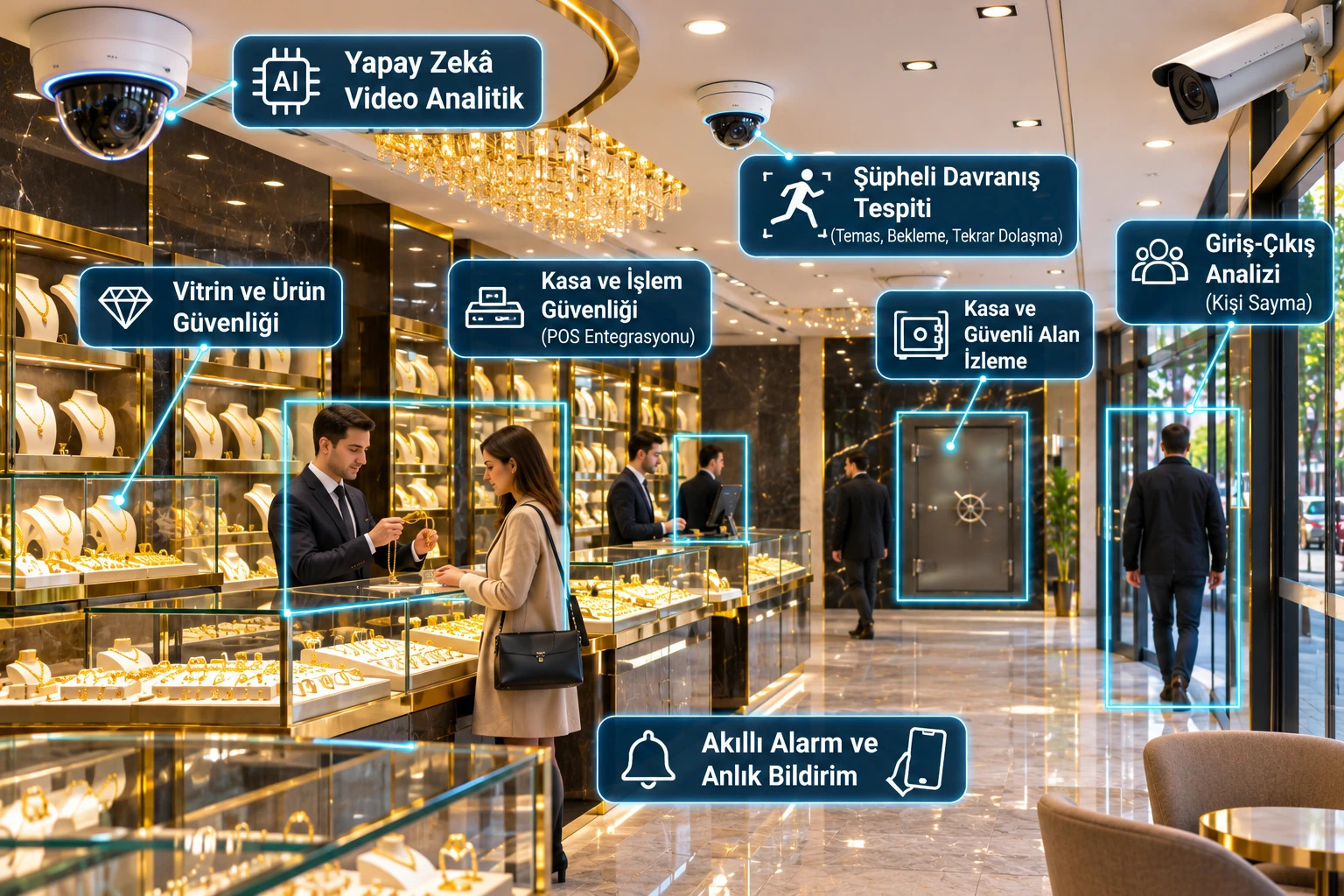
Jewellery and jewellery stores are businesses that display, store and sell gold, diamonds, precious stones, watches and other high-value goods. Because of these characteristics, they require multilayered security measures against risks such as theft, robbery, unauthorised entry, attacks on display cases and threats to staff safety.
Traditional security camera systems make it possible to view and record incidents, while AI-powered security systems can automatically detect certain risks and provide security personnel with earlier, more meaningful alerts.
Human and vehicle detection, virtual line-crossing detection, after-hours movement analysis, restricted-area security, video-assisted alarm verification and event-based recording search are among the AI technologies that can be used in jewellery stores.
However, no AI system can determine with certainty that a person intends to commit a crime or eliminate robbery risk entirely. Jewellery-store security must therefore involve more than cameras: it should include physical protection, alarm systems, access control, secure operating procedures and, where necessary, professional alarm monitoring.
What Is an AI-Powered Security System for Jewellers?
An AI-powered jewellery-store security system is an integrated solution that brings together IP cameras, video analytics software, burglar alarms, access control and other security components to detect and manage specific events.
In these systems, AI can analyse camera footage to detect predefined objects and events.
For example, detecting a person in a restricted area after the store has closed can trigger an automatic alert to security personnel.
However, the presence of a person in camera footage does not, by itself, show that the person is unauthorised or dangerous.
The Difference Between Traditional CCTV and an AI Security System
Feature | Traditional CCTV | AI-powered system |
|---|---|---|
Live viewing | Yes | Yes |
Video recording | Yes | Yes |
Human and vehicle classification | Generally limited | Available in supported models |
Virtual line-crossing detection | Model-dependent | Common AI application |
Event-based smart search | Limited | Possible with a suitable VMS/NVR |
Alarm verification | Manual | Automatic alert and human verification |
System integration | Product-dependent | Possible in advanced architectures |
False-alarm management | Basic rules | Can be improved with object classification |
How Do AI Security Systems Work in Jewellery Stores?
1. Capturing Camera Footage
IP cameras at store entrances, sales areas, display cases and designated security zones produce footage.
2. AI Analysis
The camera, NVR or analytics server evaluates the objects and events in the footage that it supports.
3. Defining Security Rules
Rules are configured for events such as detecting a person after hours, entry into a restricted area or crossing a specified line.
4. Generating an Alarm
When a defined event occurs, the system can send a notification to the alarm management platform.
5. Video Verification
Authorised security personnel review the relevant footage to assess the nature of the event.
6. Applying the Security Procedure
The business's established security and emergency procedures are applied to the verified event.
The main purpose of this approach is to let security personnel focus on important events instead of manually watching all cameras continuously.
Applications of AI Security Systems in Jewellery Stores
Security at Store Entrances and Exits
Jewellery-store entrances are important security points where customers and staff move through.
Suitable AI cameras can detect entry into designated areas, after-hours movement or a breach of a controlled door.
However, inferring criminal risk from the appearance of customers entering a store, or automatically classifying people as suspicious, is not a reliable approach.
Display-Case and Exhibition-Area Security
Jewellery-store display cases hold high-value products on show.
In addition to camera footage, display-case security can involve impact, vibration and glass-break sensors, as well as appropriate physical-protection solutions.
Some specialised video analytics systems can generate alerts for unusual movement or changes to objects in designated areas.
However, it should not be assumed that image analysis alone will reliably detect broken glass or missing products.
Safe and Sales-Counter Security
Camera placement in cash-handling areas can help ensure that incidents during transactions can be reviewed when necessary.
However, cameras should be positioned so that they do not record customer payment details, PIN entries or unnecessary personal information.
Valuables Room and Safe Area
Controlled areas where high-value products are kept in jewellery stores require particular security assessment.
Measures in these areas can include:
Unauthorised-access detection
Door contacts
Electronic access control
After-hours movement alerts
Alarm and camera integration
among other measures.
A camera system does not replace physical safe security or access security.
Store Perimeter and Shutter Security
Physical security and electronic alarm solutions should be planned together for jewellery-store façades, entrance doors and shutter areas.
After-hours human detection and perimeter-breach analysis can support the early assessment of specific events.
Staff Entrances and Service Areas
Controlled access points outside the customer area can be protected with suitable access-control and camera systems.
However, subjecting staff to continuous performance surveillance is a separate and legally problematic practice, distinct from using cameras for security.
Can AI Prevent Jewellery-Store Robberies?
AI-powered security systems can help detect certain events early and verify alarms.
However, they cannot predict with certainty that a robbery will occur.
For example, detecting a person in a restricted area while the store is closed can help assess a potential security breach.
Nevertheless, inferring criminal intent from the movements of a customer entering a store during business hours is unreliable.
The purpose of AI security systems is not to automatically declare people criminals, but to detect identifiable security events and provide decision support to authorised personnel.
Physical security, trained personnel, emergency procedures and alarm systems should be considered together to reduce robbery risk.
Smart Burglar Alarm Systems in Jewellery Stores
A burglar alarm is one of the essential components of jewellery-store security and should be designed independently of the camera system.
Magnetic Contacts
Help detect opening events on doors, windows and suitable openings.
Motion Detectors
Can detect changes associated with human movement in designated areas.
Glass-Break Detectors
Used to detect certain glass-break events under suitable design and installation conditions.
Impact and Vibration Detectors
Can detect changes in impact or vibration on particular physical surfaces.
Panic Buttons
Can enable staff to initiate an established alarm procedure in an emergency.
Alarm Communications
The transmission of alarm notifications to an authorised monitoring point over appropriate communication channels can be planned.
Video Verification
Review of camera footage associated with an alarm by an authorised operator can help distinguish a false alarm from a genuine event.
However, video verification does not replace a physical security response at the scene.
AI Video Analytics Features in Jewellery Stores
Analytics feature | Application | Limitation |
|---|---|---|
Human detection | After-hours store security | Does not determine authorisation status on its own |
Virtual line-crossing detection | Controlled entrances | Depends on camera angle |
Area intrusion detection | Perimeter of the valuables room | False alarms may occur |
Object tracking | Post-incident movement analysis | Tracking may be lost when the view is obstructed |
Abandoned object | Certain controlled areas | Does not determine whether the object is dangerous |
Removed-object analysis | Fixed display areas | Product movement may cause false alarms |
Human-vehicle distinction | Store exterior perimeter | Performance is not the same across all systems |
Smart video search | Recording review | Metadata and VMS compatibility are required |
Alarm-video matching | Event verification | Integration and time synchronisation are required |
Applications such as removed-object and display-case analytics may require specialised algorithms and field validation, unlike standard AI camera functions.
Should Facial Recognition Systems Be Used in Jewellery Stores?
Facial recognition can perform identity verification or identification based on people's biometric features.
However, biometric analysis of customers' faces or identification of their identities creates legal and technical risks that differ from standard security-camera use.
Biometric surveillance, particularly without customers' consent or another appropriate legal basis, can raise serious data-protection concerns.
For this reason, facial recognition should not be treated as the default solution for jewellery-store security.
Non-biometric security methods, controlled access, alarm verification and physical protection should be preferred in the first instance.
Which Security Camera Should Jewellers Choose?
IP Cameras
IP cameras can connect to a central NVR or VMS system through suitable network infrastructure.
Dome Cameras
Their compact design can make them suitable for indoor store applications.
Bullet Cameras
Can be used at certain exterior perimeter areas and entrances.
Varifocal Cameras
Can be advantageous where the field of view needs adjustment to site conditions.
Low-Light Cameras
Can support image quality in low-light conditions while the store is closed.
WDR-Supported Cameras
Can help preserve image detail in scenes with strong light contrasts at display cases and entrances.
However, WDR support does not guarantee clear images of faces or objects in every condition.
DORI and PPM Analysis for Jewellery-Store Cameras
In jewellery-store camera projects, how much detail a target occupies in the image is as important as camera resolution.
PPM (Pixels Per Meter) refers to the number of horizontal pixels per metre on a specified target plane.
For example, if a camera with a horizontal resolution of 3840 pixels captures an area 12 metres wide on the target plane:
In this case, the horizontal pixel density is approximately 320 PPM.
However, this value does not mean that facial recognition or identification performance is guaranteed.
Image quality is affected by the lens, lighting, motion blur, compression, camera angle and the target's actual position.
The DORI Approach
DORI is an approach that helps assess security-camera footage against different operational objectives.
Its main levels are:
Detection – Detect
Observation – Observe
Recognition – Recognise
Identification – Identify
respectively.
A DORI assessment does not replace accuracy testing of an AI algorithm.
How Should Camera Placement Be Planned in Jewellery Stores?
Store Entrance
At the entrance, the camera should have a suitable viewing angle to enable relevant security incidents to be reviewed.
Sales Area
Sales counters and customer areas should be assessed in a way that avoids unnecessary privacy intrusion.
Display Cases
Glass reflections, strong lighting and product-display arrangements can affect image quality.
Safe Area
The image coverage required for security should be defined, while protecting sensitive payment information.
Controlled Areas
Suitable integration of cameras and access control can be planned for staff passages and valuables-storage areas.
Exterior
Camera views around the store should be limited to security needs, avoiding unnecessary filming of neighbouring areas.
Night Security and AI Camera Performance in Jewellery Stores
Perimeter security becomes important while jewellery stores are closed.
Night-time performance requires consideration of:
Low-light sensors
IR illumination
WDR
Exposure settings
Motion-blur control
Glass and metal reflections
should be taken into account.
In particular, display-case glass and shiny metal surfaces can cause IR reflections.
There is no guarantee that an AI algorithm that works well by day will perform equally well at night.
For this reason, testing should be carried out under actual night-time conditions.
NVR, VMS and Recording Systems in Jewellery Stores
The recording infrastructure for security cameras is important for post-incident review and footage integrity.
NVR
It can record footage from IP cameras and manage supported analytics.
VMS
It can be used for central management of numerous cameras, event searches and user authorisation.
Event-Based Recording Search
AI metadata may make it possible to find recordings relating to specific people, vehicles or event types more quickly.
Recording Security
Unauthorised access to recording systems should be prevented, user permissions restricted and appropriate backup policies established.
Power Outages
The behaviour of the camera, network, recording and alarm infrastructure during power outages should be assessed separately.
UPS capacity and scenarios for safe shutdown or continued operation of systems should be planned.
How Many Days Should Jewellery-Store Camera Footage Be Retained?
The retention period for jewellery-store camera footage should be determined by assessing together any specific regulations applicable to the business and the provisions of KVKK.
It should not be assumed that there is one recording-retention period that applies to every workplace in Türkiye.
Since specific regulations relating to jewellery activities may impose camera and recording obligations, these should be checked separately in light of the business's activities and current legislation.
When determining the retention period, consider together:
Applicable legislation
Purpose of recording
Number of cameras
Image quality
Recording security
Automatic deletion procedures
should be considered together.
AI Security Systems and KVKK in Jewellery Stores
Recording images of customers and staff with security cameras may constitute the processing of personal data.
In Türkiye, the purpose, legal basis and proportionality of camera use, as well as data security, should be assessed under Personal Data Protection Law No. 6698.
Purpose of Camera Use
Camera systems should be used for specific security purposes.
Continuous Monitoring of Staff
Using security cameras to continuously monitor staff performance or conduct general disciplinary supervision can create legal issues.
Private Areas
Cameras should not be installed in private areas such as toilets, changing rooms, prayer rooms and rest areas.
Audio Recording
Audio recording may constitute a separate and more intrusive form of personal-data processing than video recording.
It should not be enabled automatically for general security reasons.
Retention and Deletion
Recordings should be retained only for the necessary period, and appropriate disposal procedures should be applied.
Authorisation
Only people with the appropriate duties and authorisation should be able to access footage.
Customer Privacy
When processing jewellery-store customers' images for security purposes, unnecessary facial profiling, biometric identification or behaviour scoring should not be carried out.
Integrated Security System Architecture for Jewellers
IP cameras
Video and AI analysis
Alarm system
Detector and panic alert
Access control
Access to authorised areas
Physical protection
Safe, display case and barrier
NVR / VMS / Integration Platform
Recording, event correlation and alarm management
Authorised security personnel / alarm monitoring
Event verification and defined response procedure
Security System Selection Guide for Jewellers
Criterion | What to check |
|---|---|
Risk analysis | The store's physical and operational risks |
Camera | Resolution, lens, WDR and low light |
AI analytics | Human, vehicle and restricted-area breach |
Alarm | Door, glass break, movement and panic |
Physical security | Display case, safe and access protection |
Integration | Camera, alarm, NVR and VMS |
Image quality | DORI and PPM |
Recording | Capacity, duration, security and backup |
Power continuity | UPS and communications |
Cybersecurity | Authorisation, network and updates |
KVKK | Purpose, legal basis and proportionality |
Maintenance | Periodic testing and validation |
How Should AI Security Systems Be Designed for Jewellery Stores?
1. Security Risk Analysis
The store's physical layout and the areas that need protection are identified.
2. Physical Protection Assessment
The safe, display case, entrance and other physical security measures are examined.
3. Camera Placement Plan
Viewing angles, target distances and blind spots are identified.
4. DORI and PPM Calculations
The required image detail is assessed against the objectives.
5. Alarm Scenarios
Rules are created for after-hours movement, restricted-area breaches and other specific events.
6. Integration
Camera, alarm, access-control and recording systems are linked.
7. Data Protection and Cybersecurity
Recording access, retention, network security and KVKK processes are assessed.
8. Pilot Test
Analytics and alarm performance are measured in daytime and night-time conditions.
9. Alarm Verification
False alarms, missed events and notification times are assessed.
10. Periodic Maintenance
Camera, recording, alarm and communications infrastructure is tested regularly.
Technical Checklist for Jewellers
- Has the security risk analysis been completed?
- Have display-case, safe and entrance security been assessed?
- Have camera viewing angles and blind spots been checked?
- Have DORI/PPM calculations been made?
- Have daytime and night-time image tests been completed?
- Have AI alarm scenarios been defined?
- Have the alarm system and video verification been integrated?
- Has a panic-alarm procedure been established?
- Have power-outage and communications scenarios been tested?
- Has applicable legislation on the retention period been reviewed?
- Have recording security and authorisation been ensured?
- Has the KVKK obligation to provide privacy notices been assessed?
- Have staff and customer privacy been protected?
- Have periodic maintenance and validation been planned?
Frequently Asked Questions
What is an AI-powered security system for jewellers?
It is an integrated system that uses components such as IP cameras, AI video analytics, alarms and access control to help detect and manage specific security events.
Can AI cameras prevent jewellery-store robberies?
They cannot predict or prevent a robbery with certainty. However, they can detect certain security events and provide early warnings and event verification.
How many megapixels should cameras for jewellers have?
There is no single mandatory resolution. Camera selection should be based on target distance, lens, lighting conditions and the required image detail.
Are panic buttons necessary in jewellery stores?
A panic alarm is an important component to consider as part of staff safety and emergency procedures. Applicable legislation and risk analysis should also be reviewed separately.
Can jewellery-store cameras operate at night?
Night-time imaging is possible with suitable low-light, IR or other lighting solutions. However, actual on-site testing is necessary.
Can facial recognition be used in jewellery-store cameras?
Biometric facial recognition entails data-protection requirements that differ from standard video recording. Its use requires an assessment of a specific legal basis and necessity.
How many days should jewellery-store camera footage be retained?
Specific legislation applicable to the business and KVKK requirements should be assessed together. No single general period should be assumed.
Can AI be added to existing jewellery-store cameras?
Video analytics features can be added to some existing systems using compatible IP video streams, AI NVRs or analytics servers.
Conclusion
AI-powered security systems for jewellers can add capabilities to traditional CCTV infrastructure, including automatic detection of specific security events, smart alarm management and video-assisted verification.
However, security in stores holding high-value goods cannot be ensured through camera technology alone.
Physical protection, alarms, access control, secure recording infrastructure, staff procedures and professional system integration should all be considered together.
Camera placement, DORI/PPM analysis, night-time imaging performance, alarm accuracy and KVKK requirements should be core components of the design process.
The real value of AI in jewellery-store security is not automatically labelling people as suspicious, but detecting specific security events more quickly, generating verifiable alerts and supporting a multilayered security approach.