
U.S. Stadium Security Report: Cameras Used at 96%, Gunshot Detection Systems at 13%
A new report from Shooter Detection Systems shows that, while cameras are widely used at U.S. professional sports venues, automated gunshot detection systems are less common. The headline technology adoption rates are based on NCS4’s 2024 survey.
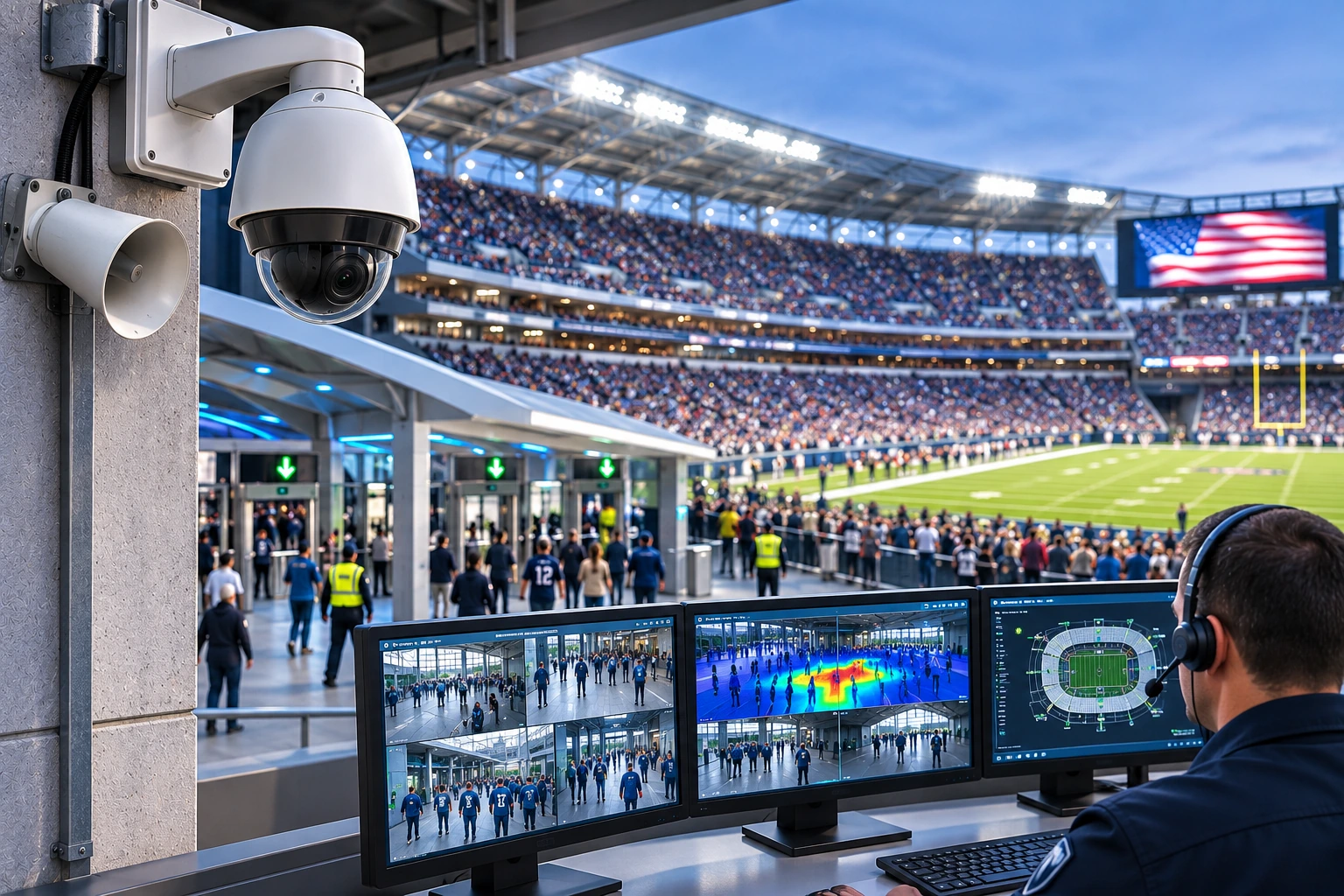
A new industry report examining the security infrastructure of sports and entertainment venues in the United States has found significant differences in the adoption of traditional video surveillance systems and automated threat-detection technologies.
Shooter Detection Systems (SDS), part of Alarm.com, published its report, titled The State of Active Shooter Security at U.S. Sports & Entertainment Venues, in November 2026.
According to a 2024 study by the National Center for Spectator Sports Safety and Security (NCS4), cited in the report, security cameras were used at 96% of the professional sports venues surveyed, walk-through metal detectors at 94%, and automated gunshot detection systems at 13%.
SDS’s study brings these findings together with more recent security and spectator research to assess stadium incident-detection and response processes.
Why Are Camera Systems More Widespread?
At professional sports venues, video surveillance systems serve a broad range of security needs, from entrances and stands to parking lots.
Cameras can be used to monitor crowd movement, capture incidents, review recordings afterward, and centrally coordinate security teams.
In NCS4’s 2024 survey, security cameras and two-way radio communications each had an adoption rate of 96%, indicating that both technologies are among the core security infrastructure at the professional sports venues surveyed.
The 94% adoption rate for walk-through metal detectors also shows that entry points play a central role in security planning.
However, having a camera system does not mean that footage can automatically detect every threat.
Real-time incident-detection capability depends on the analytics software used, camera placement, the number of operators, and how well the systems integrate with other security components.
Why Are Gunshot Detection Systems Less Common?
According to the SDS report, automated gunshot detection technology had an adoption rate of 13% in NCS4’s 2024 survey.
The same survey found that 30% of security directors considered the technology a priority investment if additional funding became available.
Gunshot detection systems use specific sensor technologies to identify potential firearm incidents and provide security teams with location information.
However, the actual performance of these systems depends on the detection method used, environmental conditions, and installation design.
It is not appropriate to view widely used CCTV technology and less commonly used gunshot detection systems as alternatives to each other. The two technologies serve different security functions and can complement one another in suitable architectures.
Furthermore, the 13% figure is not a new count conducted in November 2026; it is data from a 2024 study reassessed in the report.
Security Risks Are Not Limited to Entry Gates
The report draws particular attention to the areas outside stadiums.
Metal detectors at entrances are intended to screen people passing through designated checkpoints. However, parking lots, pedestrian routes, and open areas around a venue can present different security requirements.
Drawing on the FBI’s assessment of active-shooter incidents from 2020–2024, SDS reports that 41% of the 223 incidents recorded across the United States during that period occurred in open areas.
While this data is important, it does not show the proportion of incidents that occurred specifically at stadiums. The classification of open areas includes different types of public settings.
The report’s main conclusion from this data is that crowds need to be included in security planning not only while passing through turnstiles, but also before and after events.
Video Analytics and Alarm Integration
The technology comparisons cited in the report put video analytics use at 50% and mass notification system use at 71%.
These figures show that, despite the widespread use of cameras, video analytics and incident-response technologies are not used at the same rate.
SDS highlights the importance of coordinating camera footage, access control systems, alert infrastructure, and incident-management software when a threat is detected.
For example, information must flow consistently between systems so that security teams can accurately pinpoint an incident, access the relevant camera footage, and initiate the appropriate response procedure.
However, it should not be assumed that automated integrations will always produce safer outcomes.
False alarms, inaccurate location data, or inappropriate automatic locking operations can also create operational risks. For this reason, human oversight, tested procedures, and verifiable incident records remain important in critical response scenarios.
Scope and Limitations of the Study
SDS’s November 2026 report is not based on a new field survey conducted on a single date.
The study is an assessment that brings together FBI incident statistics, NCS4 surveys of security directors, spectator surveys, and academic publications.
In particular, the 2024 NCS4 study underpinning the 96% camera and 13% gunshot detection rates had 52 completed responses from a target participant group of 152 people.
Therefore, the rates should not be presented as a complete count of all U.S. stadiums or as current market penetration for 2026.
Another important distinction is that the report was prepared by SDS, a provider of automated gunshot detection technology.
Although the company’s assessment contains useful information for research and security planning, its commercial position in the product category should be taken into account. The report’s technology investment recommendations should not be interpreted as requirements imposed by an independent public agency.
Implications for Stadiums and Event Venues in Türkiye
Security planning at football stadiums, concert venues, exhibition centers, and large-capacity event facilities in Türkiye requires multiple systems to work together.
At these venues, it is important to ensure compatibility between CCTV infrastructure, entry control, public-address systems, and incident-management processes.
The adoption rates in the U.S. study cannot be directly applied to Türkiye. However, the distinction highlighted in the report between entry points and perimeter security is also worth considering for local venue managers.
Security teams may find it useful to consider the following questions at their own venues: Are there gaps in camera coverage? Are areas where crowds gather before entering being monitored? Can relevant footage and alarm records be reviewed at the same center during a suspicious incident? Are emergency procedures tested through regular drills?
Answers to these questions can help assess existing security infrastructure and operational needs before purchasing a particular product.
An Integrated Security Approach Takes Center Stage
The central issue highlighted by the November 2026 report is not the number of security technologies, but how they work together.
Camera, access control, detection, and notification systems each perform important functions on their own. But communicating the right information to the relevant personnel during an incident and carrying out response procedures requires integrated management of these systems.
SDS’s new assessment recommends addressing perimeter security, technology integration, and staff preparedness together at sports venues.
Implementation of this approach should be assessed in light of each venue’s risk profile, budget, regulatory obligations, and operational requirements.
Sources
Source: shooterdetectionsystems.com