
How to Choose Smart Home Systems? A Guide to KNX, Matter, and Zigbee
How do smart home systems work, and how do you choose the right technology? We examine lighting, HVAC, security, energy management, and remote control solutions. We compare KNX, Matter, Zigbee, Thread, and Wi-Fi technologies, explaining the advantages, limitations, and selection criteria for wired and wireless automation systems.
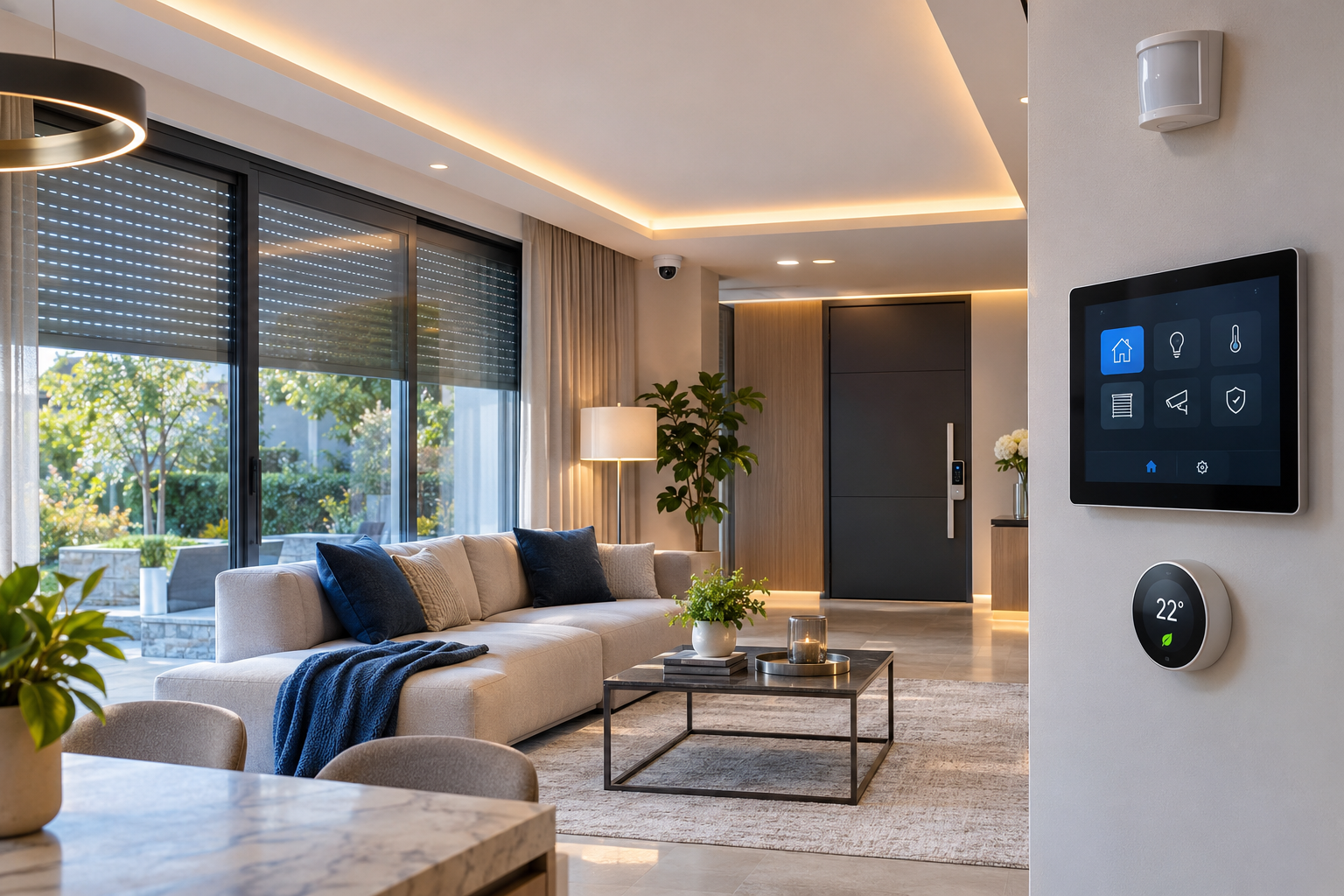
Smart home systems are technologies that enable the control of lighting, HVAC, security, blinds-shutters, energy management, and other electrical equipment in residences through a centralized or distributed automation infrastructure.
Today, smart home solutions are not limited to merely turning lights on and off with a mobile phone. Thanks to motion sensors, temperature measurements, time schedules, and user preferences, different systems within the home can work in coordination.
For example, when leaving home, lights can be turned off, the heating or cooling system can be set to an economic operating mode, the security system can be activated, and motorized blinds can be moved to a predefined position.
However, not every smart home system has the same technical infrastructure. While some solutions consist of standalone devices operating via Wi-Fi, professional automation projects may prefer wired systems like KNX or wireless network technologies such as Zigbee and Thread.
The foundation for choosing the right smart home system lies not only in the features offered but also in connection reliability, device compatibility, cybersecurity, expandability, and long-term maintenance possibilities.
What is a Smart Home System and How Does It Work?
A smart home system is a combination of hardware and software that enables devices in the home to be monitored, controlled, and operated automatically within specific rules.
The main components of the system are:
Sensors: Detect information such as motion, temperature, humidity, light, door-window status, and water leaks.
Actuators: Perform physical operations with hardware such as relays, dimmers, motor control units, or valve controls.
Control units: Evaluate information from sensors, apply automation rules, and send commands to devices.
Communication infrastructure: Enables data exchange between devices.
User interfaces: Offer control via wall panels, mobile applications, physical switches, and supported voice assistants.
In an automation scenario, when a motion sensor detects activity, the control system evaluates this information. If the ambient light level is insufficient, the relevant lighting circuit can be activated.
This operation is performed via the local network in some systems, and through the manufacturer's cloud service in others.
Important distinction: Not all smart home systems require a constant internet connection. In suitable systems that support local control, some basic automation functions can continue to operate even if the internet is disconnected.
Where Are Smart Home Systems Used?
Smart Lighting Control
Lighting automation enables turning lights on and off, adjusting light levels, scheduling, and creating different lighting scenarios.
When integrated with motion and daylight sensors, lighting in areas where it's not needed can be reduced.
For example, a corridor motion sensor activating only low-level lighting at night can contribute to both user comfort and energy management.
Heating, Cooling, and HVAC
Smart thermostats and room control systems can manage temperature values according to user preferences and time schedules.
In more advanced systems, room-based temperature control, HVAC management linked to window contacts, and various usage scenarios can be created.
However, technical compatibility between the automation system and the boiler, air conditioner, underfloor heating, or heat pump must always be checked.
Not every thermostat can control every heating or cooling device with the same functionalities.
Blinds, Shutters, and Sun Control
Motorized blinds and shutters can be managed with time schedules, daylight sensors, or user commands.
Controlling the entry of sunlight into indoor spaces can help manage the HVAC load in suitable projects.
However, the motor type, control interface, movement limits, and safety functions must be compatible with the automation system.
Home Security and Access Control
Smart home systems can be integrated with alarm systems, IP cameras, video intercoms, door-window sensors, and electronic locks.
This integration can enable sending notifications when a door is opened, activating specific lights in an alarm situation, or accessing relevant camera footage in supported systems.
However, smart home automation is not the same as a professional security alarm system. For safety-critical functions like burglar alarms and fire detection, appropriate products, system design, and relevant standard requirements must be evaluated separately.
For detailed information on electronic lock selection and door compatibility, GüvenlikOnline's technical guide titled What Are Smart Lock Systems? How Do They Work and How Are They Chosen? can be reviewed.
Energy Management and Consumption Tracking
Thanks to smart energy metering devices and suitable automation software, the consumption of specific electrical circuits can be tracked.
Measurement data can contribute to more controlled management of lighting, HVAC, electric vehicle charging, and other electrical loads.
However, the amount of energy savings depends on the physical characteristics of the facility, user behavior, device efficiency, and automation scenarios. It should not be assumed that every smart home installation will provide a certain level of savings.
Technologies Used in Smart Home Systems
One of the most important technical considerations in smart home selection is the communication infrastructure.
Wired and wireless systems have different characteristics in terms of installation cost, maintenance, coverage area, expansion, and device compatibility.
KNX: Professional Building and Residential Automation
KNX is an open building automation standard aimed at enabling different automation components to work together in residential and commercial buildings.
Lighting, HVAC, blinds-shutters, energy management, and certain security integrations can be implemented with KNX infrastructure.
KNX is not solely a wired technology. KNX TP, KNX RF, and IP-based components can be used in different system architectures.
However, KNX TP, in particular, is common in professional automation projects installed with a dedicated twisted-pair bus cable.
Advantages:
Ability to use certified devices from different manufacturers together.
Suitability for comprehensive residential and building automation projects.
Possibility to create local control architectures.
Long-term expansion and maintenance opportunities.
Technical limitations:
Wired installations require infrastructure planning during the project phase.
May require professional design, programming, and commissioning.
Initial investment cost can be higher compared to simple standalone wireless solutions.
KNX can be considered especially in newly constructed residences, comprehensive renovations, and projects where numerous automation functions are integrated.
Zigbee: Low-Power Wireless Device Network
Zigbee is a low-power wireless communication technology primarily used in sensors and smart home devices.
In Zigbee systems supporting a mesh network structure, suitable router devices can facilitate communication for other devices.
This structure can help improve wireless coverage when physical conditions and network design are appropriate.
Advantages:
Offers suitable solutions for battery-powered sensors.
Can reduce the need for additional control wiring in existing residences.
Has a broad device ecosystem including smart plugs, switches, sensors, and lighting.
Technical limitations:
Requires a coordinator or gateway in numerous installations.
Feature compatibility must be separately checked for devices from different manufacturers.
Wireless communication can be affected by building structure and radio frequency conditions.
It is not guaranteed that all advanced features of two devices claiming to use the same Zigbee standard will work on different platforms.
Thread: IP-Based Wireless Mesh Network
Thread is an IPv6-based wireless mesh networking technology developed for low-power IoT devices.
It supports devices communicating with the local IP infrastructure. A Thread Border Router acts as an intermediary for the Thread network's communication with other IP networks.
Thread is a significant connectivity technology, especially in Matter-supported smart home ecosystems.
Advantages:
Suitable for devices requiring low power consumption.
Supports mesh network topology.
Offers an IP-based communication architecture.
Technical limitations:
May require a suitable border router and network infrastructure.
Not every Thread device is automatically Matter-compatible.
Wireless network performance depends on device placement and physical conditions.
Matter: Interoperability Among Different Brands
Matter is a smart home interoperability standard developed by the Connectivity Standards Alliance.
Here lies an important technical distinction: Matter is not the exact same type of communication technology as Zigbee or Thread.
Matter is an application layer standard that enables devices to work together through common data models and control methods. It can be used over IP-based networks such as Wi-Fi, Ethernet, and Thread.
Matter's goal is to enable easier management of supported devices from different manufacturers within compatible ecosystems.
With Matter 1.5, published in 2025, camera support was added to the standard. Matter 1.6, announced in June 2026, brought improvements in setup, multi-ecosystem management, and device status information.
However, the addition of a feature to the Matter standard does not mean that all existing devices and control platforms automatically support that feature.
During purchase, the device's Matter certification, supported device type, software version, and the control platform to be used should be evaluated together.
Wi-Fi: Smart Device Connection Over Existing Network
Wi-Fi connected devices can operate over the existing wireless network in the home.
Smart plugs, cameras, video intercoms, control panels, and some home appliances can utilize Wi-Fi infrastructure.
Advantages:
Can leverage the existing home network for many products.
The need for an additional wireless gateway may be eliminated in some applications.
Can offer suitable network capacity for devices transmitting more data, such as cameras.
Technical limitations:
Capacity and coverage planning are important in networks with numerous devices.
Some devices may be dependent on the manufacturer's cloud.
Product security, software support, and network configuration should be carefully evaluated.
KNX, Zigbee, Thread, Matter, and Wi-Fi Comparison
Since these technologies do not operate on exactly the same layer, this comparison should be considered merely a technical summary to facilitate purchasing decisions.
Technology | Core Function | Advantage | Consideration |
|---|---|---|---|
KNX | Building automation and control | Professional, expandable structure | Infrastructure and programming requirement |
Zigbee | Wireless device communication | Low power consumption, mesh network | Gateway and device compatibility |
Thread | IP-based wireless mesh network | Low-power local IP communication | Border Router and network planning |
Matter | Interoperability between devices | Common control with different ecosystems | Certification, version, and feature support |
Wi-Fi | IP-based wireless connection | Leveraging existing network infrastructure | Network capacity, coverage, and security |
For example, a Matter-supported device can communicate via Thread. Another Matter device might use Wi-Fi.
Similarly, connecting Zigbee devices to the Matter ecosystem may be possible with a compatible Matter bridge. However, the existence of such a bridge does not guarantee that all Zigbee features will be automatically transferred.
Wired or Wireless Smart Home System: Which to Choose?
When choosing between wired and wireless infrastructures for smart home projects, the existing condition of the residence and the scope of automation are decisive.
Selection Criterion | Wired System | Wireless System |
|---|---|---|
New building projects | Advantageous to plan from the start | Can be an alternative or complementary |
Application to existing residence | May require cable infrastructure and renovation | Generally requires less intervention |
Communication reliability | Predictable connection with proper design | Can be affected by radio conditions |
Expansion | Depends on infrastructure and capacity | Depends on coverage and device support |
Maintenance | May require professional service | Battery, network, and device updates are important |
Initial cost | Can be higher for comprehensive projects | Small installations can be started gradually |
If lighting, HVAC, blinds, and energy management are being planned from scratch in a new villa, a wired or hybrid automation infrastructure can be considered.
If the goal is to control a few lighting circuits, sensors, and smart plugs in an existing apartment, wireless systems may require less structural intervention.
However, a wired system is not always better, nor is a wireless system always more economical. The decision should be made based on the scope of application and the total cost of ownership.
Security and Cybersecurity in Smart Home Systems
Since smart home systems involve internet-connected devices, user accounts, mobile applications, and in some cases, cloud services, cybersecurity must be one of the fundamental elements of design.
Especially in systems with camera, smart lock, alarm, and remote control functions, device compromise or unauthorized access can pose significant risks.
The ETSI EN 303 645 V3.1.3 (2024-09) standard for cybersecurity of consumer IoT devices includes fundamental provisions for device security, authentication, software updates, and personal data protection.
When choosing a smart home system, the following points should be considered:
Using unique or user-defined strong authentication credentials for each device.
Enabling multi-factor authentication if supported for remote access accounts.
Reviewing the manufacturer's security updates and support period.
Restricting IoT devices to a separate network or with appropriate access rules when necessary.
Clarifying where camera, microphone, and sensor data are processed and stored.
Testing the behavior of critical functions when the internet connection is lost.
Limiting user permissions and removing accounts that are no longer in use.
In camera systems, where images are stored is also important.
To examine the differences between cloud-based recording and local recording methods, GüvenlikOnline's article titled Differences Between Cloud Recording and Local Recording in Home Security Cameras can be utilized.
Do Smart Home Systems Work During Power and Internet Outages?
The answer to this question depends on the automation architecture used.
In systems supporting local control, an internet connection outage does not always mean that basic automation functions will stop.
However, some scenarios operating via the manufacturer's cloud service, remote access, and notification features may not be available without an internet connection.
In the event of a power outage, the system's operation depends on power supplies and backup infrastructure.
Therefore, the following should be determined during the project phase:
Functions that must operate without internet.
Devices requiring backup power during an electricity outage.
Possibility of manual control with physical switches.
System behavior in case of gateway, control unit, or router failure.
Safe operating conditions for doors, shutters, and security equipment in emergencies.
Especially in systems related to electronic locks, fire safety, and emergency evacuation, automation scenarios should not override independent safety requirements.
How Does Smart Home System Installation Cost Vary?
The cost of smart home systems is not solely comprised of device prices.
The following items should be considered in the total cost evaluation:
Number of rooms, devices, and electrical circuits to be controlled.
Need for wired or wireless infrastructure.
Costs of control unit, gateway, and actuators.
Electrical panel, cabling, and installation work.
Software, programming, and scenario creation.
Security, camera, HVAC, and other system integrations.
Maintenance, license, subscription, update, and technical service expenses.
The investment costs and scope of a simple wireless solution and a professional KNX automation project can differ significantly.
Therefore, instead of comparing product prices, it is a more accurate approach to evaluate the total installation and lifecycle cost of systems providing the same functionalities.
What to Consider When Choosing a Smart Home System?
Before purchasing a smart home system, merely examining the mobile application's appearance or the number of supported devices is not sufficient.
The following technical checklist can be used for project and product evaluation:
- Have the systems to be controlled and automation scenarios been determined?
- Has the need for wired, wireless, or hybrid architecture been evaluated?
- Has the actual protocol and platform compatibility of the selected products been verified?
- Have the basic functions that will operate without internet been defined?
- Have network capacity and wireless coverage been checked?
- Has compatibility with existing switches, curtain motors, heating, and cooling equipment been examined?
- Have camera, alarm, and smart lock integrations been planned for testability?
- Has the manufacturer's software update and security support been reviewed?
- Have power outage and manual control scenarios been determined?
- Have warranty, technical service, and spare parts availability been evaluated?
- Has the possibility of adding new devices to the system in the future been planned?
- Have post-installation function tests and user training been scheduled?
This checklist is a starting point for system selection. Competent technical evaluation for electrical safety, device suitability, and project requirements should be conducted separately.
Frequently Asked Questions
Is internet necessary for a smart home system?
Not always. In systems supporting local control, some automation functions can operate without internet. However, remote access, cloud-based services, and some voice assistant functions may require an internet connection.
Should KNX or Zigbee be preferred?
In newly built or extensively renovated residences, a professional wired KNX infrastructure can be considered. For adding automation to existing homes with limited intervention, Zigbee-based solutions may be suitable. The definitive choice depends on project requirements.
Does Matter make all smart home devices compatible with each other?
No. Matter facilitates interoperability for supported device categories and features. Product certification, the Matter version used, and the functionalities supported by the control platform must be checked separately.
Are smart home systems secure?
Properly designed systems can offer strong security features. However, security depends on the software support of the devices used, authentication methods, network configuration, and users' maintenance habits.
Do smart home systems save energy?
Properly planned lighting, HVAC, and energy management scenarios can help reduce unnecessary consumption. However, the amount of savings varies depending on the devices used and usage habits.
Long-Term Compatibility is Important in Smart Home System Selection
Smart home systems enable a holistic approach to lighting, HVAC, security, and energy management, beyond just comfort and remote control functions.
However, for a successful installation, a correct understanding of the advantages and limitations offered by different technologies is necessary.
KNX, Zigbee, Thread, Matter, and Wi-Fi can address different technical needs. Therefore, when selecting a system, device compatibility, local control, cybersecurity, maintenance, and expandability options should be evaluated, as much as the initial investment cost.
The fundamental characteristic of a well-designed smart home system is not to control numerous devices, but to ensure these devices work together reliably and sustainably.
Resources
KNX Association — What is KNX? — The KNX standard's operational approach, application areas, and interoperability with different manufacturers.
KNX Association — KNX Technology — Technical specifications of KNX TP, KNX RF, and IP-based technologies.
Connectivity Standards Alliance — Zigbee — The Zigbee standard, mesh network structure, and wireless device communication.
Thread Group — What is Thread? — IPv6-based low-power mesh network architecture.
Google Home Developers — Matter Overview — Technical explanations regarding Matter architecture and device compatibility.
Connectivity Standards Alliance — Matter 1.5 — Official announcement regarding camera and energy management support.
Connectivity Standards Alliance — Matter 1.6 — Setup and ecosystem improvements of the June 2026 release.
ETSI — EN 303 645 V3.1.3:2024 — Fundamental cybersecurity requirements for consumer IoT devices.