
Hikvision CorroShield Cameras: Corrosion-Resistant Security Camera Technologies
Hikvision corrosion-resistant security cameras deliver long-lasting video security solutions, using advanced polymer and stainless-steel housing technologies in harsh environments with salty air, high humidity, and corrosive chemicals.
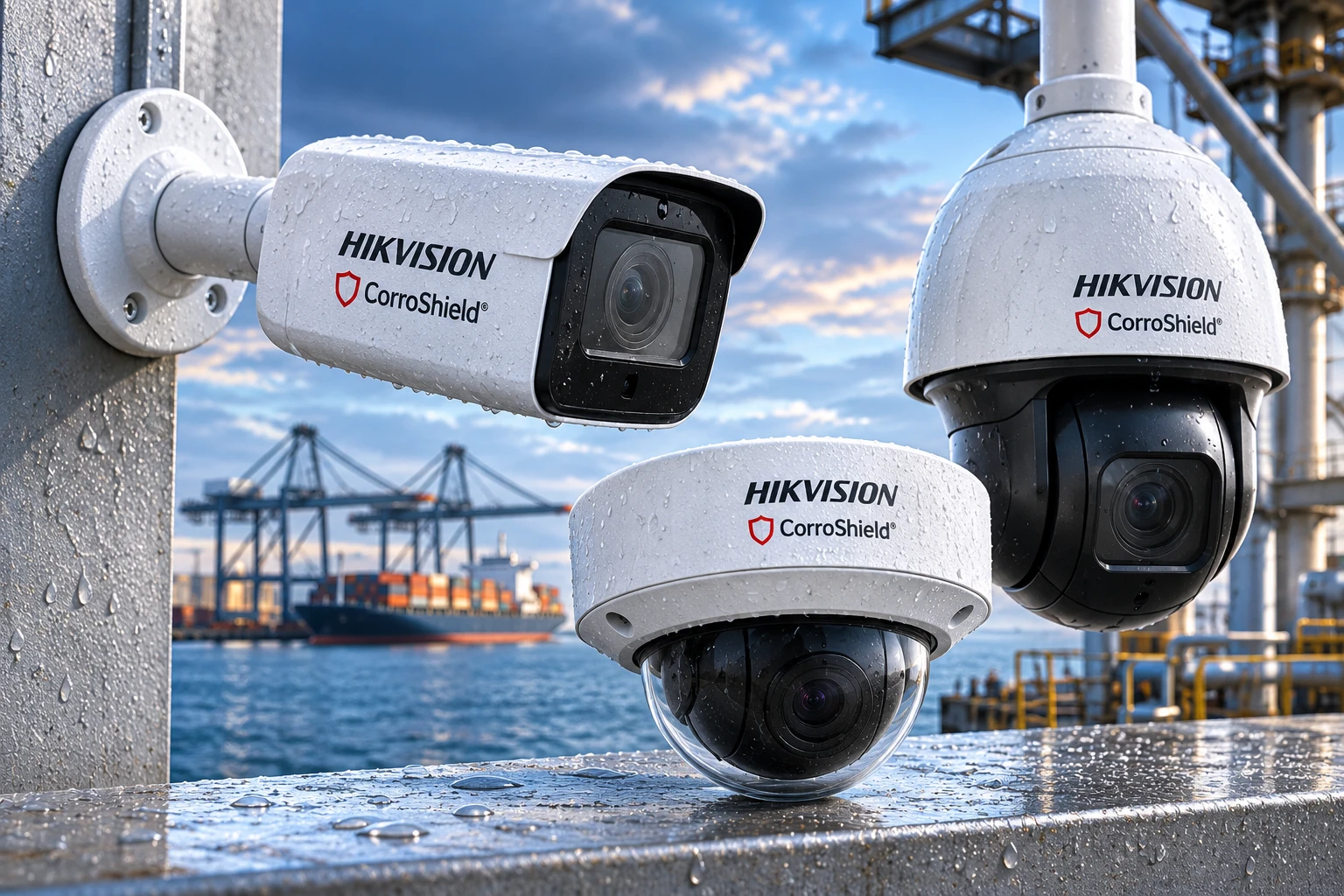
Security camera performance should not be assessed solely by image quality, resolution, and AI features. A camera’s resistance to the physical and chemical conditions of its operating environment is also critical to the sustainability of the system.
Traditional security cameras can corrode over time, especially in ports, shipyards, coastal areas, chemical plants, and industrial environments with high humidity. This can lead to image loss, connection problems, mechanical damage, and high maintenance costs.
Hikvision, with its technologies developed for these environmental conditions, with its Anti-Corrosion camera technologies, offers alternative solutions for professional video security projects.
What is Hikvision CorroShield camera technology?
Hikvision’s corrosion-resistant camera technologies are designed to reduce the harmful effects of corrosive environmental conditions on security cameras.
Unlike conventional camera housings, this product family uses specialized polymer materials, 316L stainless steel, and surface-protection technologies developed to resist corrosion.
These solutions are designed to provide protection against the following environmental effects:
Salt-laden sea air
High humidity
Salt spray
Corrosive chemicals
Industrial atmospheric conditions
Rain and outdoor exposure
Long-term environmental wear
Corrosion resistance is intended to help preserve the service life of the camera housing, mounting connections, and electronic components.
How does corrosion affect security cameras?
Corrosion is the deterioration of materials caused by environmental and chemical effects. It is a significant problem, particularly for security cameras with metal housings.
The main problems that can result from corrosion include:
Oxidation and rust on the camera housing
Peeling of the protective paint layer
Deformation of the housing and connection points
Loss of watertightness
Damage to electronic components
Loss of mechanical strength in mounting hardware
Image and communication interruptions
Shortened camera service life
Particularly in projects near the sea, the absence of direct contact between the camera and seawater does not mean there is no risk of corrosion. Salt particles carried by the wind can also cause damage to camera surfaces over time.
Hikvision corrosion-protection levels
Hikvision classifies its cameras into three main categories according to corrosion resistance.
Protection level | Materials and technology | Application |
|---|---|---|
Standard protection | Conventional aluminum alloy and plastic | Normal environmental conditions |
Medium-level protection | Special-coated or corrosion-resistant aluminum | Areas with a moderate risk of corrosion |
High-level protection | Anti-corrosion polymer or 316L stainless steel | Ports, coastal areas, and chemical plants |
The manufacturer also considers the distance from the sea when selecting a camera. However, the decision should not be based on distance alone; prevailing wind direction, humidity, chemical exposure, and site conditions should all be assessed together.
Hikvision anti-corrosion camera housing technologies
Special corrosion-resistant polymer
Reinforced polymer materials used in Hikvision’s next-generation anti-corrosion cameras were developed as an alternative to metal housings.
Key advantages of polymer camera housings:
Low weight
High corrosion resistance
Easy installation and transport
Resistance to salty environments
Potential to reduce maintenance costs
A suitable balance between durability and weight
Hikvision states that certain polymer camera housings can be approximately seven times lighter than stainless-steel housings. This advantage is particularly important when installing cameras at elevated locations.
316L stainless-steel camera housings
316L stainless steel is widely chosen for marine and industrial applications because of its corrosion resistance.
It is used especially in projects where mechanical strength is important under aggressive environmental conditions.
However, 316L stainless steel is not impervious to every chemical. Factors such as chemical compatibility, concentration, and temperature should be assessed for each project.
Corrosion-resistant aluminum technology
Certain Hikvision professional camera series use enhanced aluminum alloys and specialized surface-protection treatments.
This approach provides an alternative solution between standard cameras and high-end anti-corrosion cameras.
Standards used for Hikvision anti-corrosion cameras
The manufacturer’s technical documentation and test results are highly important when selecting a corrosion-resistant camera.
C5-M corrosion-protection class
C5-M is a corrosion category used in earlier classifications of the ISO 12944 standard to describe highly corrosive marine atmospheres.
Hikvision states that its anti-corrosion camera family offers resistance for the C5-M level.
As the current classifications of ISO 12944 also include the C5 and CX categories, the project specification should be checked to determine which edition of the standard applies.
NEMA 4X protection class
NEMA 4X is an enclosure classification that assesses the resistance of electrical enclosures to certain outdoor conditions and corrosion.
Protection features covered by NEMA 4X include water, windblown dust, and additional corrosion resistance.
IP68 protection class
IP68 indicates the camera’s level of protection against dust ingress and immersion in water under conditions specified by the manufacturer.
However, having an IP68 rating alone does not indicate that a camera is suitable for corrosion or continuous operation underwater in seawater.
IK impact resistance
The IK classification indicates a camera housing’s resistance to mechanical impacts. The required IK level should be checked in the technical documentation for the camera model to be used.
Comparison of standard IP cameras and anti-corrosion cameras
Feature | Standard IP camera | Anti-corrosion camera |
|---|---|---|
Housing material | Aluminum or plastic | Special polymer or 316L steel |
Resistance to salty air | Model-dependent; may be limited | Designed for a high level of protection |
Chemical resistance | Generally no special protection | Depends on the material and chemical |
Marine applications | Limited suitability | Can be used with suitable models |
Maintenance requirements | May increase in corrosive environments | Potential for lower maintenance |
Initial investment cost | Generally lower | Higher, depending on the model |
Total cost of ownership | May increase in harsh environments | May offer advantages over the long term |
Suitability for explosive atmospheres | Special certification required | Special certification required |
Hikvision anti-corrosion camera models
Hikvision develops corrosion-resistant cameras in bullet, dome, and PTZ form factors for a range of video security needs.
Hikvision anti-corrosion camera models
Hikvision develops corrosion-resistant cameras in bullet, dome, and PTZ form factors for a range of video security needs.
Fixed bullet camera with 4 MP resolution, ColorVu, polymer housing, IP68, 120 dB WDR, and H.265+ video compression technology.
4 MP resolution PTR dome camera with a corrosion-resistant polymer housing.
4 MP polymer anti-corrosion bullet camera with variable focal length.
4 MP polymer anti-corrosion PTZ camera with 42x optical zoom.
Model availability, hardware revisions, and technical specifications may vary by country.
Imaging and analytics technologies in Hikvision anti-corrosion cameras
Corrosion resistance safeguards the camera physically, while modern image-processing technologies also support video security performance.
Technology | Benefit |
|---|---|
ColorVu | Color imaging in low light |
DarkFighter | Improved low-light performance |
AcuSense | Human and vehicle classification |
WDR | Image enhancement in backlit conditions |
H.265+ | Bandwidth and storage optimization |
HEOP | Third-party applications on supported models |
PoE | Power and data over a single cable on compatible devices |
PTZ | Remote pan, tilt, and optical zoom |
Not all of these technologies are included as standard in every camera model.
Where are Hikvision CorroShield cameras used?
Ports and container terminals
They may be selected for port security projects that require resistance to corrosive environmental conditions caused by seawater and salty air.
Shipyards and ships
They can be used to support environmental durability on ship decks, shipyard sites, and maritime facilities. Vibration and marine certifications should be assessed separately.
Chemical and petrochemical plants
Models with verified chemical compatibility can be used in production facilities where corrosive substances are present.
Coastal areas and seaside roads
They may be selected for traffic monitoring systems near the sea, perimeter security projects, and public safety applications.
Water treatment plants
They can be used in wastewater treatment plants where high humidity and corrosive gases may occur, provided suitable materials are selected.
Food production facilities
They may be considered for areas subject to frequent washing and chemical cleaning. Compatibility with the cleaning agents and wash pressure should be verified separately.
Energy and industrial production facilities
They can support long-term operational reliability in outdoor security applications exposed to aggressive atmospheric conditions.
Are anti-corrosion cameras and Exproof cameras the same?
No. Corrosion-resistant cameras and Exproof cameras certified for use in explosive atmospheres serve different purposes.
Feature | Anti-corrosion camera | Exproof camera |
|---|---|---|
Primary purpose | Resistance to corrosion | Control of ignition risk in an explosive atmosphere |
Primary risk | Salt, humidity, and chemical corrosion | Flammable gas, vapor, and dust |
Certification | Corrosion and enclosure tests | ATEX, IECEx, or relevant certifications |
Application | Ports, coastal areas, industry | Classified hazardous areas |
A camera’s corrosion resistance does not mean it can be used in an explosive environment. In areas with explosive atmospheres, certified equipment suitable for the relevant hazardous-area classification must be used.
What should be considered when installing an anti-corrosion camera?
Using a corrosion-resistant camera does not mean the entire security system is protected against corrosion.
Professional projects should also assess the following components:
Camera mounting brackets
Stainless steel fasteners
Junction boxes
Cable glands
Outdoor data cables
Cable enclosures
Camera poles
Grounding and lightning protection
Risk of galvanic corrosion between dissimilar metals
Periodic maintenance and cleaning procedures
Metal connections that are particularly at risk of galvanic corrosion should be properly isolated.
Advantages in terms of total cost of ownership (TCO)
Focusing solely on the purchase price when selecting a camera for areas with a high risk of corrosion may be the wrong investment approach.
When calculating the total cost of ownership, the cost of the device itself should be considered alongside installation, maintenance, fault response, device replacement, access equipment and system downtime.
Although corrosion-resistant cameras may have a higher upfront cost, they can offer long-term cost advantages in suitable projects by reducing the frequency of device replacement and the need for maintenance.
Frequently asked questions
Do Hikvision anti-corrosion cameras rust?
Although they are specially designed to resist corrosion, their durability depends on the materials used and environmental conditions. Unlimited corrosion resistance cannot be guaranteed.
Can an IP67 or IP68 camera be used by the sea?
The IP rating alone does not indicate resistance to salty air and corrosion. Corrosion-protection features should also be examined for applications by the sea.
Which is more advantageous: a polymer camera or a stainless steel camera?
Polymer cameras can offer advantages in terms of weight and ease of installation. Stainless steel cameras may be preferred for specific mechanical and industrial requirements. The choice should be based on site conditions.
Can anti-corrosion cameras be used underwater?
Not every anti-corrosion camera is suitable for continuous operation underwater. For underwater applications, use dedicated camera models with clearly specified depth and operating duration limits.
Do corrosion-resistant cameras require maintenance?
Yes. The camera housing, lens surface, connection points, mounting brackets and sealing components should be inspected regularly.
Conclusion
Hikvision’s corrosion-resistant camera technologies offer important alternatives for challenging applications in which conventional security cameras may prove inadequate due to environmental factors.
Special polymer materials, 316L stainless steel housings, advanced image-processing technologies and AI-powered video analytics features make it possible to combine environmental durability with professional video security requirements.
However, a successful security project requires considering not only image quality or the IP rating when selecting a camera, but also corrosion resistance, material compatibility, certifications, installation infrastructure and total cost of ownership.
Sustainable security in harsh environmental conditions is possible with the right camera technology and the right engineering approach.