
What is a Solar-Powered Security Camera? Panel, Battery, and 4G Selection Guide
Solar-powered security cameras provide surveillance in areas lacking electrical infrastructure by utilizing solar panels and batteries. But how many watts of solar panel and how many Ah of battery are needed? We examine 4G SIM card cameras, 24/7 recording, night vision, winter performance, storage, and correct system selection criteria with technical calculations.
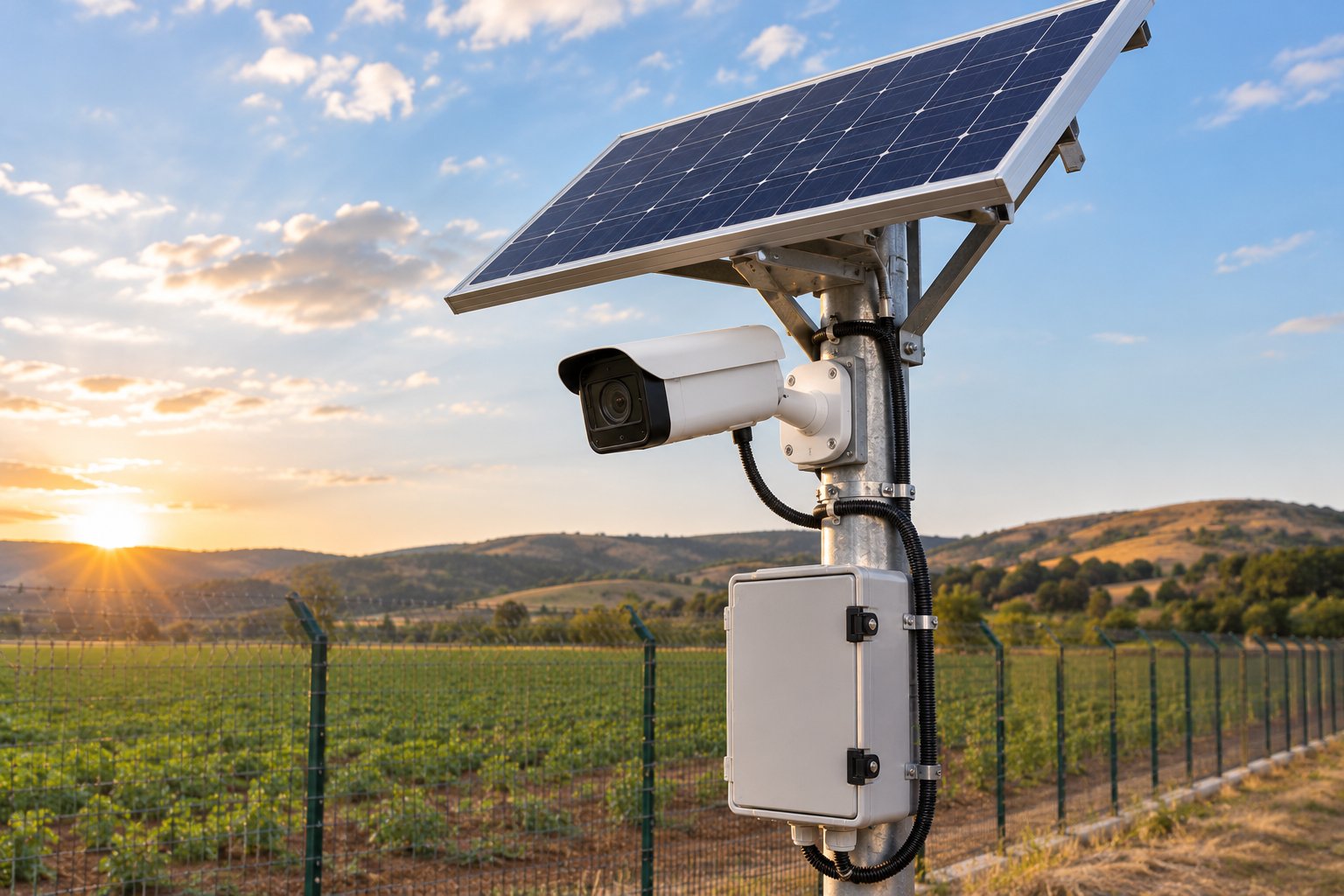
Electrical and internet infrastructure may not be available at every location where security camera systems are to be installed. Providing power to camera systems can pose a significant technical challenge, especially in agricultural lands, solar power plants, construction sites, farms, large industrial areas, and remote facilities.
In such applications, solar-powered security cameras offer alternative solutions that reduce or completely eliminate dependence on the electrical grid.
In these systems, also known as solar cameras, electrical energy generated from solar panels is used to power the camera and related communication equipment. During hours without sunlight, the energy demand can be met by the battery system.
Models with 4G/LTE connectivity can also enable remote monitoring without fixed internet infrastructure, provided there is adequate mobile network coverage.
However, purchasing a solar-powered security camera does not automatically guarantee that the system will operate continuously for 365 days.
Correct system design requires a comprehensive evaluation of camera consumption, solar panel capacity, battery size, sunlight conditions during winter months, recording method, and communication infrastructure.
So, what is a solar-powered security camera, how does it work, how many watts of solar panel and how many Ah of battery are needed? How should one decide between 4G, Wi-Fi, and continuous recording options?
What is a Solar-Powered Security Camera?
A solar-powered security camera is a video surveillance system that meets all or part of its electrical energy needs through photovoltaic (solar) panels.
In these systems, the solar panel converts sunlight into direct current (DC) electrical energy.
The generated energy can be stored in the battery via appropriate charge control equipment and transferred to power the camera.
Solar-powered camera systems generally come in two different configurations:
Integrated solar cameras: These are compact systems where the camera, a small solar panel, and an internal battery are used together or with compatible accessories.
Professional solar CCTV systems: These are more comprehensive systems consisting of an IP camera, an independent solar panel, an external battery, a charge controller, and communication equipment.
The purpose of use and operational capacity differ for both approaches.
For example, a battery-powered camera that records for short periods when motion is detected does not have the same energy requirements as a professional IP camera that provides 24-hour continuous video recording.
How Do Solar-Powered Security Cameras Work?
The fundamental operating principle of solar camera systems involves converting solar energy into electrical energy, storing it, and transferring it to the camera system.
1. Solar Panel Generates Electricity
The photovoltaic panel converts incident solar radiation into direct current electrical energy.
The amount of energy that can be generated depends on the panel's power, solar radiation, tilt, orientation, temperature, and shading conditions.
The 100 W or 200 W value indicated on the panel refers to its nominal power under specific standard test conditions.
This value does not mean that the panel will continuously generate electricity at the same power throughout the day.
2. Charge Controller Manages Energy
Electrical energy from the solar panel can be transferred to the battery system via an appropriate charge controller.
For this purpose, control devices with PWM or MPPT technologies can be used.
MPPT (Maximum Power Point Tracking) systems can ensure more efficient utilization of energy production under suitable conditions by tracking the panel's operating point.
However, the selection of the control device should not be based solely on its MPPT feature.
Panel voltage, current, battery chemistry, and charging parameters must be compatible.
3. Battery Stores Energy
An appropriate portion of the energy generated during the day is stored in the battery.
During the night or periods of insufficient sunlight, the camera can draw the necessary energy from the battery.
How long the system can operate depends on the battery's usable energy capacity and the total consumption amount.
4. Camera and Communication Devices are Powered
The solar energy infrastructure provides the necessary power for the camera and, if present, modems, routers, wireless bridges, or other control components.
DC-DC converters can be used for appropriate voltage conversion.
Important technical distinction: It is not always necessary to use an inverter to power a DC-operated IP camera from a solar panel. In properly designed systems, DC energy can be used directly with the necessary conversion and protection circuits.
An inverter, on the other hand, is a separate component considered for systems requiring AC power.
What Are the Types of Solar-Powered Security Cameras?
Battery-Powered and Motion-Activated Solar Cameras
These camera types can remain in a low-power state to reduce energy consumption and actively record when motion is detected.
Some models use PIR motion sensors or other detection methods.
Their advantages include compact design, easy installation, and relatively low energy requirements.
However, these cameras may not always provide continuous footage.
Especially in security projects requiring continuous recording, the actual recording behavior of the device should be verified.
4G SIM Card Solar-Powered Cameras
4G solar cameras can provide remote viewing and event notifications via a suitable mobile network.
These systems are particularly used in areas where fixed internet infrastructure is unavailable.
However, for communication via SIM card, coverage area, data plan, and modem energy consumption must be evaluated.
Wi-Fi Solar-Powered Cameras
Wi-Fi enabled solar cameras can operate within the coverage area of an existing wireless network.
However, being solar-powered does not automatically mean the camera can be remotely monitored without internet.
In a location with Wi-Fi but no internet access, the camera can operate via the local network; remote access over the internet depends on the relevant infrastructure.
Professional 24/7 Solar IP Camera Systems
Professional systems can be designed to provide continuous video recording with appropriate energy and storage infrastructure.
In these applications, the IP camera, solar panel, battery, MPPT charge controller, and if necessary, a 4G router, along with local or remote recording infrastructure, are evaluated together.
This configuration is particularly important in applications requiring industrial perimeter security, site monitoring, and continuous recording.
Comparison of Solar Camera Types
| System Type | Main Advantage | Technical Limitation |
|---|---|---|
| Battery-powered motion-activated solar camera | Low energy consumption, compact installation | Continuous recording may not be supported |
| Wi-Fi solar camera | Can connect to existing local network | Requires Wi-Fi coverage and network infrastructure |
| 4G SIM card solar camera | Remote access without fixed internet | Mobile coverage, data plan, and energy consumption |
| Professional solar IP CCTV | 24/7 recording and integration with different systems | May require larger panel, battery, and technical design |
The table compares general usage characteristics. The actual operating and recording features of each product should be verified with manufacturer documentation.
How Many Watts of Panel Are Needed for a Solar-Powered Security Camera?
One of the most crucial engineering calculations in solar security systems is determining the camera's daily energy requirement.
A common mistake here is to recommend a specific panel power based solely on the camera model.
However, the consumption of all equipment working with the camera must be calculated.
For example:
IP camera.
IR illumination.
4G modem or router.
Necessary energy converters.
Other sensors and communication devices.
can affect the total energy requirement.
How to Calculate Daily Energy Consumption?
Basic formula:
Daily energy consumption (Wh) = Average power consumption (W) × Daily operating time (hours)
For example, let's assume the total average consumption of the camera, 4G modem, and auxiliary hardware is 20 W.
If the system operates for 24 hours:
20 W × 24 hours = 480 Wh/day
The theoretical daily energy requirement for this system would be 480 Wh, or 0.48 kWh.
This value is not the measured consumption of an actual camera model but an assumption accepted for example calculation.
How to Calculate Solar Panel Capacity?
In calculating panel capacity, the solar energy potential at the installation site and system losses must be considered.
Simplified calculation:
Panel power (Wp) = Daily energy requirement (Wh) / (Equivalent full sun hours × Usable system efficiency)
In our example:
Daily consumption: 480 Wh.
Assumed daily equivalent full sun hours: 3 hours.
Assumed total usable system efficiency: 70%.
Panel power = 480 / (3 × 0.70) = approximately 229 Wp
With these assumptions, a panel capacity of around 300 Wp can be considered for initial technical evaluation.
However, a 300 W panel cannot guarantee continuous operation of this system in every region and on every winter day.
Consecutive cloudy days, snow on the panel, shading, and low solar radiation must be considered.
For actual capacity, solar data specific to the region and installation angle should be used.
Why is PVGIS Important in Solar Panel Calculation?
Sunlight hours are not the same in every region of Turkey.
Furthermore, a region's average annual solar energy potential does not indicate that the energy needed every day in winter can be produced.
PVGIS, provided by the European Commission's Joint Research Centre (JRC), is a technical tool that can be used to evaluate the energy production potential of photovoltaic systems.
The off-grid system calculation section of PVGIS evaluates the change in solar radiation over time, in addition to panel and battery capacity.
This allows for examining periods when the battery might be insufficient under certain system assumptions.
In professional solar camera projects, not only the annual average sunlight but also energy production under the most adverse seasonal conditions and desired system availability must be considered.
How Many Ah Battery is Needed for a Solar-Powered Camera?
In solar camera systems, the usable energy capacity of the battery is as important as the panel capacity.
The camera system is powered by the battery during the night and periods of insufficient sunlight.
Therefore, battery capacity should be determined not only by camera power but also by how many days it is expected to operate without solar energy.
Battery Capacity Calculation Formula
Simplified calculation:
Required nominal battery energy (Wh) = Daily consumption × Backup days / (Usable discharge rate × Supply efficiency)
In our previous example:
Daily energy requirement: 480 Wh.
Targeted sunless operation time: 2 days.
Assumed usable discharge rate: 80%.
Assumed supply efficiency: 85%.
Two-day energy requirement:
480 × 2 = 960 Wh
Required nominal battery capacity:
960 / (0.80 × 0.85) = approximately 1,412 Wh
In this case, a nominal capacity of approximately 1.4 kWh or more is a starting point for the example calculation.
For instance, the energy amount of a battery with a nominal capacity of 12.8 V and 120 Ah:
12.8 × 120 = 1,536 Wh
However, this does not guarantee that the battery will provide 48 hours of continuous operation at all temperatures. The actual usable capacity depends on battery chemistry, manufacturer limits, aging, temperature, and system load.
How Many Hours Will a 12 V 100 Ah Battery Operate?
The answer to this question does not depend solely on the Ah value.
First, the battery's nominal voltage and usable energy must be known.
For example, a 12.8 V × 100 Ah battery contains approximately 1,280 Wh of nominal energy.
However, not all of this energy is usable under all operating conditions.
A definitive operating time should not be provided without evaluating the battery's permissible discharge limits and power conversion losses.
LiFePO4 or Lead-Acid Battery for Solar Cameras?
Different battery technologies can be used in solar-powered camera projects.
LiFePO4 Batteries
Lithium iron phosphate (LiFePO4) batteries can offer advantages in terms of high cycle life and usable energy capacity in appropriate designs.
However, the battery management system (BMS), temperature protection, and compatibility with the charger are important.
Charging limitations, especially at low temperatures, must be considered.
In some LiFePO4 products, charging is restricted at temperatures near or below freezing. The exact limit should be determined according to the technical documentation of the respective battery and BMS manufacturer.
Lead-Acid Batteries
Lead-acid batteries such as AGM or GEL can be used in some applications.
However, permissible discharge depth, weight, cycle life, temperature, and maintenance conditions vary.
Battery Comparison
| Criterion | LiFePO4 | AGM/GEL Lead-Acid |
|---|---|---|
| Weight | Generally lower | Generally higher |
| Usable energy | High under suitable conditions | More sensitive to discharge depth |
| Cycle performance | Generally advantageous | More limited depending on application |
| Charging temperature | Pay attention to BMS and manufacturer limits | Chemistry-specific temperature and charging conditions |
| Initial cost | May be higher in most applications | May be lower in most applications |
The table shows general technical trends; it is not a definitive performance comparison covering every battery product.
Do Solar-Powered Security Cameras Work in Winter?
Solar panels do not generate electricity only on hot and sunny summer days.
Energy production can also occur on cloudy days, depending on radiation conditions.
However, reduced solar radiation, shorter days, and the panel being covered by snow or other obstructions can significantly decrease production.
Key risks to consider during winter months:
Shorter daylight hours.
Consecutive cloudy days.
Accumulation of snow or dirt on the panel.
Changing shadows from trees and structures.
Battery capacity and charging limits at low temperatures.
Increased consumption from camera, modem, or enclosure heaters.
Therefore, in systems expected to operate continuously throughout the year, periods of lowest solar energy production, battery capacity, and operational continuity must be evaluated together.
Especially in security-critical applications, an additional power source or a different power architecture can be planned if necessary.
How Does a 4G SIM Card Solar-Powered Camera Work?
4G solar cameras can establish a data connection via a suitable mobile network.
This allows a site without fixed internet to be remotely monitored under suitable conditions.
However, mobile connectivity also affects the system's energy and operating costs.
What to Consider When Choosing a SIM Card Camera?
Sufficient 4G/LTE coverage at the installation point.
Actual field signal quality.
Modem and antenna specifications.
Mobile operator and data plan.
Camera data usage.
Remote access method.
Local recording behavior when the network is interrupted.
Total energy consumption of modem and camera.
Remote maintenance and device restart features.
In necessary projects, using an appropriate external antenna can improve coverage performance. However, antenna cable loss, mounting location, and manufacturer compatibility must also be considered.
How Much Internet Does a 4G Camera Consume?
Data consumption depends on the average bitrate of the video stream and how long it is transmitted.
Approximate calculation:
Daily data (GB) = Average bitrate (Mbps) × 10.8
For example, if the camera continuously transmits video over the internet at an average speed of 1 Mbps for 24 hours:
1 × 10.8 = 10.8 GB/day
Approximate transmission for 30 days:
10.8 × 30 = 324 GB
This value belongs to a single camera.
However, if the camera only sends motion events or records video to a local SD card and only provides remote viewing when necessary, mobile data consumption can be very different.
A camera recording locally for 24 hours does not mean that all footage is transmitted over mobile internet for 24 hours.
This distinction is important in data plan planning.
Can Solar-Powered Cameras Record 24/7?
Yes. However, not all solar-powered cameras are designed to record continuously for 24 hours.
Especially in compact, battery-supported models, sleep and motion-activated wake-up mechanisms can be used to reduce energy consumption.
In such devices:
Continuous recording may not be available.
Recording may only start during specific events.
Footage before detection may not be recorded.
Recording gaps may exist between events.
In professional IP camera systems, continuous recording may be possible with appropriate energy infrastructure.
Therefore, when selecting a product, the phrases "operates 24 hours," "can be monitored 24 hours," and "records continuously for 24 hours" should be distinguished from each other.
If continuous recording of all events is desired at a critical security point, the true continuous recording feature and energy capacity must be verified with manufacturer documentation and field tests.
Where Do Solar-Powered Cameras Store Footage?
MicroSD Card Recording
The microSD card on the camera can provide local image recording in suitable models.
It can be particularly useful in areas where internet connectivity is interrupted.
However, card capacity, write endurance, recording method, and the risk of footage loss if the camera is stolen must be evaluated.
NVR or Remote Recording Server
With appropriate communication and energy infrastructure, footage can be transferred to a central recording system.
However, continuous remote recording can increase mobile connectivity and energy requirements.
Cloud Recording
Cloud storage, with suitable services, can provide remote access to footage and off-site recording protection.
However, connection continuity, data consumption, subscription, retention period, and personal data security are important.
Hybrid Recording
In some projects, local recording and remote backup can be used together.
This approach can support the continuation of local recordings when mobile connectivity is lost and the transfer of relevant events or recordings when connectivity is restored.
However, it should not be assumed that every camera supports these functions.
Errors Made in Solar Panel and Battery Installation
Even if energy calculations are performed correctly in solar security systems, incorrect field implementation can negatively affect system continuity.
Panel Remaining in Shade
Trees, poles, structures, and other obstructions can cast shadows on the panel.
The panel's position should not be determined solely by the sun's condition at the time of installation.
Incorrect Panel Orientation and Tilt
The panel's orientation and tilt should be planned according to the installation region's solar energy potential and seasonal usage objective.
The camera's viewing angle and the solar panel's orientation do not necessarily have to be the same.
Therefore, in some applications, having the panel and camera in different mounting locations can provide an advantage.
Insufficient Battery Capacity
Selecting the battery based solely on the camera model can lead to overlooking the energy consumption of modems and auxiliary equipment.
Inappropriate Charge Controller
Voltage or charging parameter incompatibility between the panel, charger, and battery can affect system safety.
Voltage Drop in Power Cables
Long and inadequately sized cables can cause significant voltage drop, especially in low-voltage DC systems.
Cable cross-section, length, current, protection elements, and operating voltage must be evaluated together.
Mechanical and Outdoor Protection
The solar panel can be exposed to wind loads, the camera pole to vibration, and the battery enclosure to temperature changes.
Mounting equipment, enclosures, cable entries, appropriate electrical protections, and mechanical supports should be designed as a whole.
Where Are Solar-Powered Security Cameras Used?
Agricultural Lands and Farms
They can be used for monitoring land entrances, equipment areas, and specific open spaces where electrical infrastructure is unavailable.
Solar Power Plants
They can be evaluated for GES (Solar Power Plant) perimeter security, technical equipment areas, and monitoring specific facility points.
Construction Sites
They can be used in construction areas where temporary or permanent electrical infrastructure is unavailable.
Factory and Industrial Facility Perimeters
They can be evaluated for remote points from the main CCTV infrastructure, along with appropriate security and communication requirements.
Logistics and Open Storage Areas
They can support monitoring remote vehicle parking areas, site entrances, and specific equipment points.
Vineyards and Rural Areas
Motion-activated or suitable 4G-connected solutions can be used in areas lacking fixed energy and internet infrastructure.
Temporary Security Points
Portable solar security systems can be considered for events, field work, or temporary facility applications.
Which Standards Are Important in Solar-Powered Camera Systems?
Solar security systems may fall under the scope of different standards as they combine photovoltaic electricity generation with CCTV technology.
IEC 62548-1:2023 + AMD1:2025
Addresses requirements related to photovoltaic array design.
It is an important reference for PV-side design criteria such as DC cabling, electrical protection, disconnection, and earthing.
However, the scope of this standard does not solely encompass all design requirements for battery and camera loads.
IEC 62676-4:2025
It is an application guide for the planning, design, installation, testing, commissioning, and maintenance of video surveillance systems.
It can be used for evaluating the imaging and CCTV performance of solar-powered cameras.
IEC 62619:2022
Relates to safety requirements for secondary lithium cells and batteries used in industrial applications.
The applicability of this standard depends on the type of battery used and the product scope.
The TSE equivalents of these standards in Turkey, applicable electrical installation regulations, and product-specific conformity documents should also be checked on a project-by-project basis.
Periodic Maintenance in Solar-Powered Camera Systems
Periodic maintenance in solar security camera systems is not limited to just cleaning the camera lens.
Energy generation and storage components must also be checked.
Maintenance can include:
Inspection of the panel surface for dirt and physical damage.
Checking the panel's shading conditions.
Evaluation of panel connections and cable routes.
Examination of the charge controller's status and error information.
Checking battery health and temperature indicators.
Verification of camera image quality.
Testing night vision and IR illumination.
Reviewing 4G connectivity and data usage.
Checking SD card or other recording systems.
Playback of past recordings.
Evaluation of system alarm and power outage records.
These procedures can be planned.
Maintenance frequency should be determined according to manufacturer instructions and environmental conditions.
Especially in critical applications, remote monitoring of battery charge status, energy production, and camera offline alarms can be beneficial.
What to Consider When Choosing a Solar-Powered Security Camera?
Before purchasing a solar camera or designing a professional system, the following criteria should be evaluated:
Whether the camera will operate 24/7 or only with motion detection.
Average and maximum power consumption of the camera and auxiliary devices.
Nominal capacity of the solar panel and winter period production.
Actual usable energy capacity of the battery.
Desired sunless operation time.
Wi-Fi, 4G, or other communication requirements.
Mobile network coverage and data consumption.
Day and night imaging performance.
SD card, NVR, or cloud recording features.
Suitability of panel and camera mounting locations.
Outdoor durability, temperature, and electrical protection.
Software security, access permissions, and data protection.
Technical service and maintenance requirements.
Initial investment and long-term operating costs.
Choosing the highest resolution camera or the largest solar panel alone does not constitute correct system design.
The correct solution must meet the facility's security and energy needs simultaneously.
Solar-Powered Camera Installation Checklist
Has the security need of the installation point been determined?
Have the camera type and recording method been correctly selected?
Have average and maximum power consumption been calculated?
Have winter period solar energy data been examined?
Has panel capacity been calculated appropriately?
Has the usable energy capacity of the battery been verified?
Have backup days and operational continuity targets been determined?
Is the charge controller compatible with the panel and battery?
Are battery temperature protection and BMS features appropriate?
Have panel orientation, tilt, and shading conditions been checked?
Has the mechanical durability of the camera and panel mounting been evaluated?
Have DC cable, connection, and electrical protection requirements been met?
Has 4G or Wi-Fi connectivity been tested in the actual field?
Have recording continuity and playback of past recordings been verified?
Have night vision and moving targets been tested?
Has personal data and remote access security been evaluated?
Have installation results and the periodic maintenance plan been documented?
This checklist has been prepared for general technical evaluation purposes. It does not replace definitive system design and electrical compliance assessment.
Frequently Asked Questions
Can a solar-powered security camera operate without electricity?
Systems with appropriate solar panel and battery infrastructure can operate without being connected to the electrical grid. However, operating time depends on energy production and storage capacity.
Does a solar-powered camera work at night?
Yes. If the battery has sufficient energy, it can operate at night. Night imaging performance depends on the camera's sensor, lens, and illumination features.
How many watts of panel are needed for a solar-powered camera?
A single panel power is not sufficient for all applications. The daily energy consumption of the camera and auxiliary devices, the solar potential of the installation point, and system losses must be calculated.
How many Ah battery is needed for a solar camera?
Battery capacity depends on daily energy requirements, system voltage, and the targeted sunless operating time. A definitive selection should not be made based solely on the Ah value.
Does a solar-powered camera work in winter?
Properly designed systems can operate in winter. However, system capacity must be carefully planned due to low sunlight, battery temperature limits, snow, and shading.
Can a solar-powered security camera work without internet?
Some models supporting local recording can record footage without an internet connection. However, remote monitoring and notification features may require a suitable data connection.
Do 4G solar-powered cameras require a SIM card?
Systems connected to a mobile network via SIM require a suitable subscription or SIM/eSIM service. The supported connection type depends on the features of the camera or modem infrastructure.
Do solar security cameras record 24/7?
Some professional systems can record continuously with appropriate energy capacity. However, many compact battery-powered models only record when an event or motion is detected.
Is a cloud subscription mandatory for a solar-powered security camera?
It is not mandatory for every product. Cameras offering local SD card recording are available. The necessity of cloud service depends on the product's features and the desired recording method.
Should a solar camera or a regular IP camera be preferred?
Standard IP camera systems may be more suitable and sustainable in facilities with electrical and communication infrastructure. However, solar solutions can be considered in locations where power lines are unavailable or difficult to install.
Conclusion: Correct Energy Design is Essential for Solar-Powered Security Cameras
Solar-powered security cameras offer significant advantages in areas where electrical infrastructure is unavailable or power connection is costly.
Especially in agricultural lands, construction sites, solar power plant sites, and remote industrial facilities, solar CCTV systems can help meet security needs with appropriate energy and communication infrastructure.
However, a successful solar camera project is not merely about combining a camera and a solar panel.
The camera's actual energy consumption, panel capacity, battery size, winter performance, data connectivity, and recording method must be planned together.
In professional systems, the goal is not just to obtain images on sunny days, but to ensure that the camera reliably performs its expected imaging and recording functions during all operational periods where security is required.