
Seagate Security Drives: SkyHawk and SkyHawk AI Models and Specifications
Seagate SkyHawk and SkyHawk AI surveillance hard drives are designed for the 24/7 storage needs of DVR and NVR camera recording systems. We examine capacity options of up to 32 TB, ImagePerfect technology, the differences between annual workloads of 180 TB and 550 TB, CMR recording technology, support for AI video analytics, and the technical criteria for choosing the right surveillance drive.
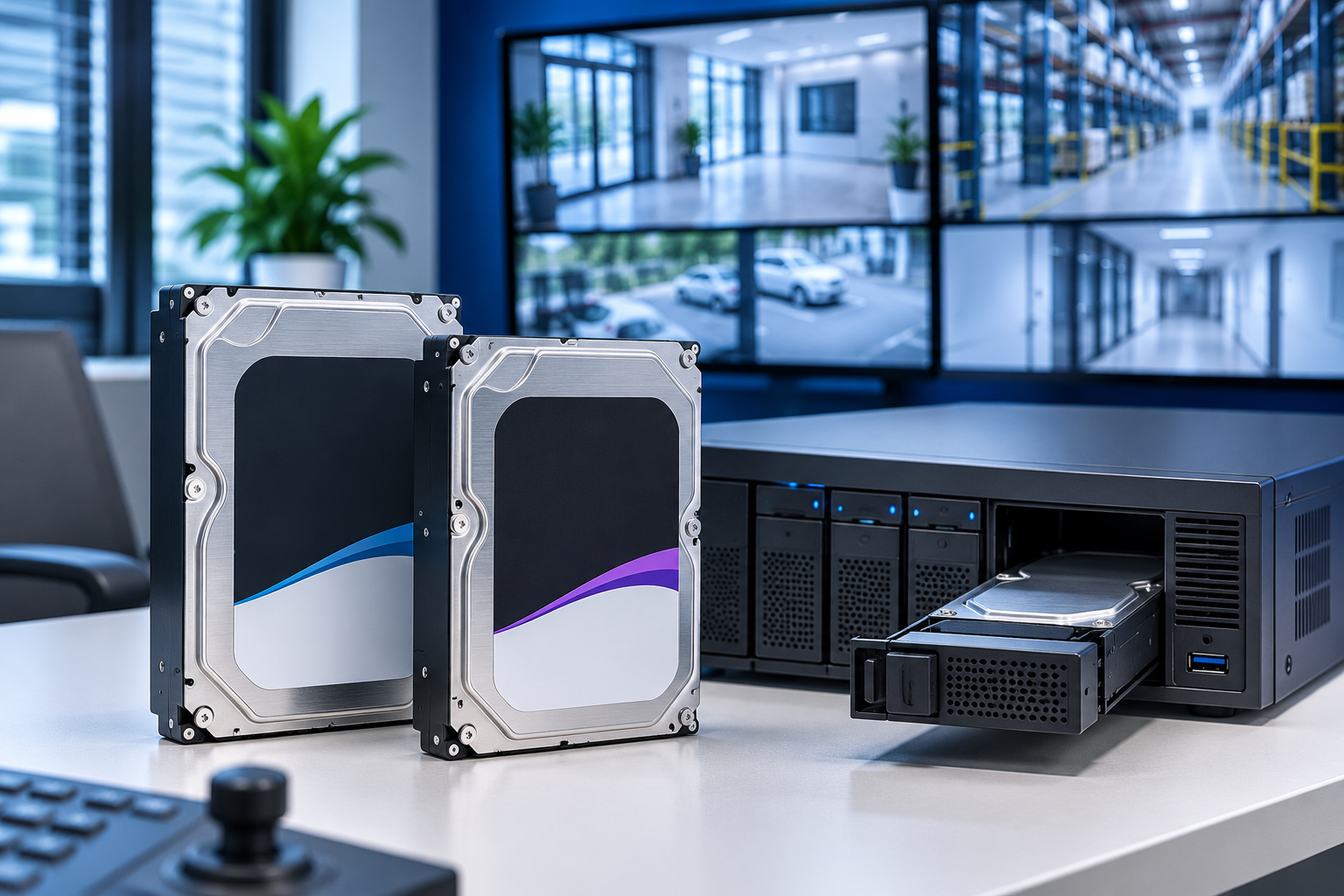
Seagate security drives are hard-drive solutions developed to continuously record video footage from security cameras on DVR, NVR and video-surveillance systems. Optimized for workloads different from those of desktop computer drives, the Seagate SkyHawk and SkyHawk AI series are designed for 24/7 operation, simultaneous camera recording, heavy data-write workloads and multi-drive storage needs.
Among Seagate's video-surveillance drives, SkyHawk, focuses on traditional DVR/NVR recording applications, while SkyHawk AI is designed for video analytics, heavier read/write activity and high-capacity NVR systems.
In the manufacturer's current product portfolio, the standard SkyHawk family offers capacities of up to 8 TB, while the SkyHawk AI family offers up to 32 TB capacity options. However, choosing the right surveillance drive depends on more than capacity alone. The number of cameras, actual bit rate, annual workload, recording time, NVR compatibility, and data security requirements should all be assessed together.
What Is a Seagate Security Drive?
Seagate Technology is an international manufacturer that develops hard drives and data-storage technologies.
The company's SkyHawk product family, developed for video-surveillance systems, includes specialized hardware and firmware features for continuously storing security-camera footage.
Recording drives used in security cameras often have to write multiple video streams to the drive simultaneously.
For example, in an NVR system with 16 IP cameras, all cameras may record continuously while a security operator watches past footage or exports specific events at the same time.
This scenario combines continuous video writing with simultaneous read requirements.
The main design objectives of Seagate SkyHawk drives are:
Use in video-recording systems capable of operating 7 days a week, 24 hours a day.
Support simultaneous recording of multiple camera streams.
Offer firmware suited to continuous data-writing operations.
Reduce vibration-related performance effects in supported models.
Help monitor drive health and potential failures.
Provide a range of storage capacities for longer recording times.
These features do not guarantee that a drive will never fail or that all camera recordings will necessarily be preserved.
Seagate SkyHawk Security Drives
SkyHawk is Seagate's HDD family for standard video-surveillance applications.
Developed for 24/7 video recording on DVR and NVR systems, this series uses ImagePerfect firmware.
Seagate's current product page lists SkyHawk capacities of 1 TB, 2 TB, 4 TB, 6 TB and 8 TB. Models such as 3 TB from different production periods may also appear in technical documents.
SkyHawk Specifications
Feature | SkyHawk |
|---|---|
Drive type | 3.5-inch HDD |
Interface | SATA 6 Gb/s |
Maximum capacity | 8 TB in the current family |
Annual workload | 180 TB |
HD camera streams | up to 64 |
Firmware | ImagePerfect |
Recording technology | CMR in currently listed models |
MTBF | 1 million hours |
Limited warranty | 3 years |
Use | DVR and NVR systems |
The manufacturer's stated camera-stream support is an upper limit based on specific test and workload conditions. It does not mean that every 64-camera system will operate reliably with a single SkyHawk drive.
What Is ImagePerfect Technology?
ImagePerfect is the firmware optimization Seagate uses in its video-surveillance drives.
The technology is intended to manage the continuous data stream generated by security-camera recordings.
Unlike conventional desktop-computer use, multiple data streams may be written continuously to disk in NVR systems.
ImagePerfect is intended to provide recording behavior suited to these workloads.
However, video loss is not caused by the hard drive alone. Packet loss on the camera network, NVR processor limits, insufficient write bandwidth, file-system problems or power outages can also affect recording integrity.
Using ImagePerfect is not an independent guarantee that no frames will be lost anywhere in the end-to-end video system.
Seagate SkyHawk AI Security Drives
SkyHawk AI is an HDD family developed for systems that use AI-powered video analytics and have heavier storage workloads.
In addition to conventional video recording, object recognition, event searches, indexing, video analysis and reading data from video archives can increase the workload on a drive.
SkyHawk AI is optimized for these types of use cases.
SkyHawk AI Capacity Options
Seagate's current product portfolio lists the following capacities for SkyHawk AI:
8 TB
10 TB
12 TB
16 TB
20 TB
24 TB
32 TB
These capacities apply to the product family. Regional availability and the supply of specific models may vary.
SkyHawk AI Specifications
Feature | SkyHawk AI |
|---|---|
Drive type | 3.5-inch HDD |
Interface | SATA 6 Gb/s |
Maximum capacity | 32 TB |
Annual workload | 550 TB |
HD camera streams | up to 64 |
AI streams | up to 32 |
Firmware | ImagePerfect AI |
Recording technology | CMR in current models |
MTBF | up to 2.5 million hours |
Limited warranty | 5 years |
Use | NVR and AI-enabled video systems |
Although SkyHawk AI drives are optimized for video-analytics workloads, the drive itself is not a processor that performs object recognition, facial recognition or AI inference.
These operations run on a supported camera, NVR, GPU or video-analysis server. The drive provides the storage infrastructure for recording and reading the associated data.
Seagate SkyHawk AI 32 TB
One of the high-capacity models in the SkyHawk AI family is the 32 TB version.
According to the manufacturer's Turkish technical data sheet, the model's main features are as follows:
Model number: ST32000VE000.
Capacity: 32 TB.
Interface: SATA 6 Gb/s.
Recording method: CMR.
Drive construction: Helium-filled.
Cache: 512 MB.
Rotational vibration sensors: Present.
Maximum sustained data-transfer rate: Model rating stated as approximately 285 MB/s.
Annual workload: 550 TB.
Limited warranty: 5 years.
This capacity may help store more video data using fewer drives.
However, the fact that a 32 TB drive can physically be installed in an NVR does not mean the device supports that capacity.
The per-drive capacity limit and firmware compatibility must be checked, especially on older recording devices.
Differences Between SkyHawk and SkyHawk AI
The main difference between the two product families is not capacity alone. Workload endurance, video-analytics support and features for multi-drive systems are also important to the choice.
Feature | SkyHawk | SkyHawk AI |
|---|---|---|
Intended use | Standard video recording | Heavy recording and AI analytics |
Maximum family capacity | 8 TB | 32 TB |
Annual workload | 180 TB | 550 TB |
HD camera streams | up to 64 | up to 64 |
AI stream optimization | Not specifically stated | up to 32 |
Firmware | ImagePerfect | ImagePerfect AI |
RV sensors | On certain models | Yes |
MTBF | 1 million hours | up to 2.5 million hours |
Limited warranty | 3 years | 5 years |
The values in the table are capacity and performance classes stated by the manufacturer for its product families.
A drive's usable performance depends on the model number, the video recorder's architecture and the actual workload.
SkyHawk AI is not required in every camera system. Standard SkyHawk may be sufficient for a small-scale NVR project, while SkyHawk AI may be considered for systems with heavier data loads and simultaneous analytics operations.
What Is Annual Workload in Security Drives?
Annual workload refers to the total amount of data transferred for which a drive is designed under specified operating conditions.
Seagate defines this parameter as Workload Rate Limit (WRL) .»؟ as
An annual workload rating of 180 TB is specified for the SkyHawk family, and 550 TB per year for the SkyHawk AI family.
This value should not be confused with the drive's capacity alone.
For example, video can be written repeatedly throughout the year to an 8 TB drive. The total amount written annually can greatly exceed the drive's physical storage capacity.
What Does 180 TB per Year Mean?
Suppose each of 8 cameras recording continuously generates an average of 4 Mbps of data.
Daily data from one camera:
4 × 10.8 = 43.2 GB
Daily data from eight cameras:
43.2 × 8 = 345.6 GB
Total annual video data:
345.6 × 365 = 126144 GB
This corresponds to approximately 126.1 TB/year of video-writing workload.
Under the same assumptions, continuous recording by 16 cameras produces approximately 252.3 TB of video data annually.
In this case, the 180 TB/year workload rating of a single standard SkyHawk drive may be exceeded.
However, workload assessments should account not only for video writing but also for other read and write operations directed at the drive. In systems with multiple drives, the distribution of workload across the drives should also be determined.
Therefore, camera count should not be used as a direct drive-selection criterion.
What Are CMR and SMR in Security Drives?
A hard drive's magnetic recording method is important, particularly for continuous video-writing performance.
CMR — Conventional Magnetic Recording
CMR is a conventional recording method in which magnetic data tracks are recorded without overlapping one another.
It can offer more predictable performance during continuous writing, access to different areas and certain intensive storage workloads.
Seagate's current SkyHawk and SkyHawk AI technical documents specify CMR recording technology for the models reviewed.
SMR — Shingled Magnetic Recording
SMR is a technology that can increase recording density by partially overlapping data tracks.
In some SMR implementations, rewrite operations can require additional data-management processes.
This can affect performance, particularly during heavy random writes or certain RAID rebuild operations.
However, it should not be categorically concluded that all SMR drives are unsuitable for every video application.
When selecting a drive for security recording, its recording technology should be verified against the latest technical data sheet for the exact product model number.
What Is SkyHawk Health Management?
SkyHawk Health Management (SHM) is a management feature that helps monitor drive-health information on supported Seagate security drives.
The manufacturer describes this technology in terms of prevention, intervention, and recovery.
When working with compatible NVR systems, SHM can provide certain drive-health and alert information.
However, SHM support depends not only on the feature in the drive but also on the recording device’s software and hardware compatibility.
Are SHM and S.M.A.R.T. the Same Thing?
S.M.A.R.T. is a general technology used to monitor health and error information on hard drives.
SkyHawk Health Management, by contrast, includes Seagate drive-management features for supported surveillance devices.
These two concepts are not entirely equivalent.
The absence of an SHM or S.M.A.R.T. alert does not guarantee that a drive will not fail. Important recordings require a separate data-protection plan.
What Are Seagate Rescue Data Recovery Services?
Rescue Data Recovery Services is a data-recovery service that Seagate offers with certain products.
If data is lost because of a mechanical or other drive failure, a professional data-recovery assessment may be available under the service terms.
Seagate's current product information specifies a three-year Rescue service plan for SkyHawk and SkyHawk AI.
However, service availability may vary by country, product model, purchase conditions, and the applicable service agreement.
A data-recovery service is not a substitute for regular data backups.
Backups, access permissions, and failure scenarios should be planned separately to protect critical video recordings.
How Many Days Can Seagate Security Drives Record?
The recording duration provided by a security drive does not depend solely on HDD capacity.
The following parameters determine recording duration:
Number of cameras.
Average bit rate per camera.
H.264, H.265, or another compression method in use.
Resolution and FPS.
Continuous, motion-detection, or event-based recording.
Audio and additional data recordings.
System and file-management overhead.
RAID configuration.
Capacity reserve.
How Is Camera Recording Capacity Calculated?
The approximate daily data volume for a camera recording continuously for 24 hours can be calculated using the following formula:
Daily data (GB) = Average bit rate (Mbps) × 10.8
Total capacity for multiple cameras:
Total capacity (TB) = Number of cameras × Average Mbps × 10.8 × Number of days ÷ 1000
This formula is a theoretical calculation based on decimal storage units and a fixed average bit rate.
Example: 30 Days of Recording on an 8-Camera System
Assume each of the eight cameras generates an average of 4 Mbps of data and records continuously for 30 days.
Parameter | Value |
|---|---|
Number of cameras | 8 |
Data rate per camera | 4 Mbps |
Total daily recording | 345.6 GB |
Target retention period | 30 days |
Theoretical data volume | 10.37 TB |
Planned capacity with a 20% usable-space reserve | Approximately 13 TB |
The 20% reserve assumption is based on the approach of filling no more than 80% of total usable capacity with recordings. It is not a universal or mandatory engineering ratio.
In this scenario, 16 TB of usable storage may be a reasonable starting capacity, provided the recording device supports it.
However, if two 8 TB drives are used in RAID 1, total usable capacity falls to approximately the capacity of a single drive. RAID design should therefore be considered separately from the calculation.
For detailed information on recording duration and legal retention requirements by industry, GüvenlikOnline’s How Many Days Should Security Camera Recordings Be Kept? guide can be consulted.
Are Seagate Security Drives Compatible with NVR and DVR Devices?
SkyHawk drives are designed for NVR and DVR applications. However, it should not be assumed that every Seagate drive is compatible with every NVR and DVR model.
The main factors affecting compatibility are:
1. Supported Capacity per Drive
Check the maximum capacity per drive specified by the recording-device manufacturer.
For example, installing a 24 TB or 32 TB HDD in an NVR specified to support 10 TB per drive does not mean that the full capacity can be used.
2. Physical and Electrical Connections
The SkyHawk and SkyHawk AI families consist of 3.5-inch SATA drives.
Check the recording device’s drive bay, SATA connection, physical dimensions, and power requirements.
3. Firmware Compatibility
Some recording devices may require up-to-date firmware to recognize or correctly operate high-capacity HDDs.
Therefore, the recording-device manufacturer’s drive compatibility list should be treated as authoritative.
4. Write Bandwidth
The total recording bandwidth supported by an NVR and the drive’s performance are different technical parameters.
Even if the drive has sufficient capacity, the NVR’s limit for processing video data arriving over the network or writing it to disk may be exceeded.
5. Vibration in Multi-Drive Systems
Operating multiple mechanical drives in the same enclosure can cause rotational vibration.
RV sensors help manage the effects of these vibrations on supported drives.
In Seagate’s standard SkyHawk family, RV sensor support varies by model and capacity, while the manufacturer offers this feature in the SkyHawk AI family.
6. Cooling and Operating Temperature
Extended operation of mechanical drives at high temperatures can adversely affect their service life.
Check the NVR’s ventilation design, drive-bay locations, ambient temperature, and the operating limits specified by the manufacturer for the relevant model.
Using RAID with Seagate Security Drives
RAID is a storage arrangement in which multiple drives are used together.
With suitable configurations, it can help increase data availability or provide a degree of resilience against drive failure.
However, not every RAID type provides data redundancy.
RAID type | General characteristics | Main limitation |
|---|---|---|
RAID 0 | Combines capacity and performance | No protection against drive failure |
RAID 1 | Data mirroring | Usable capacity is reduced |
RAID 5 | Parity arrangement that can tolerate a single-drive failure | Rebuild process and risk of a second failure |
RAID 6 | Parity arrangement that can tolerate two drive failures | Higher capacity and processing overhead |
RAID use should be planned according to the methods supported by the recording device and operational requirements.
Particularly with high-capacity drives, the rebuild time and the additional read/write load during that process should be assessed.
RAID is not a substitute for a separate backup system. RAID cannot prevent accidental deletion, unauthorized access, fire, device loss, or certain system failures.
For information on securely exporting and protecting video footage, Camera Recording Backup the article may be consulted.
What Does MTBF Mean for Seagate SkyHawk Drives?
MTBF Mean Time Between Failures is an abbreviation of the phrase and a statistical reliability indicator representing the average time between failures.
Seagate’s current product data lists:
1 million hours for SkyHawk,
up to 2.5 million hours for SkyHawk AI
as the MTBF values.
These values do not mean that a single drive will operate for 1 million or 2.5 million hours.
MTBF is a manufacturer metric based on specific testing, usage, and reliability models. It does not directly determine the remaining service life of an individual drive.
Therefore, when selecting a drive, MTBF data should be considered alongside the annual workload limit, temperature conditions, warranty, actual system compatibility, and data-protection architecture.
What Should You Consider When Choosing a Seagate Security Drive?
Comparing capacity and price alone is not sufficient when choosing the right HDD.
1. Number of Cameras and Actual Data Rate
Determine the cameras’ total bit rate. Resolution alone is not a sufficient indicator of storage requirements.
2. Target Recording Duration
Determine the business’s needs and feasible retention policy. Calculate capacity based on this period.
3. Annual Workload
Take continuous video writing, playback of past recordings, and other data transfers into account.
4. Choosing Standard SkyHawk or SkyHawk AI
Distinguish between conventional video recording and requirements for intensive analytics and concurrent data processing.
5. NVR Compatibility List
Verify the exact model number and NVR firmware version, as well as the drive’s brand and capacity.
6. Drive Count and RAID Configuration
Assess whether a single drive is sufficient in light of performance, capacity, and fault-tolerance requirements.
7. Warranty and Authenticity
Check the product serial number, warranty status, seller information, and any data-recovery service.
For product verification, Seagate offers an official drive verification page and a warranty lookup service .They are available.
Seagate Security Drive Installation Checklist
- Have the number of cameras and total recording bit rate been calculated?
- Has the recording retention period been determined?
- Have HDD capacity and usable-space reserve been calculated?
- Has the annual read/write workload been assessed?
- Has the SkyHawk or SkyHawk AI product family been selected?
- Has the exact HDD model number been verified?
- Has the maximum disk capacity supported by the NVR been checked?
- Has the recording device’s firmware version been checked?
- Have the drives’ power and cooling requirements been assessed?
- Has a RAID or independent-drive architecture been determined?
- Have drive-health monitoring features been checked?
- Have cyclic recording and capacity-full behavior been tested?
- Have actual recording duration and playback of past footage been tested?
- Has a backup procedure been determined for critical recordings?
- Have failure-notification and drive-replacement processes been established?
This checklist is intended for preliminary technical assessment. The final drive selection should be based on the system’s actual recording workload and the relevant device manufacturer’s technical documentation.
Where Are Seagate Security Drives Used?
Homes and Small Businesses
Standard SkyHawk models may be considered for DVR/NVR systems with a small number of cameras.
Stores and Retail Businesses
In-store security cameras can be used to record footage from checkout areas, storage rooms, and entrances.
Shopping Centers and Commercial Buildings
In facilities with many cameras and different recording servers, high capacity, recording bandwidth, and data protection requirements become important.
Industrial Facilities
Can be used in camera recording systems operating 7/24 at factories, warehouses, and logistics centers.
AI-Powered Video Analytics Systems
The SkyHawk AI family may be considered for NVR systems that make intensive use of object detection, event indexing, or advanced search functions in recorded footage.
However, in enterprise systems with very large data volumes, Seagate's enterprise drive families such as Exos and other storage architectures should also be compared from a technical standpoint.
Frequently Asked Questions About Seagate Surveillance Drives
Is Seagate SkyHawk a regular computer drive?
SkyHawk is an HDD family optimized for video surveillance applications. Although it can technically be used in computers, its primary design target is DVR/NVR recording workloads.
What is the difference between SkyHawk and SkyHawk AI?
Standard SkyHawk is rated for a workload class of 180 TB/year, while SkyHawk AI is rated for 550 TB/year. SkyHawk AI is also designed for higher capacities and intensive data processing associated with video analytics.
Can Seagate SkyHawk run 7/24?
Yes. The SkyHawk series is designed for 7/24 video surveillance applications. However, actual reliability depends on operating temperature, usage conditions, and system design.
What is the maximum capacity of Seagate SkyHawk AI?
In the manufacturer's current product portfolio, the SkyHawk AI family offers capacities of up to 32 TB.
Does SkyHawk AI perform AI analysis?
No. SkyHawk AI is a hard drive. It is not a camera, NVR, or server that performs AI processing; it provides storage suited to the data workloads generated by those processes.
Can a Seagate surveillance drive be used in Dahua or Hikvision NVR devices?
It can be used in compatible models. However, it should not be assumed that every Seagate model is supported by all Dahua, Hikvision, or other-brand NVR devices. Check the manufacturer's current lists for per-drive capacity limits and device compatibility.
How many days of recording can a 4 TB or 8 TB Seagate surveillance drive store?
Recording time depends on the number of cameras, average bit rate, recording method, and available storage space. The exact number of recording days cannot be determined from HDD capacity alone.
Can camera footage be recovered if a surveillance drive fails?
Professional data recovery may be possible for some types of failure. However, no data recovery service can guarantee that all recordings will be restored. Appropriate backup procedures are necessary for critical footage.
How to Choose the Right Seagate Surveillance Drive
Seagate SkyHawk and SkyHawk AI are two HDD families developed for the different storage needs of security camera systems.
Standard SkyHawk can be considered for 7/24 recording in traditional DVR and NVR applications, while SkyHawk AI is intended for systems requiring higher annual workloads, greater capacity, and intensive video analytics.
However, the most suitable surveillance drive is not the model with the highest capacity; it is the drive that meets actual data-write workloads, the target recording duration, NVR compatibility, and data security needs.
Therefore, choosing a Seagate surveillance drive should take into account capacity calculations, performance evaluation, the appropriate drive architecture, recording-device compatibility, and failure scenarios.