
Hikvision DS-3WAP6630-EI Wireless Access Point
Review manufacturer-documented connectivity, capacity and installation information for Hikvision DS-3WAP6630-EI. Compare port roles, power requirements and compatibility conditions using this exact model's technical table.
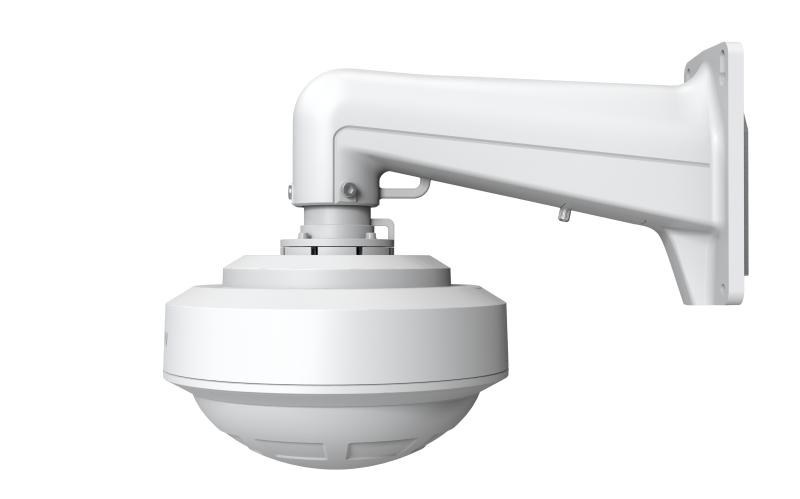
Product description
The manufacturer lists this Ports specification for Hikvision DS-3WAP6630-EI: 1 × Gigabit PoE in port, 1 × Gigabit fiber optical port. Plan connections for this exact model. Distinguish endpoint and upstream connections rather than counting ports with different speeds and roles as equivalent links.
Listed Wireless Standard: Wi-Fi 6. Retain the scope of this specification; aggregate switching capacity, per-port link speed and achieved end-to-end throughput are different measurements. Plan network load alongside protocol and connection conditions.
Power specification: Standby Power Consumption: 5.5W Typical Power Consumption: 15W Maximum Power Consumption: 18W. Select the supply and connections against the listed input requirements. Power-supply or adapter support alone does not establish PoE output from network ports or inclusion of an adapter.
Installation specification for Working Temperature: -30°C to 65°C (-22°F to 149°F). Evaluate the operating environment and enclosure requirements against these limits. Plan cabling, power and connection protection using the installation documentation.
Technical Specifications
| Net Weight | 1.6 kg (3.53 lb) |
|---|---|
| Gross Weight | 5.64 kg (12.43 lb) |
| Packing List | 3000 M Access Point × 1, Screw Pack × 1, Installation bracket × 1, Waterproof cap × 1, Fiber optic converter head × 1, Afety rope x 1, Quick Start Guide × 1, Regulatory Compliance and Safety Information × 1 |
| Protection Grade | IP68 |
| Storage humidity | 0% to 100% (no condensation) |
| Working Humidity | 0% to 100% (condensation) |
| Installation Mode | Wall mounting, Holding pole (holding pole diameter 67-127mm) |
| Power Consumption | Standby Power Consumption: 5.5W Typical Power Consumption: 15W Maximum Power Consumption: 18W |
| Power Supply Method | DC power supply: 12 V, 2 A; PoE power supply: IEEE 802.3at; |
| Storage temperature | -40°C to 70°C (-40°F to 158°F) |
| Working Temperature | -30°C to 65°C (-22°F to 149°F) |
| Product Dimensions (W × H × D) | Ø240 mm × 200 mm (excluding bracket) |
| EMC | CE-EMC (EN 55032:2015/A1:2020 EN 55035:2017/A11:2020 EN IEC 61000-3-2:2019/A2:2024 EN 61000-3-3:2013/A2:2021 EN 50130-4:2011/A1:2014) |
|---|---|
| Radio | EN 50385, EN IEC 62311, EN 62311, EN IEC 62368-1, EN 301 489-1, EN 301 489-3, EN 301 489-17, EN 55032, EN 55035, EN IEC 61000-3-2, EN 61000-3-3, EN 50130-4, EN 300 328, EN 301 893, EN 300 440 |
| Safety | CB (IEC 62368-1: 2018), CE-LVD (EN 62368-1:2014/A11: 2017) |
| Chemistry | CE-RoHS (2011/65/EU), WEEE (2012/19/EU), Reach (Regulation (EC) No.1907/2006) |
| Interface | Support uplink port VLAN; Support MAC address modification; Support LAN configuration; Support Port VLAN; |
|---|---|
| IP Services | Support DHCP Client; Supports DHCP Server; Support LLDP; Support SADP; |
| Operation Mode | AP mode (default); Routing mode; |
| Service and Support | Support NAT Traversal; Support Audit Log; Support Fault Diagnosis; Support Fault Alarm; Support One-Click Fault Collection; Support Network Diagnostic Tools; Support SSH; Support Cloud Service Diagnosis; Support Local Upgrade; Support Online Upgrade; Support Cloud Service; Support App Management; Support CAPWAP DTLS encryption; |
| Wireless Management | Support wireless configuration; Support RF configuration; Support Health Mode; Support guest SSID; Support wireless 802.11k/v/r roaming; Support wireless optimization; Support wireless SSID speed limit; Support wireless RF speed limit; Support wireless intelligent speed limit; Support wireless terminal speed limit; Support weak signal access control; Support weak signal to kick offline; Support roaming sensitivity adjustment; Support wireless access control; Support wireless terminal association; Support Band steering; Support AP load balancing; Supports airtime scheduling (ATF); Support smart antenna technology (beamforming), improving the signal's strength on clients; |
| Portal Authentication | Support Portal Authentication; |
| FEM | 2.4 GHz: 2 x eFEM 5 GHz: 3 x eFEM |
|---|---|
| Antenna | 2.4 GHz: 2 built-in omnidirectional antennas 5 GHz: 3 built-in omnidirectional antennas |
| Bandwidth | 2.4G: Auto/20/40 MHz; 5G: Auto/20/40/80/160 MHz; |
| RF Design | Dual-radio 4 spatial streams 2.4G: 2 × 2, MU-MIMO 5G: 2 × 2, MU-MIMO |
| Modulation | OFDM: BPSK @ 6/9 Mbps, QPSK @ 12/18 Mbps, 16-QAM @ 24 Mbps, 64-QAM @ 48/54 Mbps DSSS: DBPSK @ 1 Mbps, DQPSK @ 2 Mbps, and CCK @ 5.5/11 Mbps MIMO-OFDM: BPSK, QPSK, 16-QAM, 64-QAM, 256-QAM and 1024-QAM OFDMA |
| Antenna Gain | 2.4 GHz: 4 dBi 5 GHz: 5.1 dBi |
| Wireless Speed | Max: 2976 Mbps; 2.4G: 574 Mbps; 5G: 2402 Mbps; |
| Wireless Security | WPA2-PSK, WPA-WPA2-PSK, WPA3-PSK, WPA2-WPA3-PSK |
| Wireless Standard | Wi-Fi 6 |
| Transmitting Power | 2.4G: Combined power: 28 dBm; 5G: Combined power: 30 dBm; Note: The actual transmission power varies according to regulations in different countries and regions; |
| Working Frequency Band | Radio 1: 5G (11a/n/ac/ax); Radio 2: 2.4G (11b/g/n/ax); |
| Recommended Coverage Range | Recommended Coverage Radius: 150 meters. Note: The signal coverage range is greatly affected by the environment. For example, walls, glass doors, and other obstacles will affect the signal coverage. The above - mentioned values are for reference only. |
| Max. Number of Connected Clients | 256 |
| Recommended Number of Connected Clients | 110 |
| Ports | 1 × Gigabit PoE in port, 1 × Gigabit fiber optical port |
|---|---|
| RESET | 1 × Reset hole |
| VLAN ID Range | 1~4000 |
|---|---|
| Internet Access Mode | DHCP,Static |
| Max. Number of VLANs | 8 |
| Max. Number of Wireless SSIDs | 8 |