
Bosch Emergency Public Address Systems: PRAESENSA, PAVIRO, and Voice Evacuation Solutions
Bosch emergency public address and voice evacuation systems ensure reliable transmission of intelligible voice warnings during fire and other emergencies. We compare the PRAESENSA, PAVIRO, and PLENA VAS product families in terms of IP-based architecture, EN 54 standards, fire alarm integration, loudspeaker selection, phased evacuation, and technical project criteria.
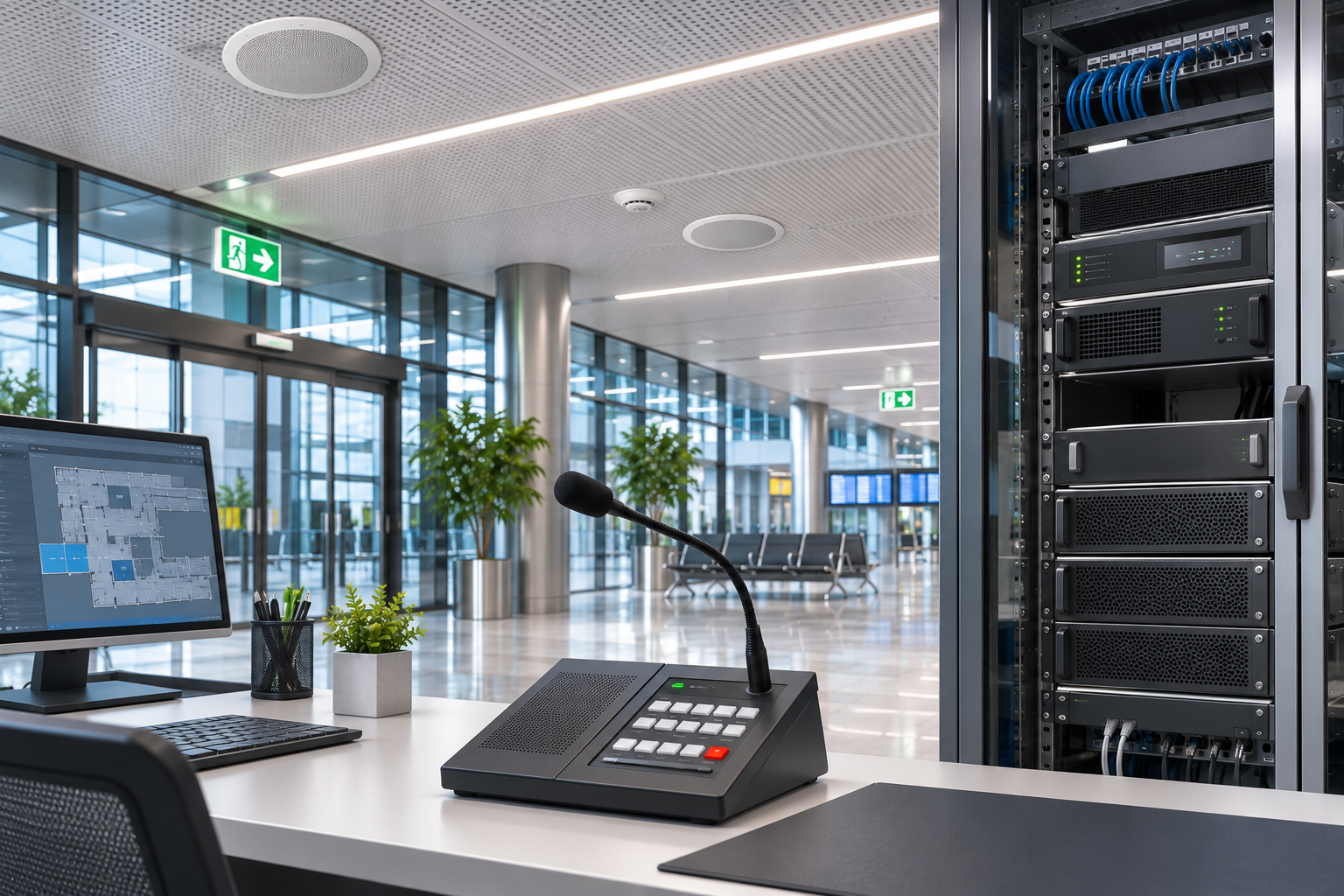
Bosch emergency public address systems are professional sound and evacuation solutions that ensure intelligible voice instructions are transmitted to building occupants during fire and other emergencies. These systems are used to inform people about danger, direct them to safe exits, and, if necessary, evacuate different zones in a controlled manner.
In Bosch's public address and emergency public address portfolio, the PRAESENSA, PAVIRO, and PLENA Voice Alarm System (VAS) product families stand out. Developed for buildings and facilities of various sizes, these solutions can provide daily announcements and background music functions alongside emergency voice warnings within the same infrastructure.
However, a general public address system and a certified voice alarm system for fire and emergency evacuation do not have the same technical requirements. In emergency public address applications, message priority, speech intelligibility, loudspeaker line supervision, backup power, and compliance with relevant standards are among the fundamental design criteria.
What is a Bosch Emergency Public Address System?
A Bosch emergency public address system is a complete set of hardware and software components that enables the transmission of automatic or live voice messages to specific areas within a building.
In international technical literature, these systems are referred to as Public Address and Voice Alarm (PAVA).
In addition to general public address functions, PAVA systems support the broadcasting of priority messages and the implementation of relevant security scenarios during emergencies.
A typical Bosch PAVA system may consist of the following components:
System control unit: Manages announcement and alarm scenarios.
Power amplifiers: Amplify audio signals to power loudspeakers.
Call stations: Allow authorized users to make live announcements.
Emergency microphones: Enable priority announcements during fire and evacuation.
Loudspeakers: Transmit voice messages to relevant areas.
Line monitoring components: Help detect specific faults in loudspeaker circuits.
Backup power systems: Support the continuation of essential functions when mains power is interrupted.
Integration interfaces: Establish connections with fire detection and other security systems.
The role of these components is not just to produce sound, but to reliably deliver the correct message to the correct zone in an emergency.
How Do Bosch Emergency Public Address Systems Work?
In emergency public address systems, normal operation and emergency operation scenarios are managed with different priorities.
During normal operation, background music or informational announcements can be made to specific zones.
When appropriate alarm information is received from the fire detection system, predefined emergency scenarios can be activated.
An example sequence of operation is as follows:
The fire alarm panel evaluates the alarm received from the relevant detector or manual call point.
According to the approved cause-and-effect scenario, the necessary command is transmitted to the emergency public address system.
The system identifies the evacuation zone associated with the alarm.
Non-priority music and general announcement broadcasts are stopped or suppressed in the relevant zones.
The pre-recorded evacuation message is routed to the relevant loudspeaker lines.
If necessary, authorized personnel can make live announcements via the emergency microphone.
The system monitors line, amplifier, communication, and power faults on supported hardware.
This sequence of operations may vary according to the project's fire and evacuation scenario.
Important: The occurrence of a fire alarm does not mean that a general evacuation announcement must be made simultaneously in all buildings. In some buildings, phased or zonal evacuation strategies may be applied. This strategy should be determined according to relevant regulations and the approved emergency plan.
Bosch PRAESENSA: IP-Based Emergency Public Address System
PRAESENSA is an IP-based public address and emergency public address system offered under the Bosch brand.
The architecture, specifically developed for medium and large-scale projects, allows audio sources and control components to be managed over an IP network.
One of PRAESENSA's key features is its ability to offer solutions suitable for centralized or distributed system topologies.
Thus, system components located in different parts of the building can be connected to each other via an appropriate network infrastructure.
Key features of PRAESENSA
IP-based audio and control communication.
OMNEO media networking technology.
Centralized and distributed installation options.
Redundant operation in supported configurations.
Dynamic management of amplifier power.
Zonal announcement and evacuation scenarios.
Secure network communication and authentication mechanisms.
Software-based configuration and expansion.
According to the manufacturer's statements, PRAESENSA offers voice alarm control solutions certified under EN 54-16.
However, for the system to be installed in compliance with the relevant standard, the product's certification scope, network design, power infrastructure, and application requirements must be evaluated together.
What is OMNEO Technology?
OMNEO is the network technology that enables the transmission of audio and control data over IP in the PRAESENSA system.
Manufacturer documents state that OMNEO utilizes standards or technologies such as AES67, Dante, and AES70.
In appropriate configurations, encryption for audio communication and authentication mechanisms between devices can be used.
These features help protect IP-based communication.
However, the presence of encryption features does not automatically mean that the system is protected against all cybersecurity threats.
Network Redundancy in PRAESENSA
In life safety systems, a single connection failure affecting critical functions is a significant risk.
PRAESENSA offers features for network and system redundancy in supported configurations.
However, to create a redundant network topology, network switches, physical cable routes, and power supplies must be evaluated together.
Making a critical network connection from two different ports may not provide the expected protection if the cables are exposed to the same physical risks.
PRAESENSA Small System Control Device
The PRAESENSA product family also includes the PRA-SCS small system control device.
According to the manufacturer's technical description, PRA-SCS helps create a more compact system architecture in certain medium-scale applications.
When used with PRA-AD608 amplifiers, it can be configured to support up to six amplifiers and a total of 48 zones.
However, this capacity belongs to the specific product combination described.
It should not be assumed that PRA-SCS has the same capacity as larger control devices.
Bosch PAVIRO: Flexible Public Address and Emergency Public Address
PAVIRO is Bosch's professional audio system family that combines public address and emergency applications.
The manufacturer positions PAVIRO as a solution that can be considered especially for medium-scale and multi-zone applications.
One of the system's key features is the routing of different audio sources to zones and the flexible use of power amplifiers.
Key features of PAVIRO
EN 54-16 certified emergency public address control architecture.
Four-channel audio matrix.
Zonal music and announcement routing.
Dynamic channel and amplifier assignment.
Redundant operation in appropriate configurations.
Networked multi-control unit options.
Live and recorded voice message management.
Supported configuration and management functions via IRIS-Net.
Is PAVIRO an IP-based system?
PAVIRO does not have a fully IP-based architecture in the same way as PRAESENSA.
However, it offers features for creating a networked system via Dante with the appropriate OM-1 network interface.
According to the manufacturer's description, up to four distributed control units can be connected to each other in supported configurations.
This feature can help expand the system in some multi-zone projects.
However, it should not be assumed that all PAVIRO audio and control components use the same IP network architecture as PRAESENSA.
In Which Projects Can PAVIRO Be Used?
PAVIRO can be considered in the following applications:
Medium and large-scale office buildings.
Hotels.
Educational institutions.
Commercial buildings.
Specific industrial facilities.
Complexes requiring zonal public address.
The number of announcement zones required, simultaneous audio channels, amplifier power, and integration requirements are important in system selection.
Bosch PLENA VAS: Compact Voice Alarm Solution
PLENA Voice Alarm System (VAS) is Bosch's solution family for small and medium-scale public address and emergency public address applications.
The manufacturer describes PLENA VAS as a standalone and relatively easy-to-configure system.
The PLENA VAS control unit includes functions such as message management, an emergency microphone, and a built-in amplifier.
According to the manufacturer's product description, the basic control unit supports up to six zones, and higher zone capacity can be achieved with appropriate expansion components.
Technical specifications of PLENA VAS
EN 54-16 certified control solution.
Built-in message manager.
Emergency microphone.
Loudspeaker line supervision.
Supported redundant amplifier configurations.
Zonal announcement and music functions.
Router components for expansion.
PLENA VAS can be particularly considered for the maintenance of existing small and medium-scale installations or in projects where relevant products are still usable.However, for new projects, the current supply status of the products, technical support period, software, and spare parts availability should be verified.
PRAESENSA, PAVIRO, and PLENA VAS Comparison
Bosch's three product families have different system architectures.
Criterion | PRAESENSA | PAVIRO | PLENA VAS |
|---|---|---|---|
Basic architecture | Fully IP-based | Hybrid/digital architecture with network connectivity support | Traditional centralized structure |
Prominent scale | Medium and large | Medium and multi-zone | Small and medium |
Audio routing | Flexible distribution over IP | Four-channel matrix | Basic zonal routing |
Expansion | IP network architecture | Control units and routers | Zone routers |
Redundancy | Integrated redundancy options | Supported redundancy options | Appropriate amplifier redundancy |
Critical evaluation | Network and cybersecurity design | Channel, zone, and topology limits | Capacity and product lifecycle |
This comparison is based on the general product architectures described by the manufacturer.
The fact that PRAESENSA has a newer IP architecture does not automatically mean it is the most correct or most economical choice for every project. Especially in the expansion and modernization of existing PAVIRO or PLENA infrastructures, the current state of the system should be evaluated.
Are Bosch PRAESIDEO Systems Still in Use?
PRAESIDEO is a digital public address and emergency public address platform developed by Bosch in previous years.
This technology has been one of the important product families used in multi-zone projects.
Today, the PRAESENSA product family stands out, especially in terms of new IP-based designs and modernization options.However, if an existing PRAESIDEO system needs to be replaced, existing cabling, control devices, audio channels, loudspeakers, and fire integrations should be examined.
A definitive decision regarding the continuation or termination of maintenance and spare parts support should not be made solely based on the product family name.
How Are Bosch Emergency Public Address Systems Integrated with Fire Alarm Panels?
One of the most important functions of emergency public address systems is to convert alarm information from the fire detection system into the correct voice evacuation scenario.
Integration can be achieved between Bosch's AVENAR fire alarm panels and PRAESENSA and PAVIRO systems in appropriate configurations.
What is Smart Safety Link?
Smart Safety Link is an integration approach developed to enable Bosch fire detection and voice alarm systems to work together.
According to the manufacturer's technical descriptions, supervised IP-based communication can be established between AVENAR fire alarm panels and compatible PRAESENSA or PAVIRO systems.
This structure offers an alternative to integration methods based on classic input-output contacts.
Through Smart Safety Link, predefined scenarios for different evacuation zones can be initiated in suitable systems.
However, the following conditions must also be verified:
The model of the AVENAR panel used.
The software and license status of the fire panel.
The relevant version of the PRAESENSA or PAVIRO system.
Network interfaces used in the integration.
Alarm, fault, and communication interruption behaviors.
Approved cause-and-effect matrix.
In particular, hardware and license requirements from the manufacturer's older integration documents should not be applied to new systems without modification.
Zonal and Phased Evacuation
In large buildings, different announcement scenarios can be created for the fire-affected zone and other areas.
For example, in a shopping mall, an evacuation instruction can be prepared for the fire-affected zone, while a waiting or different redirection message can be prepared for other specific zones.
However, when and which zones will be evacuated should be determined according to the facility's fire safety strategy.
Phased evacuation is not merely about selecting zones in software.
The evacuation plan, fire zoning, stair and exit capacity, building use, and intervention procedures of authorized personnel must be evaluated together.
Regarding the relationship between the fire detection system and other security components, GüvenlikOnline's article titled Fire Detection System Selection Guide for Factories can be reviewed.
Why is Speech Intelligibility Important in Emergency Public Address Systems?
One of the most important performance criteria in voice evacuation systems is the ability of users to understand the message given.
A high sound level from a loudspeaker does not mean that the message is intelligible.
The following conditions, in particular, can affect speech intelligibility:
High ambient noise.
Long reverberation time.
Inappropriate loudspeaker placement.
Large or high-ceilinged spaces.
Timing differences in sounds from different loudspeakers.
Inappropriate frequency response.
Sound level being excessively high or insufficient.
What are STI and STIPA?
STI (Speech Transmission Index) is one of the metrics used to evaluate the intelligibility of speech transmission.
STIPA is the method used to measure this evaluation in specific applications.
IEC 60268-16:2020 standard defines the STI model, measurement signals, and evaluation methods for speech intelligibility. There is also a 2025 amendment to this standard.
However, IEC 60268-16 alone does not define a universally applicable acceptance limit for every fire evacuation project.
Measurement points, acceptance criteria, and the required intelligibility level should be determined according to the relevant design standard and project requirements.
How Should Loudspeaker Placement Be Planned?
The primary goal of loudspeaker placement is to ensure adequate sound distribution and speech intelligibility throughout the protected area.
Therefore, loudspeaker selection should not be based solely on power rating.
Ceiling loudspeakers, wall-mounted loudspeakers, column loudspeakers, and horn loudspeakers have different usage conditions.
Loudspeaker type | Areas where it can be considered | Critical criterion |
|---|---|---|
Ceiling loudspeaker | Office, hotel, corridor | Ceiling height, dispersion |
Wall loudspeaker | Corridor, technical area | Mounting height, directionality |
Column loudspeaker | Large and reverberant areas | Directionality, intelligibility |
Horn loudspeaker | Industrial and noisy areas | Sound coverage, environmental conditions |
Special purpose loudspeaker | Outdoor and hazardous areas | Environmental suitability and certification |
These are general application examples. The EN 54-24 compliance, technical specifications, and usage classes of loudspeakers must also be verified.
100 V Loudspeaker Lines in Bosch Emergency Public Address Systems
In professional public address and emergency public address applications, 100 V line systems are commonly used.
This approach allows appropriate transformer-equipped loudspeakers to be powered via specific cable lines.
However, the use of a 100 V system does not mean that cable losses or amplifier capacity calculations are insignificant.
How is Amplifier Power Determined?
When selecting an amplifier, the total power requirement of the loudspeakers must be calculated.
For example, the selected power taps of loudspeakers connected to the same line are summed. Then, cable losses, amplifier capacity, and redundancy requirements are evaluated in the relevant system design.
In this process, looking only at the total wattage value is not sufficient.
Which zones the lines are divided into.
Messages to be broadcast simultaneously.
The output configuration supported by the amplifier.
Backup operation scenario in case of fault.
Monitoring of loudspeaker circuits.
Relevant product and system limits.
must be examined together.
In emergency public address systems, amplifier power, sound quality, and safe operational continuity should not be evaluated independently.
Why Are Line Monitoring and Redundant Operation Necessary?
In emergency public address systems used for life safety, undetected loudspeaker circuit faults pose a significant risk.
In appropriate systems, short circuits, open circuits, or other defined faults can be monitored.
Similarly, in the event of a power amplifier failure, the goal can be to maintain certain functions with a supported redundancy architecture.
Backup Power Supplies
When mains power is interrupted, an appropriate backup power infrastructure is required for the system to operate for the necessary duration.
In backup power calculation:
Consumption in standby mode.
Amplifier load during emergency announcement.
Power requirements of control and network devices.
Battery capacity and available energy.
Cable and distribution losses.
Operating times required by relevant standards.
must be taken into account.
Battery capacity should not be determined solely by summing the maximum powers written on the devices.
The actual calculation should be made according to the system's operating scenario and the manufacturer's technical instructions.
Cybersecurity in IP-Based Emergency Public Address Systems
IP-based solutions like PRAESENSA make the reliability and protection of the network architecture important.
Therefore, general application habits used in camera or office data networks should not be directly transferred to life safety systems.
KEENFINITY's official technical descriptions recommend preferring a dedicated network for IP-based emergency public address systems like PRAESENSA.
The use of an existing corporate IT network should only be considered when the necessary availability, security, redundancy, and bandwidth requirements are verified.
Important control headings include:
Limiting unauthorized access.
Protecting network devices and physical connections.
Appropriate network segmentation.
Supported encryption and authentication methods.
Software and firmware version management.
Monitoring network and connection faults.
Verification of redundant communication paths.
Protection of emergency public address priorities.
The presence of an IP connection alone does not mean that remote management is secure or that internet-based management is suitable for every project.
EN 54 Standards in Bosch Emergency Public Address Systems
In systems used for voice evacuation due to fire, the correct design of the system is as important as the suitability of the products.
The main standards in this area are:
Standard | Scope |
|---|---|
EN 54-16:2008 | Voice alarm control and indicating equipment |
EN 54-24:2008 | Loudspeakers for voice alarm systems |
EN 54-4:1997 + amendments | Power supply equipment for fire alarm systems |
CEN/TS 54-32:2015 | Planning, design, installation, and maintenance of voice alarm systems |
IEC 60268-16:2020 | Evaluation of speech intelligibility by STI method |
ISO 7240-19:2007 | Design, installation, and service requirements for emergency sound systems |
The validity of ISO 7240-19:2007 standard was confirmed by ISO's evaluation in 2025.
EN 50849:2017 should also be carefully distinguished. While this standard addresses emergency sound systems, it excludes sound systems used for fire evacuation. Therefore, in fire evacuation projects, EN 50849 should not be considered as the sole equivalent of EN 54 requirements.
In projects in Turkey, the current TS equivalents of the standards and the applicable national legislation must also be verified.
In Which Buildings is an Emergency Public Address System Mandatory in Turkey?
Article 81 of the Regulation on Fire Protection of Buildings contains requirements for audible and visual warning systems in case of fire and other emergencies.
According to the seventh paragraph of Article 81, announcement systems that provide evacuation or relocation within the building by means of automatic voice messages and live announcements from the fire center are mandatory in the following places:
Hotels, motels, and dormitories with more than 200 beds.
Public buildings, shopping centers, supermarkets, industrial facilities, and similar structures specified in the regulation, with a building construction area larger than 5,000 m² or a total user count exceeding 1,000 people.
All buildings with a structural height exceeding 51.50 meters.
The same article of the Regulation also stipulates that emergency announcements must have priority over other broadcasts such as general announcements and background music.
Article 83 of the Regulation contains fire resistance requirements for relevant cables leading to voice evacuation amplifiers and loudspeakers that must operate during a fire.
Therefore, emergency public address systems should not be treated solely as technical equipment selection or a sound system project.
Building class, fire safety project, relevant legislation, and the requirements of authorized authorities must be evaluated together.
Where Can Bosch Emergency Public Address Systems Be Used?
Bosch PRAESENSA, PAVIRO, and PLENA VAS solutions can be considered in buildings and facilities of different scales.
Area of use | Primary technical need |
|---|---|
Shopping malls and retail centers | Multi-zone announcements and phased evacuation |
Airports | Numerous announcement zones and operational continuity |
Hospitals | Intelligible instructions and controlled evacuation |
Hotels | Floor and zone-based announcement management |
Factories | Intelligible sound transmission in noisy environments |
Logistics centers | Wide area coverage and line supervision |
Campuses | Multi-building and centralized/distributed architecture |
Public and office buildings | Fire alarm integration and safe guidance |
These areas are example applications. The suitability of a particular product family should be determined by project size, environmental conditions, and technical requirements.
What Should Be Considered When Choosing a Bosch Emergency Public Address System?
1. System architecture
Centralized, distributed, or IP-based architecture requirements must be determined.
2. Evacuation zones
Announcement zones must be compatible with the evacuation strategy in the fire safety project.
3. Speech intelligibility
Loudspeaker placement, ambient noise, and reverberation conditions should be evaluated within the scope of acoustic design.
4. Amplifier capacity
Loudspeaker powers, total load, simultaneous audio channels, and redundancy requirements must be calculated.
5. Fire alarm integration
Control panel, software version, license requirements, and cause-and-effect scenarios must be verified.
6. Line and fault monitoring
Necessary supervision features for loudspeaker lines, amplifiers, and critical communication links must be determined.
7. Power continuity
Main and backup power sources must be sized according to relevant operating scenarios.
8. Maintenance and technical support
Periodic tests, software management, product lifecycle, and spare parts support must be evaluated.
Bosch Emergency Public Address System Technical Checklist
System integrators, project engineers, and technical procurement teams should answer the following questions:
- Has the building's emergency public address requirement been evaluated according to regulations?
- Have evacuation zones and the cause-and-effect matrix been prepared?
- Have PRAESENSA, PAVIRO, and PLENA VAS been technically compared?
- Have the control device and announcement zone capacity been verified?
- Have loudspeaker placement and acoustic calculations been performed?
- Have acceptance criteria for speech intelligibility been determined?
- Have loudspeaker power and amplifier capacity been calculated?
- Have line monitoring and redundant amplifier scenarios been planned?
- Have IP network topology and redundancy requirements been evaluated?
- Has backup power capacity been calculated?
- Has fire panel integration been verified?
- Have EN 54-16 and EN 54-24 compliance documents been reviewed?
- Have post-installation functional and acoustic tests been planned?
- Has a periodic maintenance and user training program been established?
Maintenance processes for emergency public address systems should be handled together with fire detection and other emergency components.
In this regard, GüvenlikOnline's technical guide titled How to Perform Periodic Maintenance in Fire Detection Systems? can also be reviewed.
Frequently Asked Questions
What is a Bosch emergency public address system?
Bosch emergency public address systems are professional PAVA solutions that, in addition to daily public address functions, ensure the transmission of priority voice messages to relevant zones during fire and similar emergencies.
What is the difference between Bosch PRAESENSA and PAVIRO?
PRAESENSA has a fully IP-based system architecture. PAVIRO, on the other hand, is a system specifically designed for medium-scale projects with digital audio routing and optional IP network connectivity options. The final choice depends on project capacity and integration requirements.
Can Bosch PLENA VAS be used in new projects?
The manufacturer's product portfolio includes technical descriptions for PLENA VAS. However, for new installations, the current supply status of the devices, certification scope, support period, and spare parts availability must be verified.
Can Bosch emergency public address systems be connected to a fire alarm panel?
Supported integration methods such as Smart Safety Link can be used between appropriate Bosch AVENAR fire panels and PRAESENSA and PAVIRO. However, model, license, network, and software compatibility must be checked.
Is EN 54-16 sufficient for an emergency public address system?
No. EN 54-16 covers voice alarm control and indicating equipment. Loudspeakers, power supplies, system design, speech intelligibility, and installation requirements must be evaluated separately.
Can music be broadcast on an emergency public address system?
Background music and general announcement functions can be used in appropriate systems. However, fire and other emergency messages must have priority and be able to override other broadcasts in necessary areas.
Is STI measurement required in Bosch emergency public address systems?
Speech intelligibility is one of the important performance criteria for voice evacuation systems. The necessity of measurement, method, and acceptance limits should be determined according to relevant standards and project conditions.
Correct Project Design is Important in Bosch Emergency Public Address Systems
Bosch PRAESENSA, PAVIRO, and PLENA VAS systems offer public address and emergency public address solutions for buildings and facilities of different scales.
PRAESENSA's IP-based architecture, PAVIRO's flexible audio routing, and PLENA VAS's compact control approach can meet different application requirements.
However, to create a reliable voice evacuation infrastructure, speech intelligibility, loudspeaker placement, fire alarm integration, backup power, and periodic maintenance processes are as important as the technical features of the products.
The main purpose of a correct emergency public address system is not just to make a loud warning, but to reliably transmit the correct message that people can understand, at the necessary time, and to the necessary zones during an emergency.
Sources
KEENFINITY Group — Public Address and Emergency Public Address Systems — Current Bosch PAVA portfolio and system comparison.
KEENFINITY — PRAESENSA IP-Based Public Address and Emergency Public Address System — IP architecture, OMNEO, and redundancy features.
KEENFINITY — PAVIRO Public Address and Emergency Public Address System — PAVIRO audio matrix, network connectivity, and EN 54-16 features.
KEENFINITY — PLENA VAS — Compact voice alarm architecture and product components.
KEENFINITY — PRAESENSA Small System Control Device — PRA-SCS control device capacity and technical limitations.
KEENFINITY — Central Point Warsaw Project — Smart Safety Link integration between AVENAR and PAVIRO.
KEENFINITY — Completion of the Acquisition of Bosch Product Business — Company restructuring in 2025.
T.C. Ministry of Justice — Regulation on Fire Protection of Buildings — Voice evacuation and related cabling provisions.
EVS — EN 54-16:2008 — Voice alarm control and indicating equipment.
EVS — EN 54-24:2008 — Loudspeakers for fire voice alarm systems.
EVS — EN 54-4:1999+A1+A2 — Relevant European standard and amendments for power supply equipment.
EVS — CEN/TS 54-32:2015 — Design, installation, and maintenance of voice alarm systems.
IEC — IEC 60268-16:2020 — Measurement of speech intelligibility with STI.
ISO — ISO 7240-19:2007 — Design and service of emergency sound systems.
EVS — EN 50849:2017 — Emergency sound systems other than fire evacuation.